Fall Down the Rabbit Hole with Erin LeCount
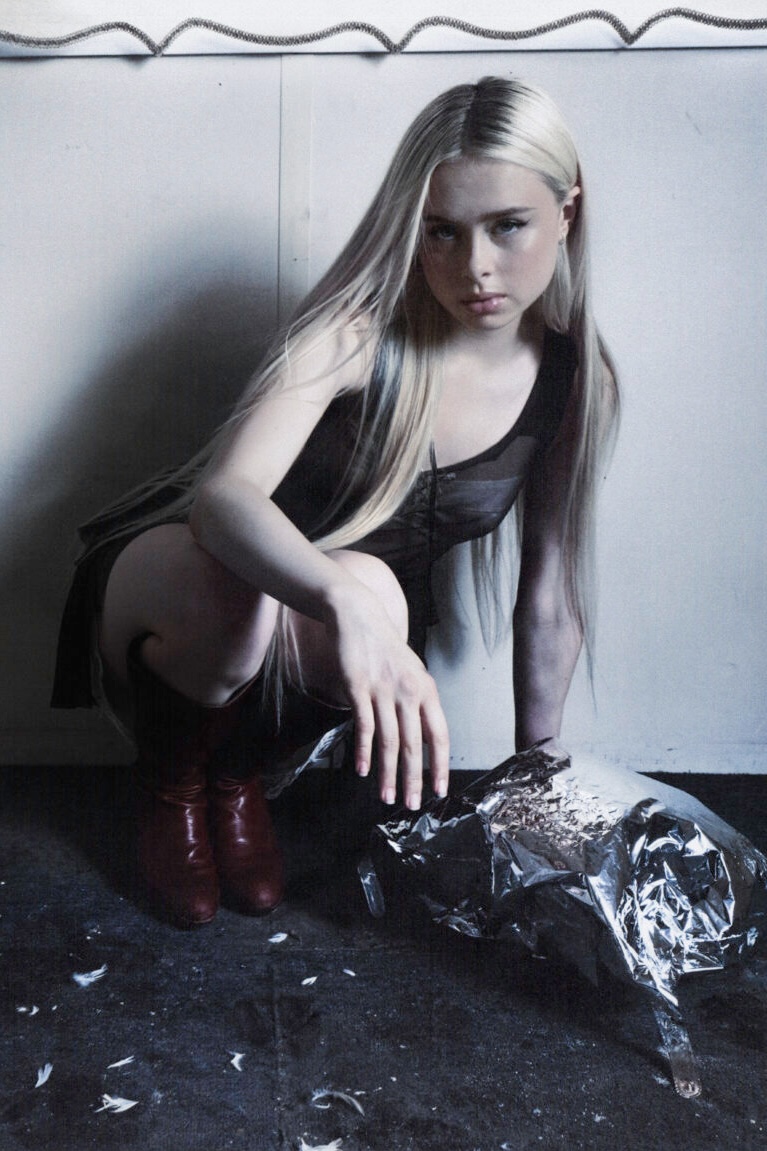
The self-taught multihyphenate dishes on why she took the reins of her creative process early in her career, how growing up as an existential child shaped her lyricism, and the psychological phenomenon that inspired her latest EP.
Erin LeCount is an anomaly. The UK-born alt-pop singer-songwriter is not only an entirely self-taught artist, but she is also the sole writer and producer on her work – a rarity for an artist at any age, much less someone who is freshly 23 years old.
LeCount almost feels too good to be true – she somehow possesses the vocal prowess of Florence Welch, the introspective lyricism of Ethel Cain, and a production quality on par with some of pop’s biggest names. On top of that, she’s also impeccable at connecting with fans by crafting engaging social media content on Instagram and TikTok, where she’s amassed over 7.4M likes as well as a combined following of nearly 300,000 on both platforms, taking listeners down her virtual rabbit hole.
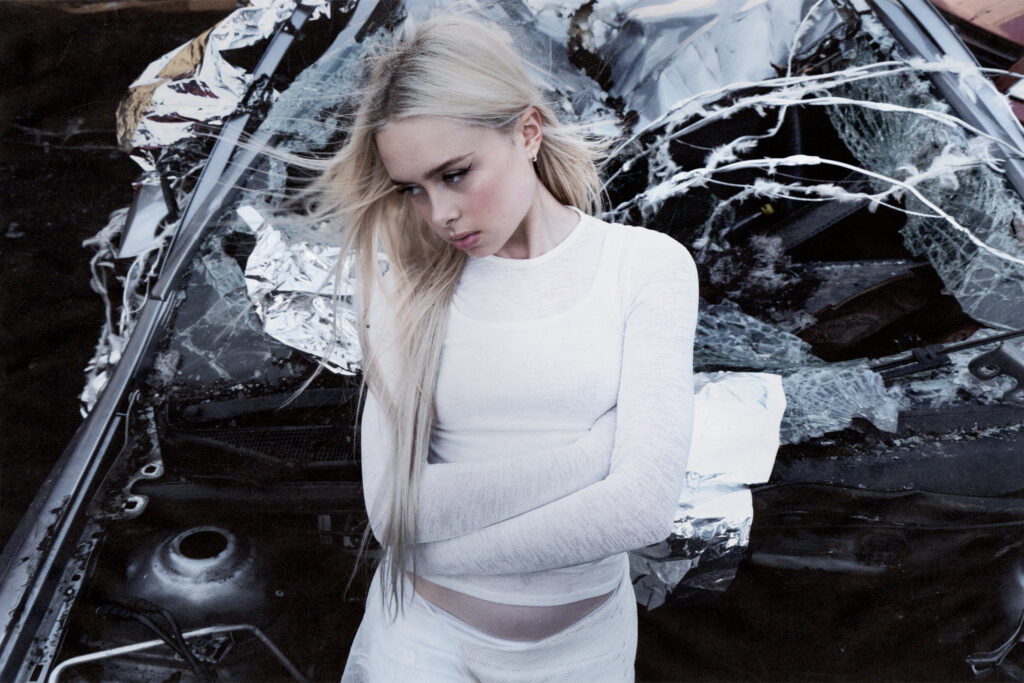
But as confident and wise beyond her years as she is now, she was initially motivated by the self-consciousness she felt as a teenager in the room with experienced, older male producers.
“In sessions, I would just have this overwhelming sense of imposter syndrome,” she tells V over Zoom. “I felt like there was a language that I couldn’t speak because I couldn’t articulate to producers what I wanted. I’d completely freeze up and not be able to write anything”
That feeling led her to download music production software, where she honed the skills she utilizes today to lead her creative process on her own terms. LeCount’s producing chops are on display in full force on her latest project, which, at its core, depicts a downward spiral. The EP’s title, PAREIDOLIA, is derived from the psychological phenomenon defined as “the tendency to perceive a specific, often meaningful image in a random or ambiguous visual pattern.”
“Pareidolia is a phenomenon that happens because our brains are trying to make patterns out of things that we don’t understand, and that really resonated, because I think self-sabotage and destructive spirals are the brain’s only way of feeling safe and like we understand what’s happening,” she explains.
LeCount explores these behaviors in a variety of ways on each of the EP’s six tracks. “DON’T YOU SEE ME TRYING?” describes a sickening cycle of self-sabotage. “808 HYMN” opens with the line “When I was a kid, I used to think the moon was following me home,” and the narrator later laments “I’ve been praying to the constellations / Turns out they were all just satellite stations.” And “ALICE” transports listeners into a codependent relationship’s demise, revealing that the song’s subject reflects the narrator’s most detrimental qualities back to her.
Despite some of the darker themes explored on the project, LeCount tells V that “the EP was a way of living vicariously through the music and sort of giving in to that urge to self-destruct through music rather than taking those actions in real life,” adding that she hopes listeners can “feel that relief and catharsis without necessarily going there themselves.”
For more on PAREIDOLIA, V caught up with the rising star just after her first-ever North American tour, ahead of the EP’s release.
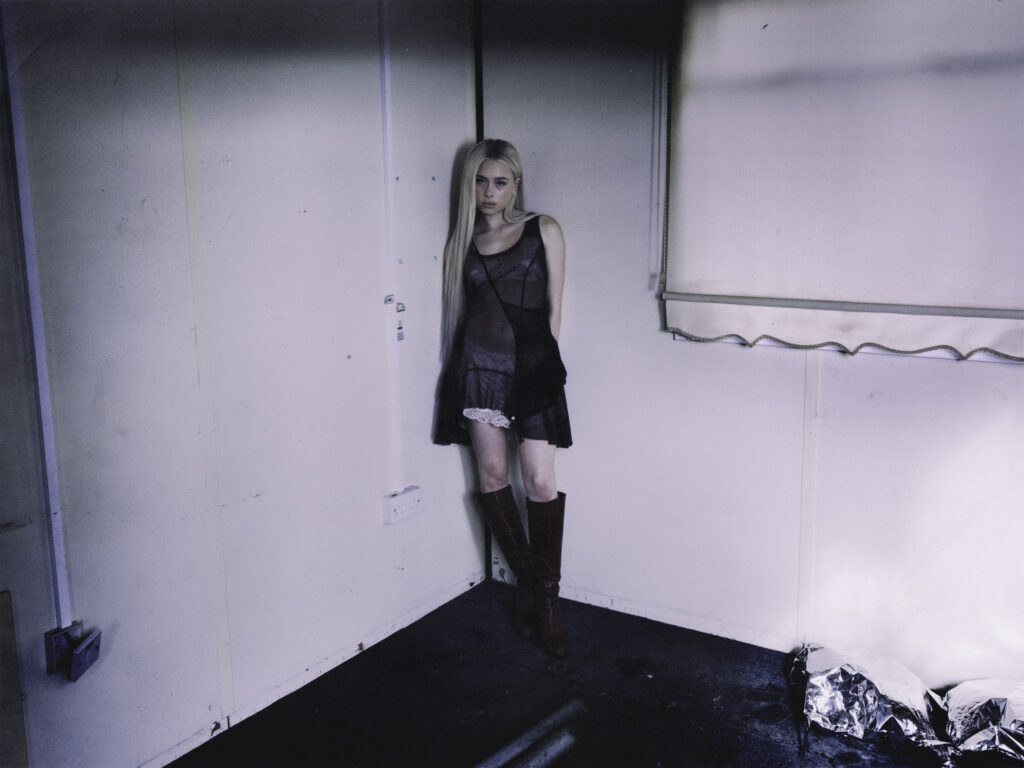
V Magazine: You’re having a massive year so far — you just wrapped your first North American tour, which sold out in under a week, closing with two nights at The Roxy Theatre in LA. How was your first experience performing live in the US?!
Erin LeCount: I sort of didn’t know what to expect — I’ve gotten used to the etiquette and culture of the UK shows. Those audiences are super loud, passionate, and quite intense, so I wasn’t expecting necessarily the same energy, but the US shows were honestly some of my favorite shows I’ve ever played. People were so incredible and knew songs that weren’t out yet. I think it just took my brain a second to register that I can be so far from home and people still know the songs — I knew the shows were all sold out, but being in the room and experiencing it tangibly is a completely different feeling.
V: That’s awesome. I bet that’s such a cool feeling. I only recently began listening to your music, and I can already see how much you connect with your audience. As a self-taught artist and a solo writer and producer, you have a unique ability to access raw emotions in your music that is palpable to listeners. What is the process of creating a song from start to finish like for you?
EL: Everything starts with a stream of consciousness – I tend to start with words. Things will always pop up if I go for a walk. But I’ll get little phrases, or I guess the equivalent of poetry or stream of consciousness rambling, written down. It just sits with me, and sometimes ideas sit for longer and it’s sort of a way of journaling. Then maybe a day later, or a month later, I’m at the computer and I’ll be making something, most of the time shooting in the dark, just trying to find something that I love. There’s this sort of weird marriage that happens where I’ll be playing something and suddenly realize that I’ve written the perfect lyrics for it that marries the feeling the music is giving me like a month before, and I have to go back through a journal or my phone and find that. I’m very much about waiting for the right timing for things and getting as much down as possible, so that when the idea is ready to conceive, it just comes.
V: Yeah, that’s so cool. How did you initially get into producing?
EL: I got into producing because I really hated sessions – that was my turning point. I’d been making backing tracks for songs that I liked on the free version of GarageBand, but I’d not ever really recorded vocals to it. I was just trying to make alternative backing tracks and then started writing to really simple tracks of my own. When I started getting put in sessions after that, I would just have this overwhelming sense of imposter syndrome. I felt like there was a language that I couldn’t speak because I couldn’t articulate to producers what I wanted. I’d completely freeze up and not be able to write anything and would go home and then study GarageBand. I eventually used it so much that I bought Logic, but it began as just a method for imposter syndrome in the room. I just wanted to understand the basics. But as soon as I was on the surface level of Logic, I just kept going deeper and I’m so glad I did, because I can’t imagine how I would be making music without being involved on the production side now. It’s perfect for my brain.
V: At this point in the sessions when you were feeling imposter syndrome, about how old were you?
EL: Seventeen.
V: So was your first EP [2023’s Soft Skin, Restless Bones] self-produced as well, right after you branched off and decided to do your own thing?

EL: So, that was actually co-produced. I eventually met an amazing person called James, who goes by Jakwob. I made all those songs on my computer, but I still wasn’t calling myself a producer – I didn’t think what I was doing was genuinely production. In my mind, I was just getting ideas down and the people in sessions were the producers. But I met James, and he was like the first person to validate me. He was like, “you’re a producer, and I shouldn’t be changing any of these things. We should just work on them together, and we should work off your laptop and your project.” He was a helping hand through that project that I really needed, because it was so early. I’d only been producing for six months.
V: That’s so impressive. Dating back to those early stages of your career, religious imagery has remained a constant theme in your work. I was shocked to learn that you told Teen Vogue that you were actually not raised religious at all, which, to me, is just an even greater testament to your songwriting ability. What first intrigued you about exploring motifs of religion in your music, and how do you access that?
EL: It’s funny, because my family aren’t religious; I wasn’t raised religious. I’m not sure where it came from, but from quite young, I had obsessive and compulsive thoughts about religion and being in trouble and heaven and hell. I was quite an existential child who was afraid of that. There was a lot of magical thinking about religion and God and someone looking down and judging me. And so I sort of had a self-inflicted, strange relationship with it from when I was quite young. As I got older, I realized that the issue was that I do genuinely feel really connected to something bigger than me and believe in something divine, but maybe that’s not necessarily as clear-cut as the idea of God that I had. Finding things like divination and astrology and tarot was a way of feeling like there was something bigger than me that I was connected to that wasn’t guilting me or looking down on me. I still have a complex relationship with it and about what religion means and preaches in terms of sexual orientation and stuff like that. But it’s a complex relationship, like any other relationship.
V: Wow, that’s such an interesting nature versus nurture question, given that it was kind of self-imposed in that way.
EL: Yeah, it’s such a strange thing. I think I was a really existential child, and I was very sensitive and conscious to all the bad things happening in the world. I found that really devastating, and I couldn’t understand why that would happen and why that was the way the world worked. I think that caused me many crises starting around the age of eight.
V: I see a lot of similarities in your music, not necessarily sonically, but thematically, to Ethel Cain, in the way that you evoke religious imagery and metaphors. When I first saw the title “AMERICAN DREAM,” I thought of Cain’s song “American Teenager.” While the themes in the two songs differ, this general trope has been explored by a wide variety of artists in a myriad of ways. Given that you are not American yourself, how did you initially come up with the concept for this song?
EL: I mean, it’s funny because I feel like I wrote it almost prematurely – I relate to it more now than I did when I wrote it. At that time, I’d been to the US, but I hadn’t toured there yet. When I first wrote it, I couldn’t even really decipher what it was that I was writing about. But I understand it so much better now as this confusion about what it means to sacrifice a lot of your personal relationships and stability in pursuit of your dream. I think there’s such an American hustle culture and there’s a lot of focus on individualism. I realized that while I don’t agree with that “everyone’s out for themselves” kind of thinking, it’s exactly how I live my life. I do put everything in my life aside to pursue this career. There’s this perfectionist in me that never feels like I’m doing enough. So the song is about the sadness of getting what you want and looking at what you’re giving up for it, and wondering if that’s gonna measure up. I love what I do and this is the best thing in the world to me. It’s the most long-standing thing that I’ve loved and wanted. I’m navigating how to have that and while also maintaining meaningful interpersonal relationships and having a life and a personhood of my own, because I think I can be pretty one-track-minded and quite obsessive when I have a goal.
V: Yeah, that’s so interesting. Again, it’s just so cool how you can go to a place in your own writing and production that you either are anticipating or haven’t experienced – so creative.
EL: Thank you, I think definitely there’s been multiple times where I’ve written a song and it’s been a prophecy of some kind. The breakup song will be written six months prior to when it happens, and it’s not til after that I listen back and I go, “oh, my God, that seed was there for a really long time.”
V: Exactly! I also wanted to ask you about another song from the EP that is not yet out — “ALICE.” In it, you detail a relationship that has run its course, largely due to a codependency and competitiveness derived from struggling with the same thing. Was this inspired by a real relationship in your life, or is the relationship a metaphor for what it’s like to live with an eating disorder?
EL: I think I intentionally let it sit on the cusp of both. I wrote many versions of “ALICE” and it does come from a real-life experience. However, many versions of “ALICE” that I tried to write before this one were skewed, warped perceptions of the relationship. This version felt like the most accurate and grown-up depiction of both parties’ responsibility, but also enough vagueness. In these situations, it’s not always about the other person. It’s about your relationship to the thing you’re struggling with. It’s about how you see yourself, and that person just brings up all those feelings in you. So “ALICE” definitely comes from a real person and a real experience, but I think the song itself is more about what she showed me in myself that I didn’t like. Alice is me as much as I am her, and I like that it kind of blurs in the song. That was, I think, needed and intentional.
V: Yeah, absolutely. And the whole concept of the rabbit hole, like Alice in Wonderland, I think that’s so cool as well. It’s just filled with so many really fascinating layers. The EP’s title, PAREIDOLIA, is essentially defined as the tendency to perceive meaning in something random – what does that mean to you, and how does it appear throughout each of these six tracks?
EL: I knew that the EP was going to be about all these different stages of a downward spiral and the markers of where you’re at in that spiral, but the name came a bit later. A lot of the songs are about going back to something, whether it’s going back to feeling like a child or going back to old self-destructive habits that you’ve lived a hundred times and done before. It’s very much about regression, or a relapse. Pareidolia is a phenomenon that happens because our brains are trying to make patterns out of things that we don’t understand, and that really resonated, because I think self-sabotage and destructive spirals are the brain’s only way of feeling safe and like we understand what’s happening. It’s a way of feeling in control over something new or scary that we don’t understand or know what to do with, even if that thing is good. A lot of the EP is about good things happening and wanting to ruin them – “DON’T YOU SEE ME TRYING?” especially is all about that. But the idea of patterns, there’s a lot of lines in there that are examples of actual pareidolia as well. Like in “808 HYMN,” the lines “I’ve been praying to the constellations / Turns out they were all just satellite stations” and “I used to think the moon was following me home.” There’s quite a lot in there about mistaking things for something else, more metaphorically as well, like “Concern looks like love” in “DON’T YOU SEE ME TRYING?”. Everything is in this warped lens. PAREIDOLIA was a perfect summary of that, because it’s just based on habits and patterns and old data.
V: Finally, what do you hope this project leaves listeners with?
EL: I think for me, the EP was a way of living vicariously through the music and sort of giving in to that urge to self-destruct through music rather than taking those actions in real life. I hope that people can find that and feel that relief and catharsis without necessarily going there themselves. I hope it brings comfort to anyone who has been there or is there. Because ultimately, the tracklist ends with “ALICE” and the last thing I say is, “I think about you often, but I don’t want you back.” And that was sort of the softest way of writing an ambiguous ending signaling that I don’t necessarily want to be back there. Yeah, I hope people can cling to that.
Discover More