V-ISITS: Casa Sagnier
Where Barcelona’s most prolific architect once lived, a hotel breathes at the tempo of the city he built
Barcelona doesn’t announce itself. It arrives—in the quality of light on limestone, in the particular way a wrought-iron balcony casts its shadow at four in the afternoon, in the unhurried authority of a waiter who knows the vermouth you need before you do. I hadn’t been to Europe since my son was born. Four years is long enough for a city to change its mind about what it wants to be. And Barcelona, it seems, has decided.
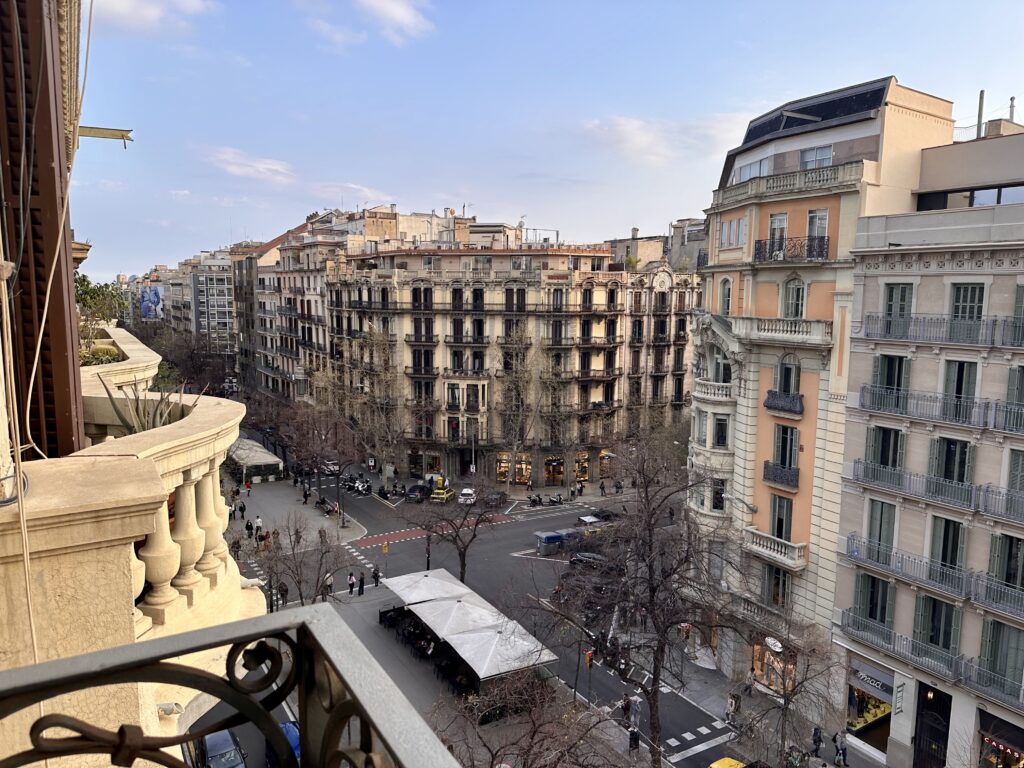
The upper Rambla de Catalunya is where that decision is most legible. Not the tourist-clogged artery of the lower stretches, but the tree-lined boulevard near the Diagonal, where the restaurants have linen and the locals outnumber the visitors by a margin that feels almost protective. It is here, at number 104, that Hotel Casa Sagnier occupies the former home and studio of Enric Sagnier i Villavecchia, the architect who, with more than 380 classified works, built more of this city than anyone. More than Gaudí. More than Domènech i Montaner. More than Puig i Cadafalch. And yet his name, outside Barcelona, barely registers. Casa Sagnier corrects this quietly, without didacticism, by letting you live inside his story.
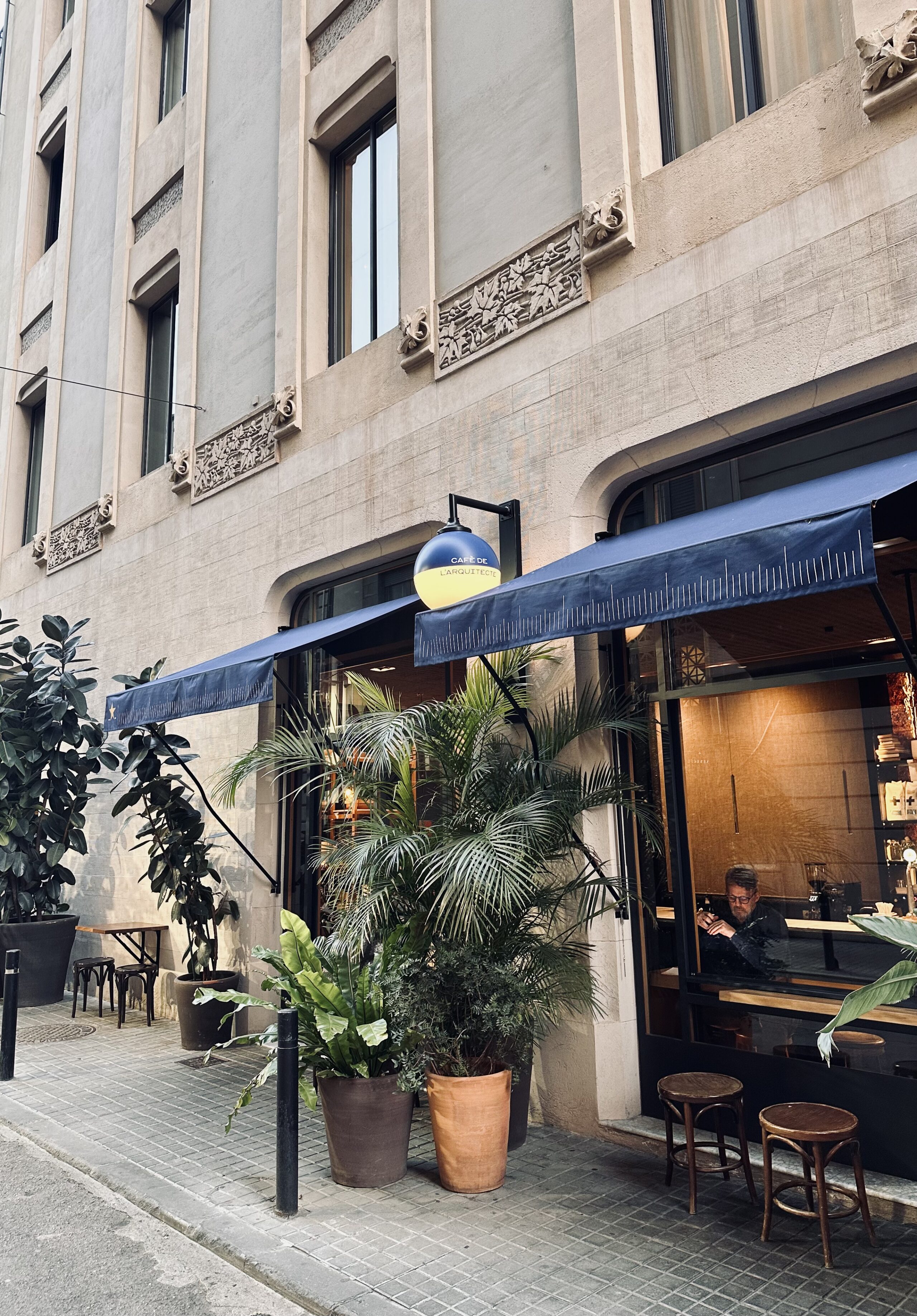
The building was originally called Casa Dolors Vidal de Sagnier, after the architect’s wife. He designed it in 1892 as both residence and atelier, in one of the Eixample’s most coveted blocks, freed from the obligations of a client, indulging his own vocabulary of Gothic references and ornamental sculpture. Medallions attributed to Francesc Pastor crown the façade. A figure of the Immaculate Conception by Josep Llimona watches the corner at Passatge de la Concepció. These are not decorations. They are arguments, Sagnier’s case for a city that could hold grandeur and domesticity in the same breath.
That tension is the hotel’s animating principle. The Pérez-Sala family, who also operate the beloved Primero Primera nearby, undertook a restoration in 2021 with architect Federico Turull of TurullSørensen that resists the two most common failures of heritage hospitality: the museum that forgets to be comfortable and the renovation that forgets to be reverent. Casa Sagnier is neither. It is a home that happens to have fifty-one keys.
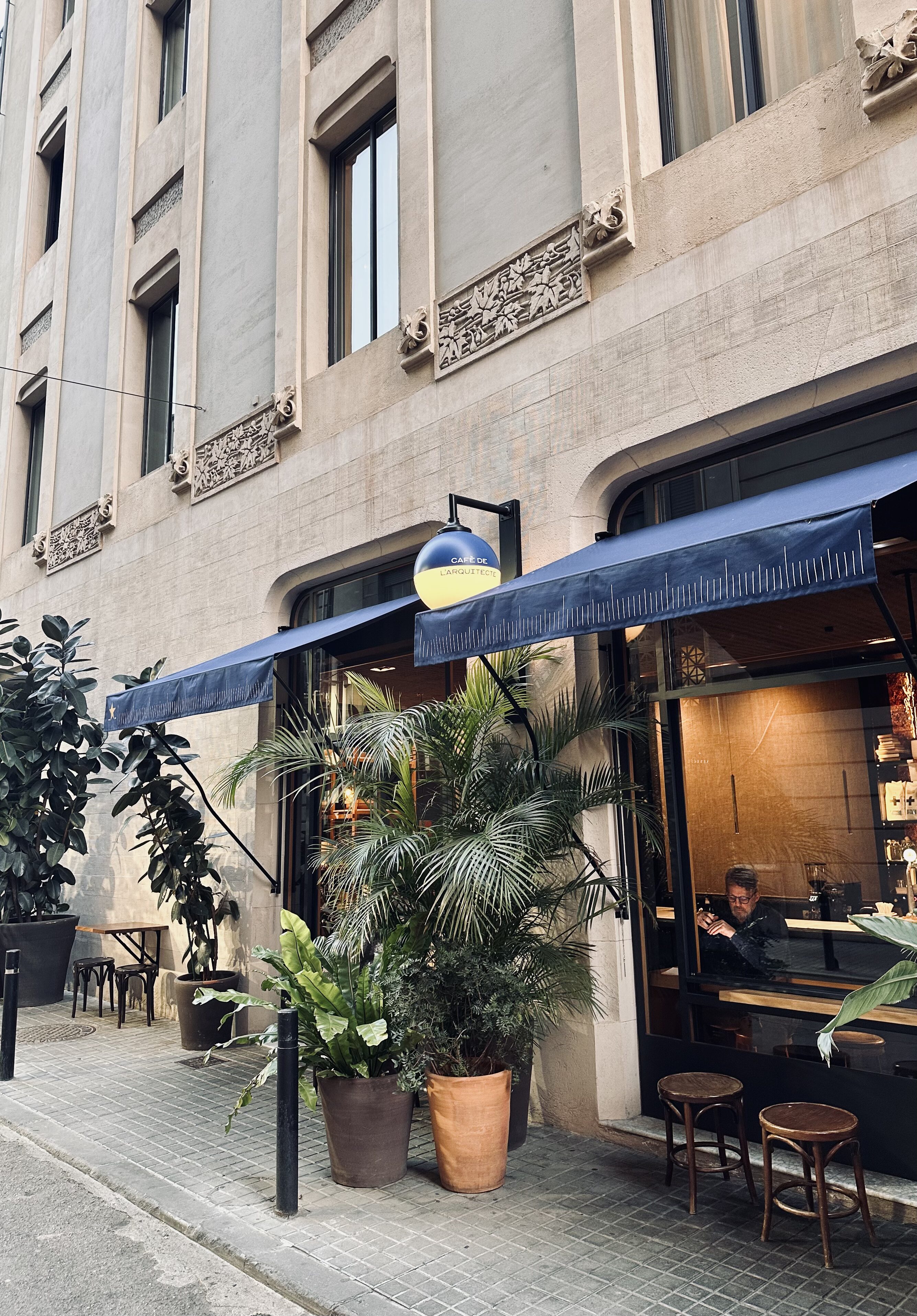
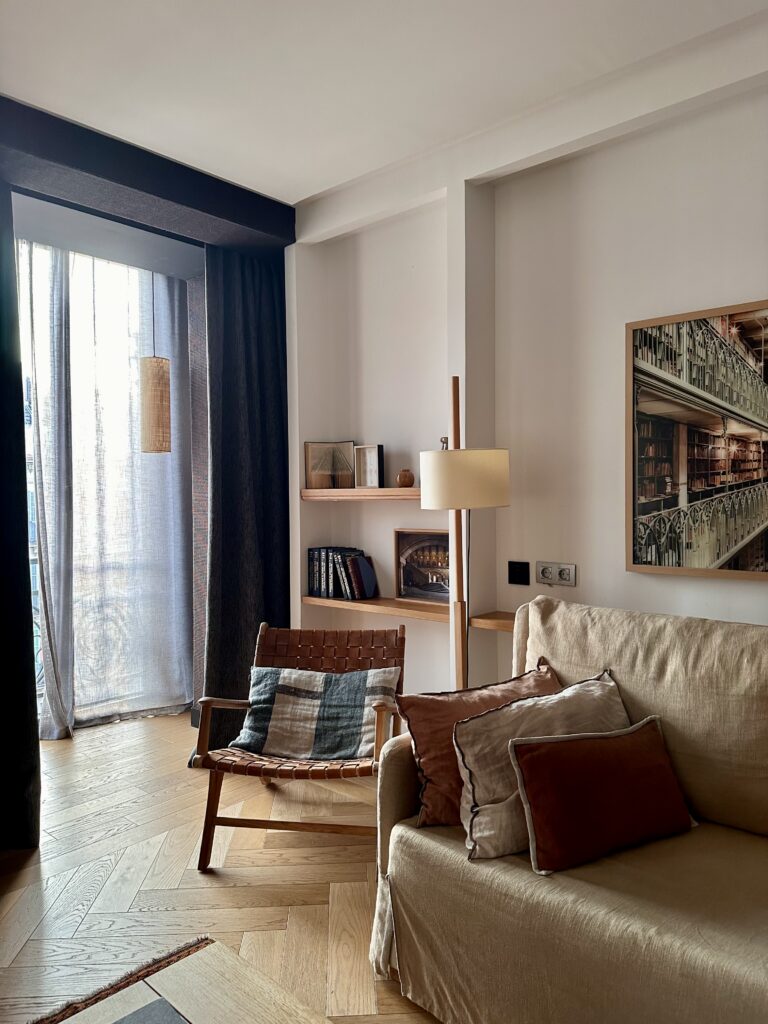
You enter from the Rambla and the space bifurcates with the calm logic of a well-run household. Reception sits in the center, deliberately recessed and private. To the left, the bar of Cafè de l’Arquitecte opens toward Passatge de la Concepció through a wall of glass. To the right, a sitting room with a working fireplace, a library you might actually read from, and the kind of furniture that invites you to stay past your intention. Above the mantel, a portrait of Sagnier composed entirely of postage stamps – one of several installations by the studio Elefante – watches the room with the bemused patience of a man whose house has outlived its original purpose and found a better one.
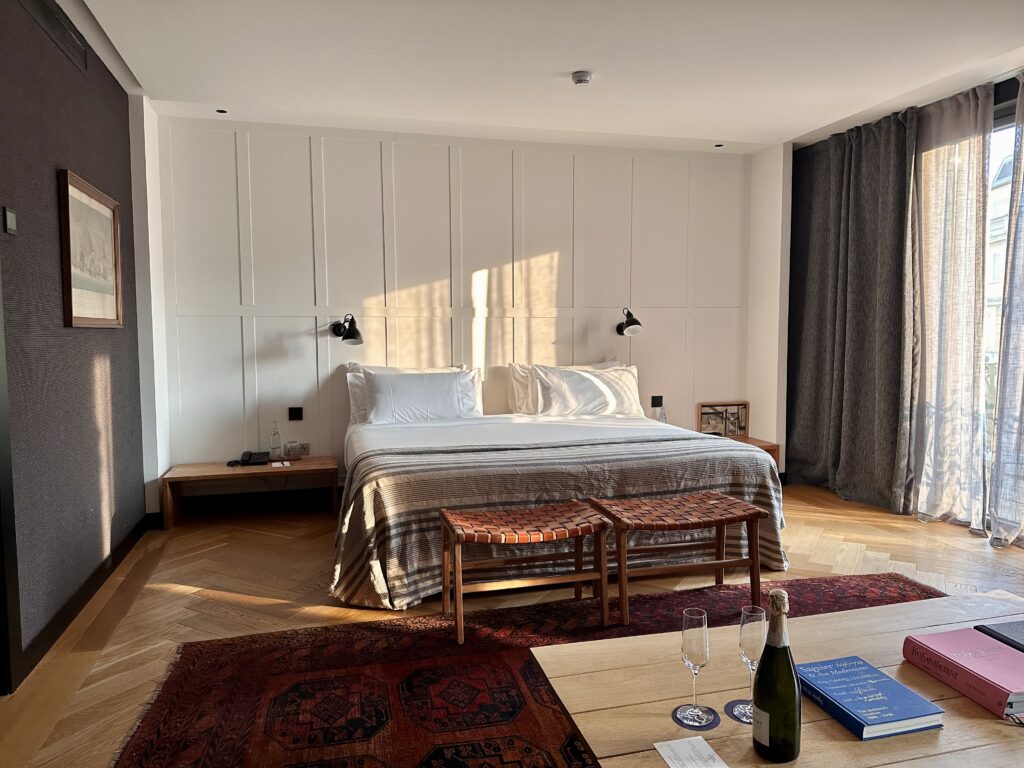
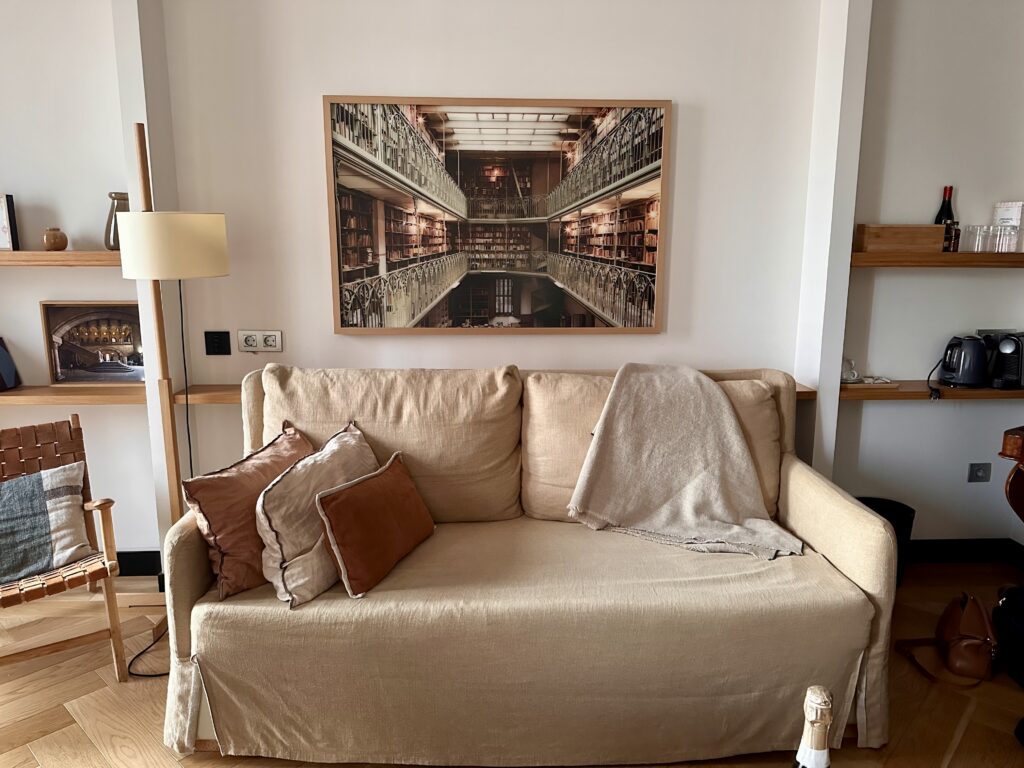
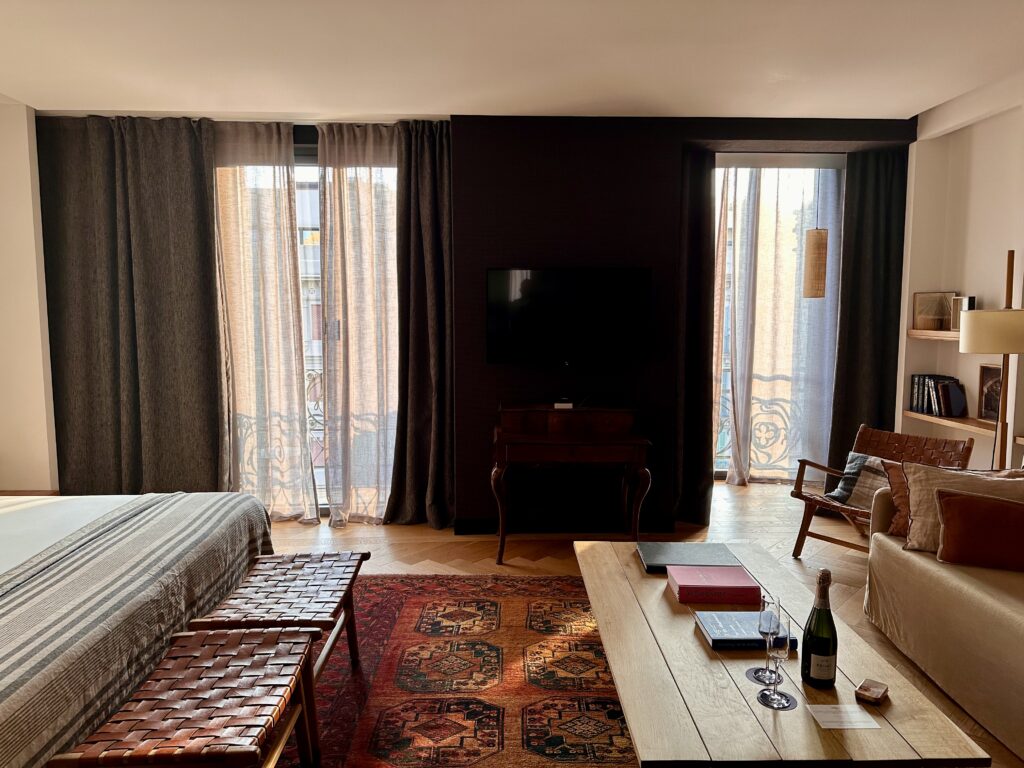
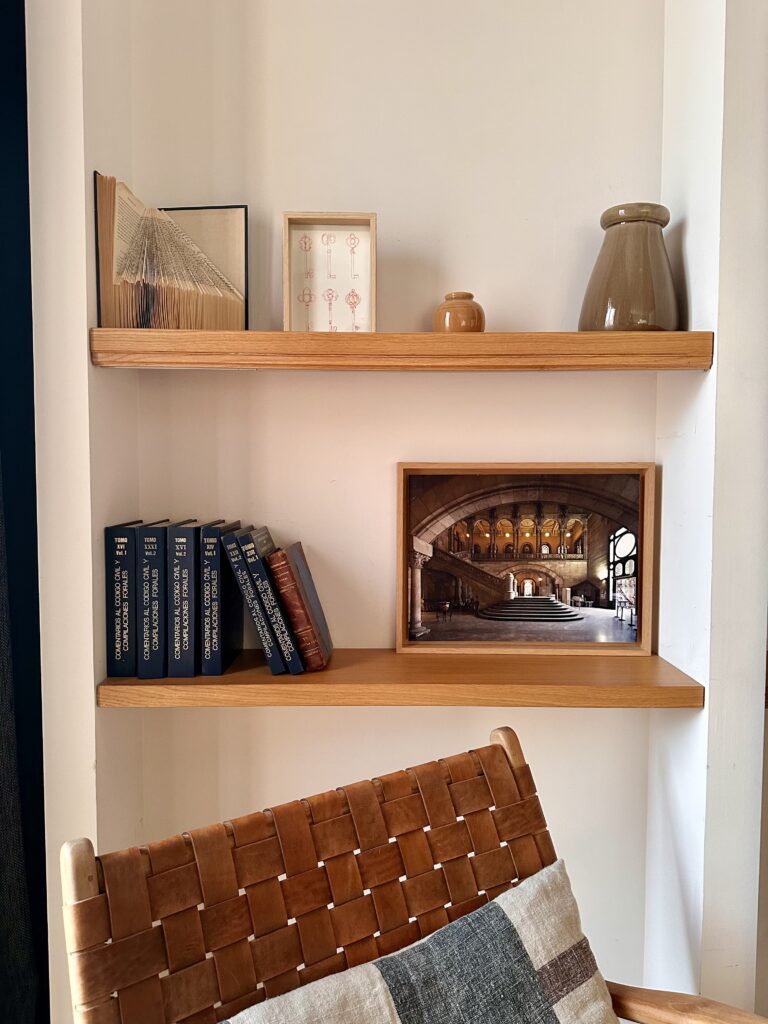
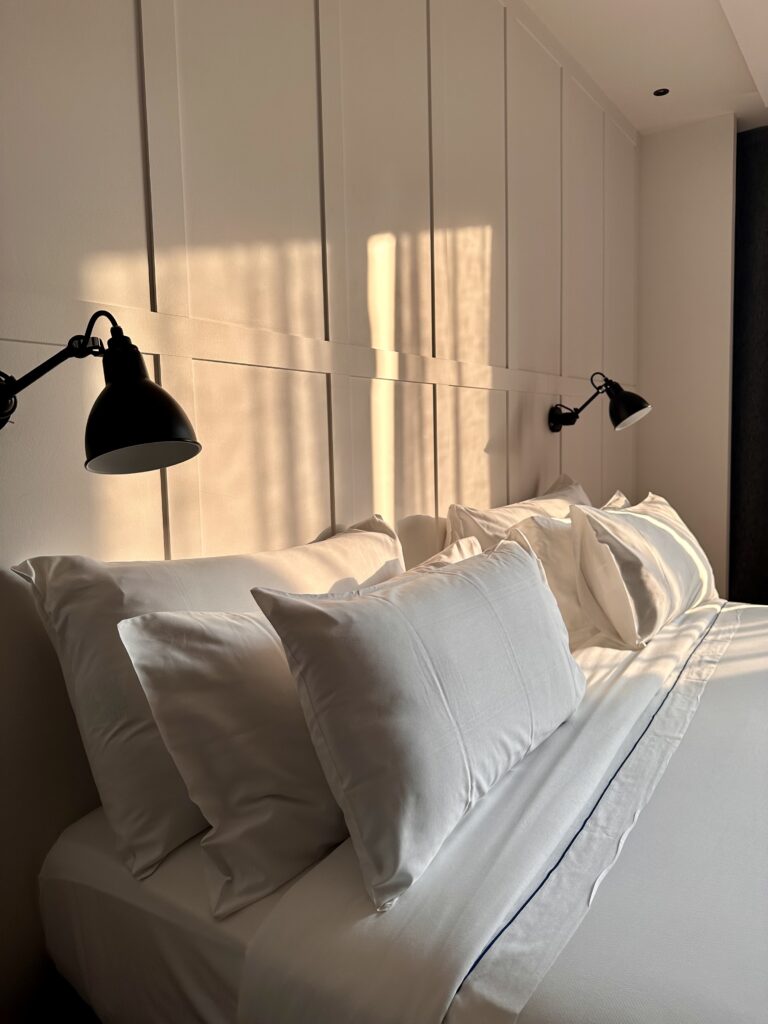
The rooms are dressed in white and black with wooden floors, handwoven rugs, and the sort of restraint that signals confidence rather than austerity. Original marble has been preserved, etch marks and all, an insistence on honesty that extends to the lighting, which compartmentalizes each space into chambers of warmth rather than flooding it with indiscriminate brightness. The TMM lamps by Miguel Milá, Sagnier’s own grandnephew, thread through the property like a familial signature. Modernity as inheritance.
But I didn’t come to Barcelona to admire lamps. I came because my son had never seen Europe, and because something in me needed to remember why I started making things in the first place – why the texture and energy of a city could once rearrange the way I thought about a collection, a hotel concept, a silhouette, a room. Casa Sagnier answered that question on the first evening, when I sat at Cafè de l’Arquitecte and watched the neighborhood breathe.
The café operates on a rhythm that belongs to the city, not the hotel. From nine in the morning until midnight, it shifts between restaurant, bar, and social infrastructure with the fluidity of a place that has earned its regulars. The clientele at lunch were not tourists consulting guides. They were Barcelona – women in considered garments conducting what appeared to be a very elegant argument over accounting, two men sharing a newspaper at a table for four, a young creative sketching. This is not manufactured atmosphere. You cannot buy this. You can only build a space intelligent enough to attract it.
And then there are the croquetas.
I am aware this is a small thing to eulogize. But when someone does something fundamentally simple with such precision that it reorganizes your understanding of what the dish can be, it deserves language. The croquetas at Cafè de l’Arquitecte are not a side dish. They are a highlight – golden, molten, structurally perfect, the kind of bite that makes you briefly distrustful of every croqueta you’ve had before. The patatas bravas carried the same conviction. And a glass of De Muller Vermut Reserva, local and unhurried, completed a meal that cost a fraction of its worth and delivered more pleasure than restaurants charging five times the price with half the grace.
Step outside the hotel and Passatge de la Concepció unfolds beside you: a narrow, tree-shadowed lane that connects the Rambla to Passeig de Gràcia and has become one of Barcelona’s most concentrated corridors of good eating. La Flauta II sits nearby, turning out the kind of precise, unpretentious Catalan cooking that makes you wonder why anyone eats anywhere else. The upper Rambla itself has become something remarkable: a boulevard that rivals, and in certain lights surpasses, anything on the Right Bank. Elevated restaurants line both sides, tapas bars alongside international kitchens, all operating at a level that suggests not tourism-driven aspiration but a genuine civic appetite for quality.
I don’t know if Barcelona has always possessed this sophistication or if the years since the pandemic – years in which the city has grappled publicly and sometimes painfully with the pressures of overtourism – have catalyzed something new. What I do know is that the upper Rambla does not feel manufactured for visitors. It feels like a neighborhood that decided, collectively and without announcement, to be excellent. And that the locals who fill its terraces each evening seem unsurprised by the beauty of the place they’ve made, as though this were simply the standard to which a serious city should hold itself.
Casa Sagnier integrates into this ecology without friction. The building’s scale is human – not imposing, not diminished, but calibrated to the specific register of Eixample elegance that makes Barcelona feel like a city designed for people who actually live in bodies. The service operates on the same frequency: intuitive, unhesitating, present without performance. When we needed something for our son, it appeared. When we needed space, the staff vanished with the discretion of people who understand that true hospitality is the art of making attention invisible.
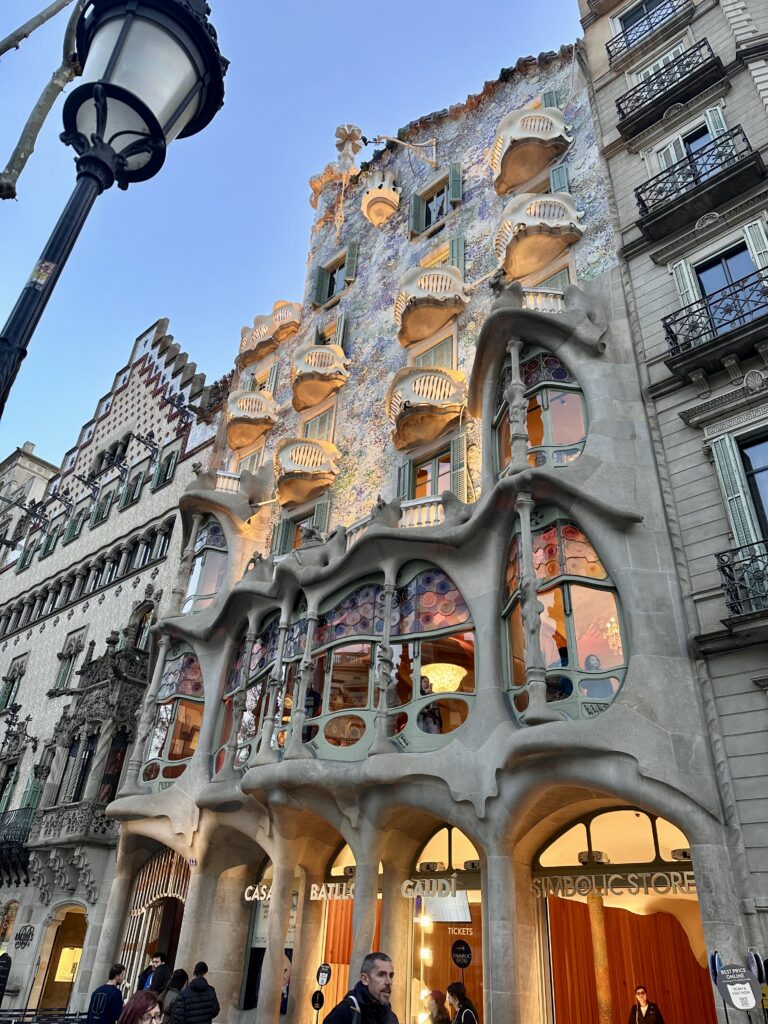

On the last evening, I stood on the Rambla as the streetlights came on and the trees turned the boulevard into something that felt almost implausibly cinematic. My son was holding a napkin from Cafè de l’Arquitecte that he’d drawn on during dinner – a building, naturally, with too many windows and a flag on top. Sagnier would have approved of the ambition, if not the engineering.
I had come to Barcelona looking for a spark. What I found instead was something less dramatic and more useful: a hotel that understood the relationship between a building and the city it belongs to, between comfort and character, between the personal and the public. Casa Sagnier does not try to be everything. It tries to be the best version of one specific thing: a home, opened to strangers, in a city its architect spent a lifetime constructing. That it succeeds so completely is a tribute not just to Sagnier, but to the family that understood what his house was always meant to be.
A place where Barcelona feels, finally, like the best version of itself.
Discover More