Divine Fashion With Gaurav Gupta
The designer speaks about light, darkness, and the soul of couture
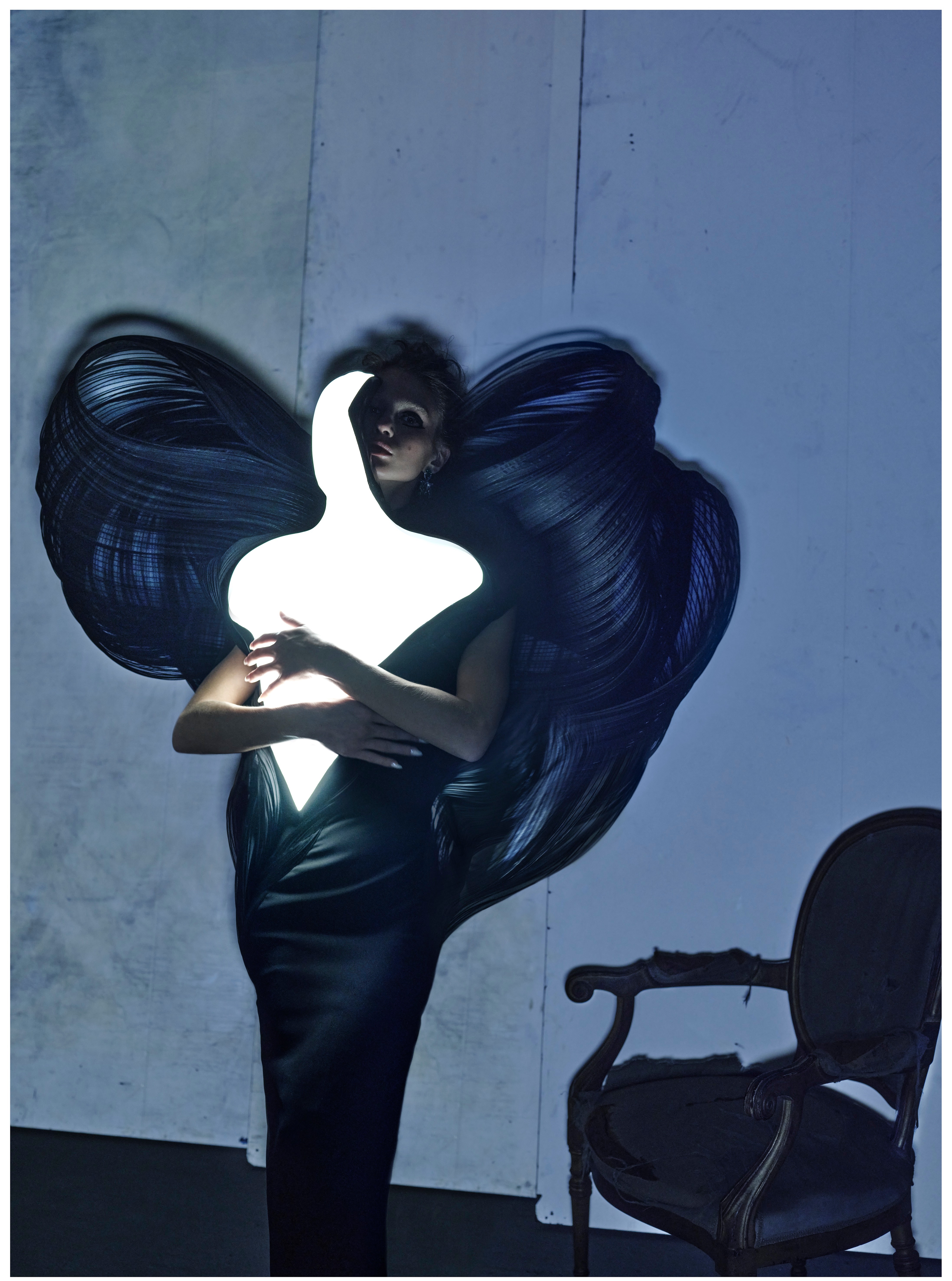
The dress glows. Not metaphorically; it actually emits light, an illuminated breastplate built into the organza that radiates outward through the silhouette. Shot by Nick Knight, styled by Anna Trevelyan, and worn by one of V160’s cover stars, Maria Klaumann, it’s the opening look from Gaurav Gupta’s Spring Haute Couture 2026 collection. It’s the kind of thing that stops you mid-scroll and makes you question what fashion is actually for.
Gupta has been asking that question his whole career. The New Delhi-born couturier designs from a place that’s harder to name than most—somewhere between mythology and mathematics, between the body and whatever exists just beyond it. Beyoncé has worn his work. So has Adele. So has Cardi B at the Grammys, in a sculptural look that broke the internet for about a week.
None of that seems to be the point for him, exactly. V’s Anna Trevelyan talked with him to find out what is.
Anna Trevelyan: Let’s get right in! We shot your amazing light-up opening look for this issue in our Couture story with Nick Knight. Our EIC Stephen Gan was so inspired by it that he wanted us to interview you and find out more. What was your inspiration for that specific piece?
Gaurav Gupta: For me, the opening look to The Divine Androgyne collection represented a very stark expression of light and dark, lightness and darkness, yin and yang, good and evil, and the beauty that exists in balance. I was envisioning this almost spiritual aura emerging from the body, like energy or a spirit growing outward from within a human form.
I wanted the illuminated form to feel almost amorphous and alive, while the dark side of the garment felt like clouds of shadow moving around it. The whole idea was to create something that existed between the physical and the spiritual. Something cinematic, emotional, and almost otherworldly.
AT: It was quite funny when we were shooting the look — the light only works for 15 minutes before needing to recharge, so we were hectic, running around trying to get the picture before the battery died! Did you have any funny issues developing this collection or during the show? With these crazy pieces, I’m sure there are some stories!
GG: Yes, the illuminated garment was actually quite technically challenging because we wanted the light to feel soft and emotional rather than overly futuristic or high tech. We almost wanted it to feel like an old-world lamp glow rather than a digital light source, so we approached the technology in a very intentional and restrained way.
There were definitely some chaotic moments backstage. The twin look, for example, required the models to enter and move into the garment while carefully holding interconnected threads and structures together at the same time. Some of the sculptural pieces completely changed the way the body could move, so the fittings themselves became a performance.
A lot of these garments almost behaved like living characters. That unpredictability is something I actually enjoy because it keeps couture alive and experimental.
AT: When I was at your show and saw the finale cosmic galaxy look, I gasped. What an absolutely unique and beautiful piece of couture craftsmanship and imagination. After the show, I sprinted backstage alongside Hanan from I Deserve Couture as we were desperate to see it up close. The conjoined twins’ look was so visceral — it provoked such a feeling in me. Please tell us more about the collection’s inspiration overall, where these characters came from, what they mean, and what you want to share with us through these looks.
GG: The collection came from a very personal place. In the previous couture collection, Across The Flame, we spoke publicly for the first time about [poet and performer] Navkirat [Sodhi]’s accident and our journey together. A lot of people started defining us within certain ideas of husband, wife, masculinity, femininity, and relationships.
That questioning is where The Divine Androgyne was born. I became deeply fascinated by the duality that exists within all of us, masculine and feminine energies, Shiva and Shakti, light and dark, softness and power. I wanted to challenge why people define love, identity, and connection within fixed structures.
The twin look represented this idea of interconnected energy and form. Two beings existing separately but spiritually and emotionally intertwined. The cosmic finale then became the universal expression of that duality. Masculine and feminine energies dissolving into something infinite and celestial.
So the collection was really about balance, transformation, emotional extremity, and the endlessness of identity and love.
AT: Your work has been worn on so many red carpets, music videos, and more. Are there any moments that are a real highlight for you?
GG: I think what has been most meaningful for me is when cultural conversations begin through fashion. When Beyoncé wore a version of a sari drape, or when Cardi B wore that sculptural look at the Grammys, those moments felt exciting because they created new visual conversations globally.
Adele was also a very emotional moment for me personally because I’ve always admired her so deeply. But overall, I love moments when fashion creates wonderment and fantasy, when people start seeing silhouettes, drapes, and identities in completely new ways. That is what I strive for.
AT: I wonder what your thoughts are on Indian fashion right now. I feel India has often been overlooked in the global fashion market, which is crazy to me because there is so much talent, beauty, and extremely high levels of craftsmanship coming out of India. Do you think that’s changing, and that India is finally being more recognised? What are your thoughts?
GG: India has long been seen primarily as a production and manufacturing base, even though we have some of the deepest traditions of craftsmanship, textiles, and artistry in the world. In many ways, the fashion industry itself is still quite young in India from an industrial and global business perspective.
What is happening now is the globalization of Indian thought, Indian philosophy, and Indian aesthetics. India is such an extreme and complete universe in itself that for a long time, it almost existed independently from the global lens. But now the world is beginning to understand not only India’s mythology and traditions, but also its futurism, spirituality, scientific thinking, and progressive philosophies.
I think Indian fashion is entering a very important new era globally because designers are finally creating from authenticity rather than imitation.
AT: I always feel like you must be a fan of cinema — the way you design is so cinematic and full of storytelling. What are some films that inspire you and your work?
GG: I literally see life as a movie constantly. One of my all-time favourite films is The NeverEnding Story. I love fantasy worlds that feel emotionally immersive and spiritually expansive.
I love Hitchcock, Pedro Almodóvar, Stanley Kubrick, and films that psychologically transport you into another universe. I love Eyes Wide Shut for its beauty and atmosphere. I love fantasy worlds like Game of Thrones, the Harry Potter films, Dune, and even darker films like Requiem for a Dream.
I’m also inspired by artists beyond cinema, people like Nick Knight or Matthew Barney, creators who build entirely new streams of culture and visual language. I’m always drawn to worlds that feel surreal, parallel, emotional, and transformative.
AT: You collaborate regularly with the poet Navkirat Sodhi. How does her poetry align with and inspire your work? How do your worlds collide?
GG: Our worlds have collided over many lifetimes, I believe. We are truly soulmates. We’ve lived together creatively and emotionally for decades now, so our ideas naturally overlap and evolve together.
Our openness to art, culture, philosophy, spirituality, and the world constantly feeds each other’s practices. Her poetry is deeply esoteric, encrypted, emotional, and progressive, and very often it gives signals to my creative process without either of us even consciously planning it. And sometimes the reverse happens as well.
AT: Where did you grow up, and how did this inform your creativity today?
GG: I grew up in Delhi, India, but I travelled extensively across India with my family growing up. My maternal side of the family has ancient temples, and I spent a lot of time experiencing ancient Indian cities, mythology, rituals, philosophy, and spiritual traditions.
I think the endlessness you experience in India spiritually and philosophically gives you a sense of freedom creatively. My fascination with mythology exists alongside a very scientific and futuristic way of thinking, and both of those worlds constantly merge within my work.
AT: Do you design your own clothes? Who are some other designers you love to wear personally, or love seeing what they do?
GG: Yes, mostly I design my own clothes or my team very graciously makes them for me. Personally, I wear designers like Rick Owens, Yohji Yamamoto, Rei Kawakubo, Junya Watanabe, Craig Green, Vivienne Westwood, and Hussein Chalayan, who I interned with and have always admired deeply.
I’ve always loved the beautiful anarchic spirit of Vivienne Westwood. I’m drawn to designers who completely reshape silhouettes, ideas, and culture through fashion.
AT: I was in Mumbai last year and visited your beautiful store! Do you plan to open any stores elsewhere anytime soon?
GG: Yes, we currently have five stores across India, and we are preparing to open our Paris couture appointment space very soon, which feels incredibly special for us. Paris has always been emotionally and creatively important in the world of couture, so it feels like a very natural next step for the house. We also have plans for further international expansion over the next few years.
AT: Are there any upcoming artists, designers, or creatives that we may not know yet that you would love to put on our radar?
GG: I honestly feel like this is a very exciting moment culturally because so many interesting artists and creatives are finally being seen and celebrated globally.
What I’m personally very excited about is the future of tribal Indian art and indigenous visual languages. I think they are going to have a very powerful global moment in the coming years.
AT: Who have been your biggest supporters along the way, and how have they helped your brand grow? For example, I know you collaborate closely with Hema Bose on brand development — how does that kind of teamwork function for you?
GG: What we have really managed to build at Gaurav Gupta is a family. My brother is also my business partner, and we’ve built this brand together over the last 20 years from scratch. I’m incredibly thankful that he has always believed in my conceptual and artistic world while also bringing a very beautiful business balance to it.
My artisans, atelier teams, and designers have also been with me for many years, some for 15 to 20 years. They are not separate from the creative process. They are deeply part of the emotional and artistic DNA of the house.
And yes, Hema Bose is one of my closest friends and someone I deeply trust creatively and strategically. She is a complete visionary and has a very strong instinct for cultural storytelling and collaborations. We resonate deeply in our philosophies, ideas, and vision for how Eastern conceptual thought can exist within a global cultural atmosphere. A lot of the collaborations we create together are not just fashion moments, they become larger cultural conversations.
AT: Who is the woman you see dressed in Gaurav? Who do you design for?
GG: I design more for a mind or a spirit rather than specifically for a woman. I design for someone who wants to experience different levels of artistic, spiritual, emotional, and playful expression. They can be any age, any form, any identity. What connects them is a desire for freedom, fantasy, transformation, and self-expression.
AT: What are your future goals? Where is Gaurav Gupta going from here?
GG: There is so much happening right now. My goal is truly to build an Indian brand that exists globally across couture, ready to wear, accessories, beauty, and beyond.
The next few years are very exciting and very busy for us. We’re focused on growing the business in a sustainable and meaningful way while continuing to push creativity and innovation forward.
AT: Is there anything you want to say to future fashionistas, fashion enthusiasts, designers, stylists, collaborators, and fashion fans?
GG: There is no shortcut to originality or innovation. Art has to come from something deeply real. Follow instinct, not trends or mobs. The most powerful work always comes from authenticity and emotional truth.
AT: Thank you, Gaurav! We are so excited at V to see what’s next from you. ♥
GG: Thank you so much. It really means a lot to see the work resonate emotionally with people. That connection is why we continue creating.
This cover story is featured in V160: now available for purchase!
Photography Nick Knight
Fashion Anna Trevelyan
Creative Director Calum Knight
Editor-in-Chief Stephan Gan
Model Maria Klaumann (The Lions)
Hair Franco Gobbi (Streeters) using Fragile Cosmetics
Makeup Val Garland (Streeters) using MAC Cosmetics, Danessa Myricks & NARS
Manicure Adam Slee (Streeters)
Set Designer Andrew Tomlinson
Executive Producer Kat Davey
Fashion Market Editor Copelyn Bengel
Production Sidonie Barton
Digital Technician Gabriel Lloret
Photo Assistants Lara Hughes, Gil Warner, Oldnightkid Wang
Fashion Assistants Leonie Dennett, Timmy Taiwo, Nicole Alonzo
Hair Assistant Laura Swaine
Makeup Assistant Paula Maxwell
Discover More
