Read the Room: In Kyle Carrero Lopez’s ‘Party Line,’ the Dance Floor and Family Lore Collide
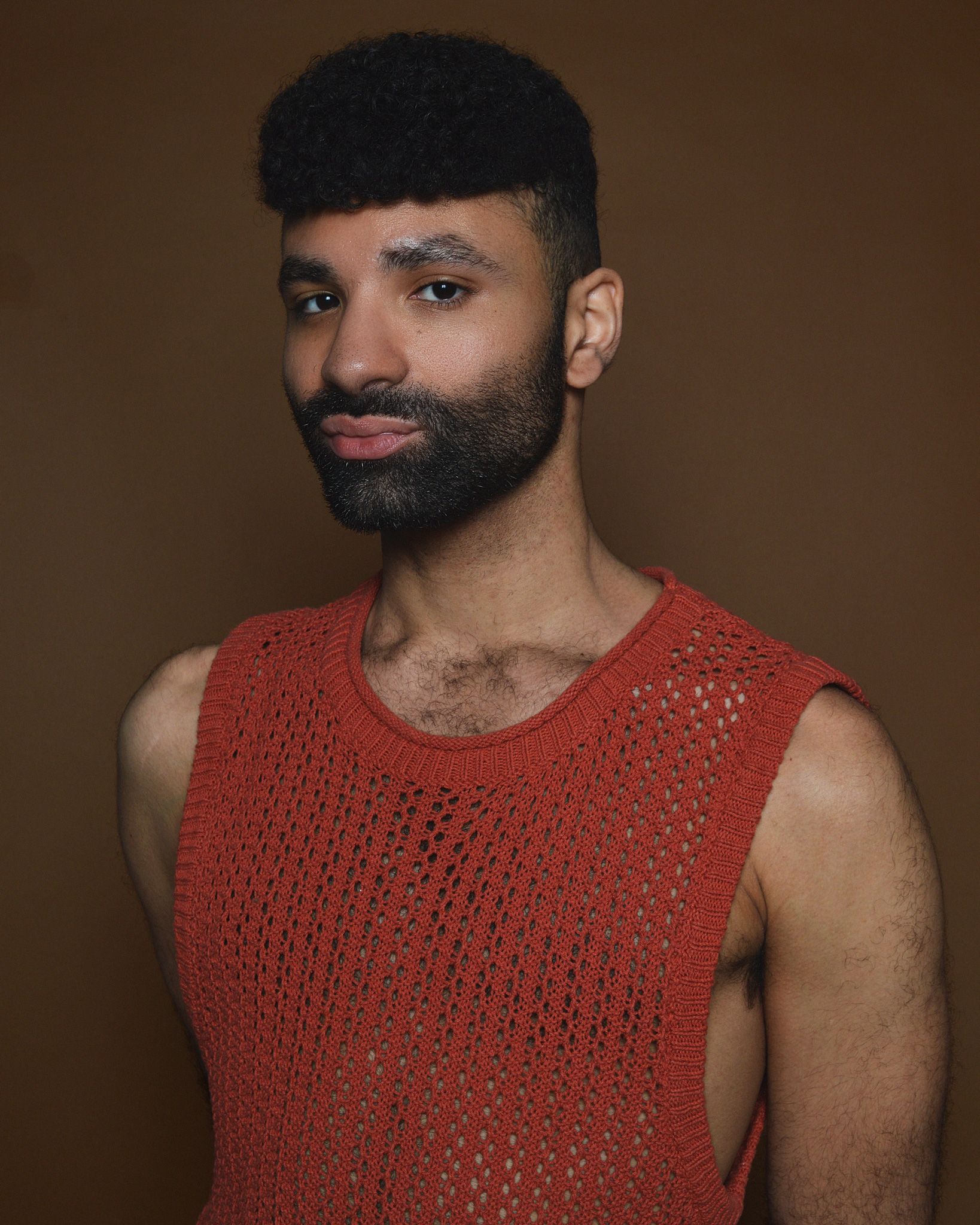
The Brooklyn-based writer contemplates queer nightlife, the Cuban diaspora, and their intersections in his new book of poetry
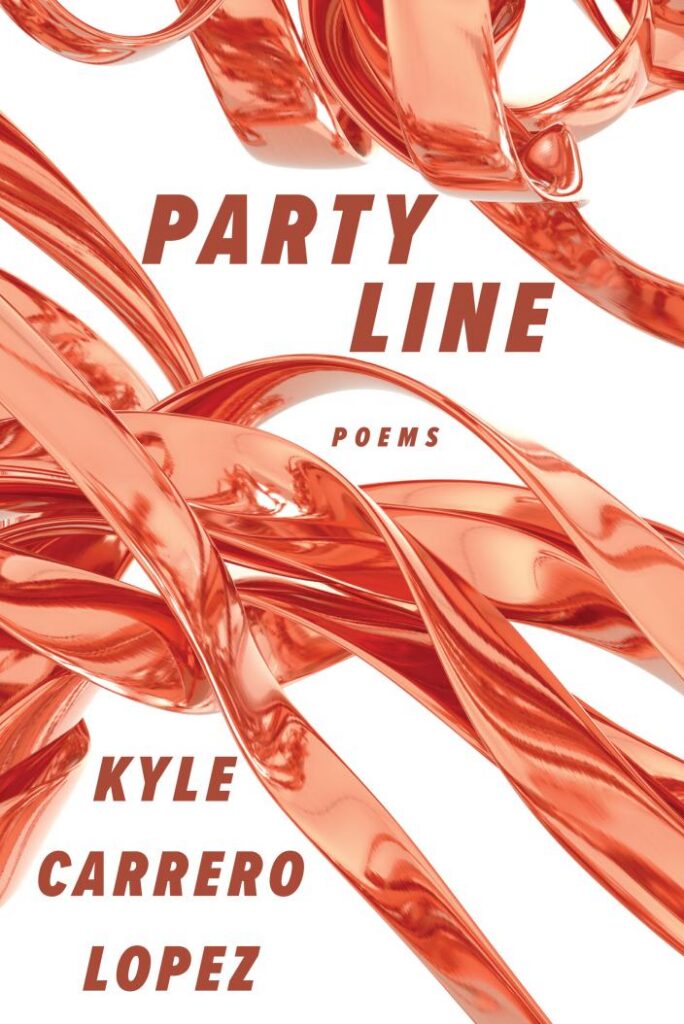
Living at the convergence of nightlife, family, and politics, Kyle Carrero Lopez’s new poetry book Party Line is inspired by everything from Party Girl to Celia Cruz; from the Moscow-Washington hotline to Fire Island; from pigeons to Cuban governance, and more. Released July 7 by Graywolf Press, the book asks where party lines of all kinds start and end and bend; what happens if their inhabitants feel stuck at parties that profess to keep them safe; how people craft lives of their own when a party’s demands pull them from themselves. Lopez celebrates and critiques these spheres, identifying their parallels and distortions, allowing us to witness them unfolding into each other.
In his work, Lopez is motivated by “marginalization within the margins,” as he says; the experiences of “people who don’t even feel at ease within the groups that they are supposed to feel at most ease in.” It’s a thought that applies as much to the dance floor as it does to family barbecues as it does to trans healthcare in Cuba. Throughout its pages, Lopez’s poems are vibrant and analytical, rooting us in a series of cultural moments, then asking us to think more deeply about each of them.
Party Line is Lopez’s first book, though his debut chapbook, Muscle Memory, won the 2020 edition of the [PANK] Books Contest and was published in 2022. His work has been published in the Los Angeles Review of Books, The Yale Review, Best New Poets, The Atlantic, and more. He also works in nightlife as a party host, and is active in organizing support for those living in Cuba, especially the trans community.
V spoke to Kyle Carrero Lopez about nightlife as poetry, the importance of working against propaganda, and what a party actually means. His poem, “I’m Asked a Lot What a ‘Party Host’ Job Means,” from Party Line is reprinted below with permission.
Kyle Carrero Lopez: The book’s been a long time coming, so it feels really good.
V: How so?
KCL: I went on submission with this book two years ago. Carmen Giménez, who’s the Executive Director and Publisher for Graywolf, ended up being my editor. She had ideas for the book I felt would make it even stronger than what I submitted, so there was all of this energy and possibility in the conversation that made me want to go with them. Between when the book got picked up and now, July 2026, there was a pretty intensive period of close attention to each of the poems. I wrote a bunch of new stuff as well, and we reshaped a lot of the book. We thought very intently about what the book was trying to do and what it could look like. I feel overall it was a really generous process. I feel very lucky to be working with people who could see a version of the book that was even better than what I was thinking.
V: How is the book different from what you submitted? Was there a deepening of the thematic material for you, and did your relationship to the text grow and change in that time as well?
KCL: Absolutely. The core ideas of the book were there from inception. I knew I had created something that was a lot about US-Cuba relations, about parties, about my family and their history in Cuba, and my own travels in Cuba, but as I continued to shape this book with Graywolf, I saw more connections over time. One of the biggest changes was that I had all of these poems in the book that were pretty short form–I’m generally pretty short form. It’s unusual for me to have a poem that’s longer than two pages. I had all of these poems encircling similar themes, one or two pagers, sometimes half a page. There’s a couple poems in the book that are no longer than two couplets, but Carmen at Graywolf saw an opportunity for me to link some of these poems into a larger lyric essay [called “Public Policy”]. It’s in the middle of the book. I had never really thought about putting it together, but it ended up being almost a coda for what the book became. It touches on all of the major themes and intertwines them so you can understand the project of the book. It’s serious, it’s got humor. It’s doing a lot of the sound work the poems do. It’s imagistically doing work that’s happening throughout the book. I love that poem as one of the book’s key touch points.
V: How did you decide what a party means to this book and how did you want to explore that?
KCL: I have been writing a series of prose poems for several years. The working title was Party Politics. Those were each at different parties, [with] different observations, weirdnesses, funny things I saw happening, ways I saw power moving through these spaces. Somewhere along the way, Party Line came to me as a more resonant title, more ambiguous, less on the nose, and a bit of a triple or even quadruple entendre. It could mean the literal line; to a party line, as in what a political group is and sets as the standard, and if you deviate from that, it’s a problem. There’s also the party line [on the telephone], which folks of a certain age know about. That technology really interests me, and I love the way a party line would work, that you share this line with your block, and you could tune in and listen in on your neighbors’ conversations. You keep your call short in case other people need it. I thought something about a line where there’s multiple people on it, multiple voices going on, resonated with my overall process and aesthetic. There are interlocking conversations happening within the book, different tones. You could flip to one page and encounter one voice; on another, the voice is completely different, but I like to think they all cohere into one party line. Once I thought about it that way, I felt it was suitable. That technology is from the ‘60s, ‘70s, and the book is located a lot in that time frame anyway, so it felt good.
V: I loved seeing nightlife celebrated in poetry, taken seriously on its own, and spoken about in the language of nightlife–not trying to put it in an ivory tower. Can you talk about your decision to do that?
KCL: That was the goal, and I’m glad it landed for you in that way. I do come from a nightlife family. My father worked as a DJ. My godfather works as a promoter to this day. My maternal grandfather used to run a social club. I come from party people, born into this life. In adulthood, I have chosen it for myself. Queer nightlife specifically has been a refuge and a safe haven for me, a place where I’ve carved out my own identity. Now it’s become work for me as well [Lopez works as a party host; more on this below]. It’s become part of my labor in my time here, in a way that I make money and try to give back to the community. Rather than only participating in nightlife, I’ve become a part of facilitating it, which means a lot to me. As far as the language of nightlife, I’m always really interested in hyper-specific jargon, in-group vocabularies, and sonically, it’s always fun. There’s a lot of texture and personality in those words. I wanted to write it authentically and conversationally. The bonus is that it sounds good, so you can’t really lose.
My goal is not to necessarily over-intellectualize nightlife because sometimes that can get a little annoying to me. But I wanted to take it seriously as a place of encounter, of consequential, observable human behavior that is not solely frivolous or divorced from the larger goings on in the world. I wanted to see what happens if, within one book, I’m talking about dark room parties and afters, but then I’m also talking about Suzanne Césaire and Adrian Piper, James Baldwin. What happens when all of these things are in conversation with one another?
V: Along with the discussion of nightlife, we also get this discussion of marginalized identity, especially in terms of diasporic identity, queer identity, and identities of color. It’s a continuation of actively taking up space.
KCL: There are many margins explored throughout the book. I’m really invested in Black life in the States and in Cuba, in queer and trans life, particularly the lives of queer and trans people, of Black queer and trans people, and queer and trans people of color more broadly. I’m really interested in marginalization within the margins. I feel this book at once embraces the idea of community life and living together, and is also quite critical of it. Lately, talking to my friends, I’m on this anti- “community” tirade. “Community” is such a bullshit buzzword; a lot of the time, people talk about how much they love community when they’re talking about their five friends. A lot of people are full of shit. Family or chosen family, that’s a form of community, right? Even within a family of color, there is marginalization that happens in those spaces, and so it’s at once joyous and painful. Those are the stories I want to highlight, of people who don’t even feel at ease within the groups that they are supposed to feel at most ease in.
V: As if to say nightlife and family are not utopias either.
KCL: Yes. I think that nightlife, and especially queer nightlife spaces, often posit themselves as pseudo-utopian. I already have an issue with that. The idea that anywhere is perfect almost creates a tension for when someone does raise an issue, that they’re the problem. You’ve been promised something perfect, right? If we take it all the way back to Utopia by Sir Thomas More, the original story, there was slavery in Utopia, in that version. If a perfect world is built upon the subjugation of some, and maybe you want to get really technical and say he’s not talking about the worst version of slavery possible. Still, there is an underclass; then how is it perfect? Who is it utopia for? That’s broadly how I feel about the idea of utopias. I’m also pretty critical of talking about the dance floor as a church, a holy place, or whatever. The church asks a lot of conformity as well, and if you’re not able to fold yourself into the expectations of the church, you often are not truly welcome. As I wrote this book, if the dance floor is a church, I do love it, I will go back, but I had a crisis of faith as I got more critical of this church, as it were. I think of family in the same way. These are all different forms of parties, and that’s why I tied them all together within the book. This was really thinking about what is going on that’s constituting this party, why is it so often that homogeneity is an expectation of the party, and what is being lost? We demand that flattening.
One aspect of the book I am most proud of is that I tried to write my poems on Cuba, and in response to the US-Cuba situation, in a way that did not feel like I was a propaganda machine in either direction. The goal of my work is to honor the experience of everyday people, so not to be critical at all of the Cuban government would be dishonest, even though I am obviously, within the book and outside of poetry, very committed to anti-imperialism. I support Cuban independence. But I felt it would be dishonest for me not to in any way acknowledge some of the problems and the structural issues in Cuba. Sometimes leftist perspectives in the States, perhaps to counterbalance propaganda in the other direction, overcorrect and act as though Cuba is a utopia. My hope is to open up conversation and build our ability as people living outside of Cuba to be in solidarity with the Cuban people and offer more than oversimplified leftist platitudes.
I'm Asked a Lot What a "Party Host" Job Means
By Kyle Carrero Lopez

and there’s neither jokey monologue
nor vamping onstage; stranger
banter, sure, but no mic time at all—

hosting translates to a Gay New York version of promoting:
share the flyer, send names to the door girl,
show up in something that shows skin, like the other hosts.

When our bottle service comes, we pour shots,
pull others to join us, connect with people!
Shake and shimmy and keep the energy
up and up. All fun, all silly,
all of it with operating costs in mind.

Half-dressed and skin glowing,
in moments I’m the locus of power,
empower patrons to stay, have
another, song of the dive bar siren;
I move them where I want them.

If he buys a round for all his pals,
that’s an easy hiii, hey big spender, here’s a drink
ticket so the next one’s free.
He’ll feel jolly and seen
and soon he’ll do it again.

In the door-to-door canvassing days it was the same:
extend your clipboard close enough
to each person’s hand, the higher-ups taught us,
that they feel compelled to grab it.
If they do that, you’ve got them.

Didn’t matter how much they’d care
about clean water, clean air.
I knew they’d write a check
as soon as they held my gift.
“I’m Asked a Lot What a ‘Party Host’ Job Means” from Party Line. Copyright © 2026 by Kyle Carrero Lopez. Reprinted with the permission of Graywolf Press, Minneapolis, Minnesota, www.graywolfpress.org.
Discover More