The Balancing Act Starring Melanie Martinez
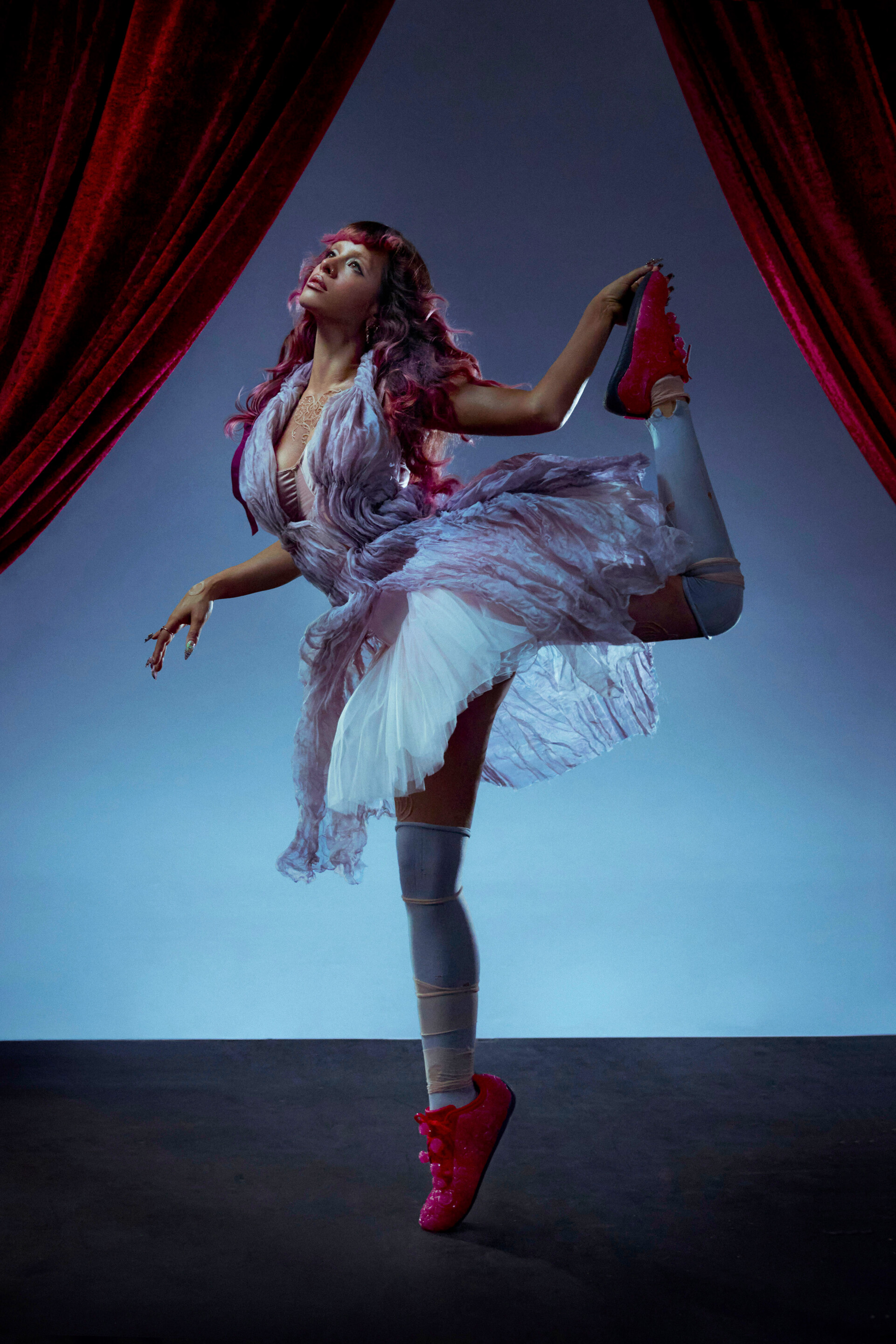
Our digital cover star’s latest projects traverse both heaven and hell on earth. For the artist herself, creation at this level demands total, unbalanced, and obsessive devotion
It is sometimes strange to think of Melanie Martinez as a real-life person. Her worlds have always been so vivid, so watertight, so complete, that one forgets they are not places in which she actually lives—forgets, and pictures her instead as an alien who really inhabits these alternate dimensions, the rest of us earthlings watching from the ground, racking up billions of views on her YouTube. Through Cry Baby, K-12, and Portals—the last of which remade her outright as a wide-eyed creature adrift in the afterlife—the character and the woman were nearly impossible to pull apart. It was difficult to picture Melanie Martinez as someone who drives a car, keeps a bank account, scrolls on Instagram, or worries about everyday human things.
With HADES, the distance between her invented worlds and ours has begun to collapse. To make an album about hell, Martinez did not have to invent an entire new realm; she only had to look around her—at the homelessness crisis, acute in Los Angeles, where she lives; at cults (including the less obvious ones); at the Disneyfication of girlhood and the young women it strands, each desperate to be a perfect, flawless princess.
If the album names the hell around us, the current tour builds it and shuts you in. Night after night, Martinez raises an elaborate underworld onstage—an exaggeration, but one drawn entirely from the world we inhabit (this time, with her). That is the trick of it: the staged hell and the real one are the same hell at different volumes, so exiting the venue doors post-concert only ever turns it down. Which is to say, even after the show ends, concert-goers are still in hell. Just a less fabulous one than the one born from Martinez’s mind.
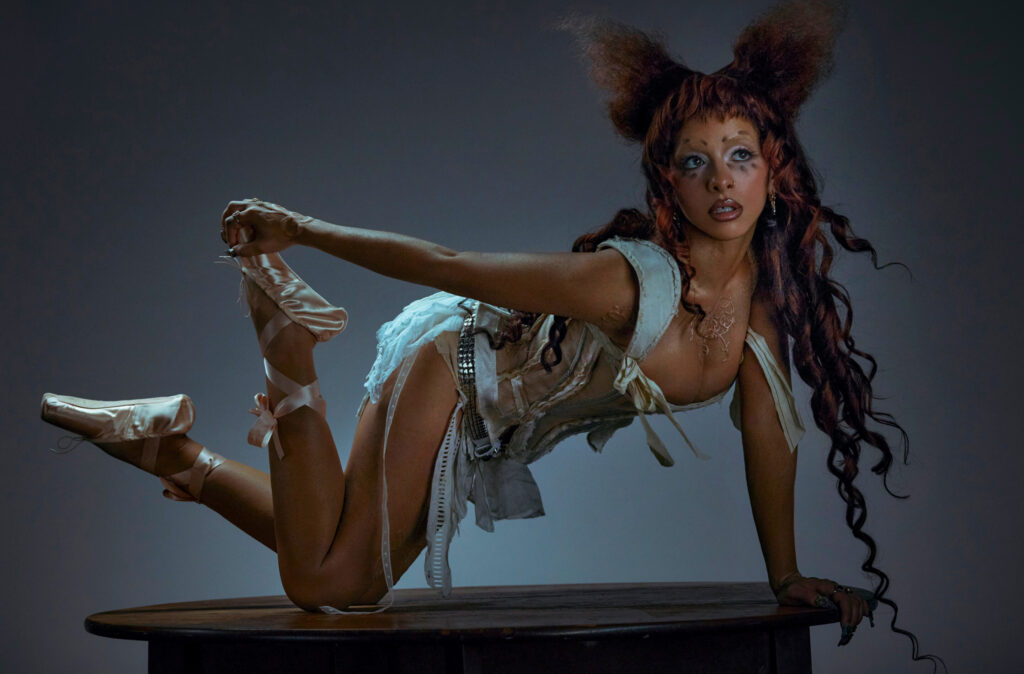
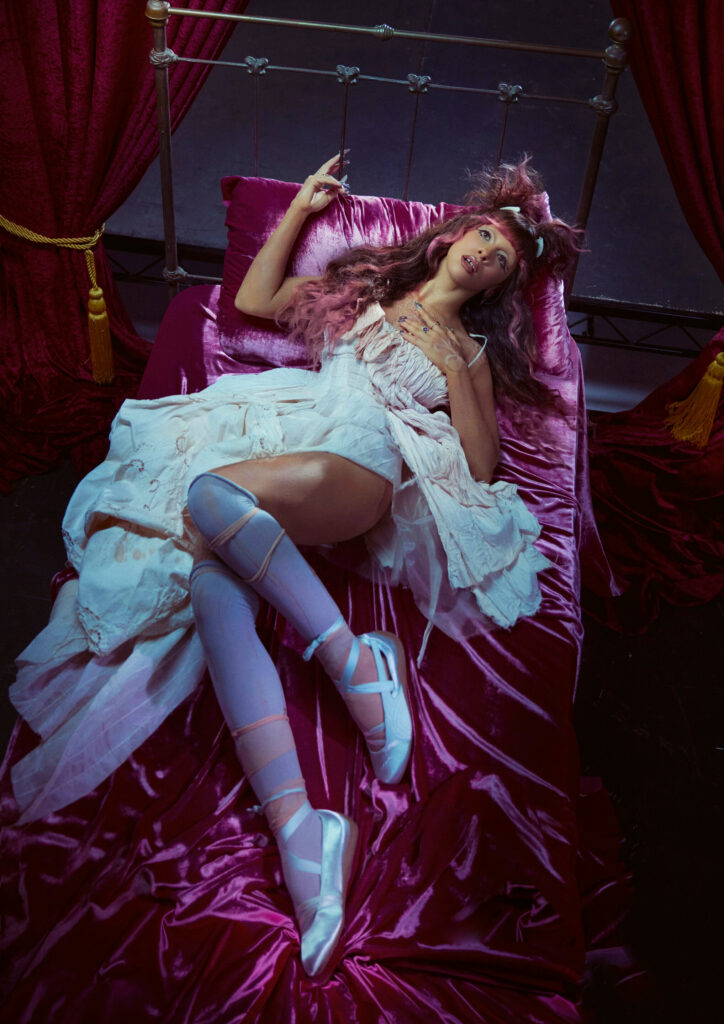
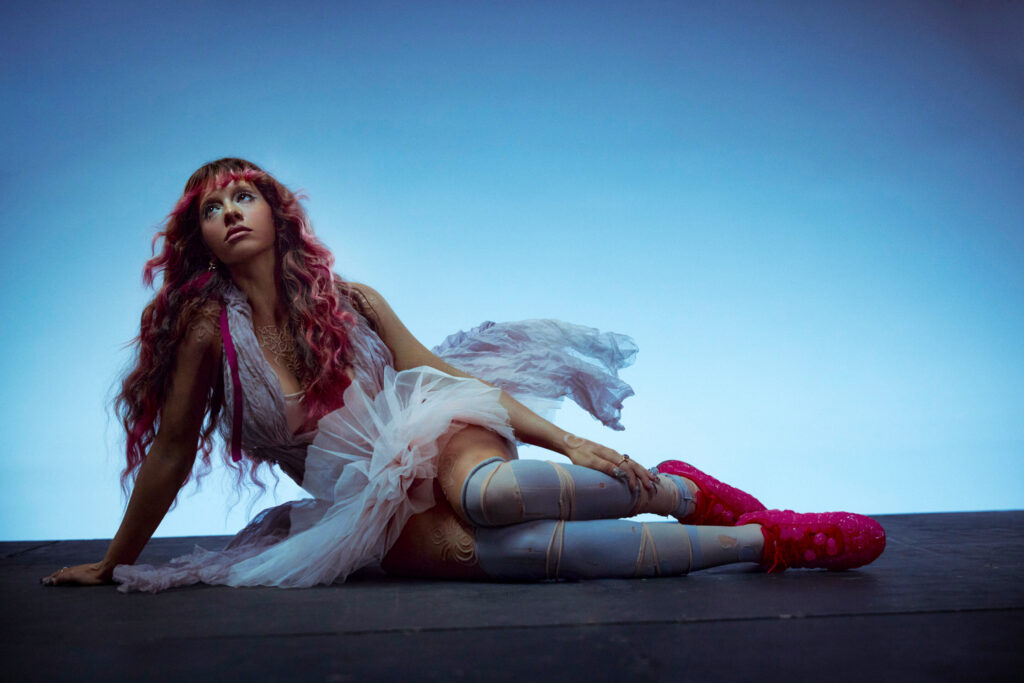
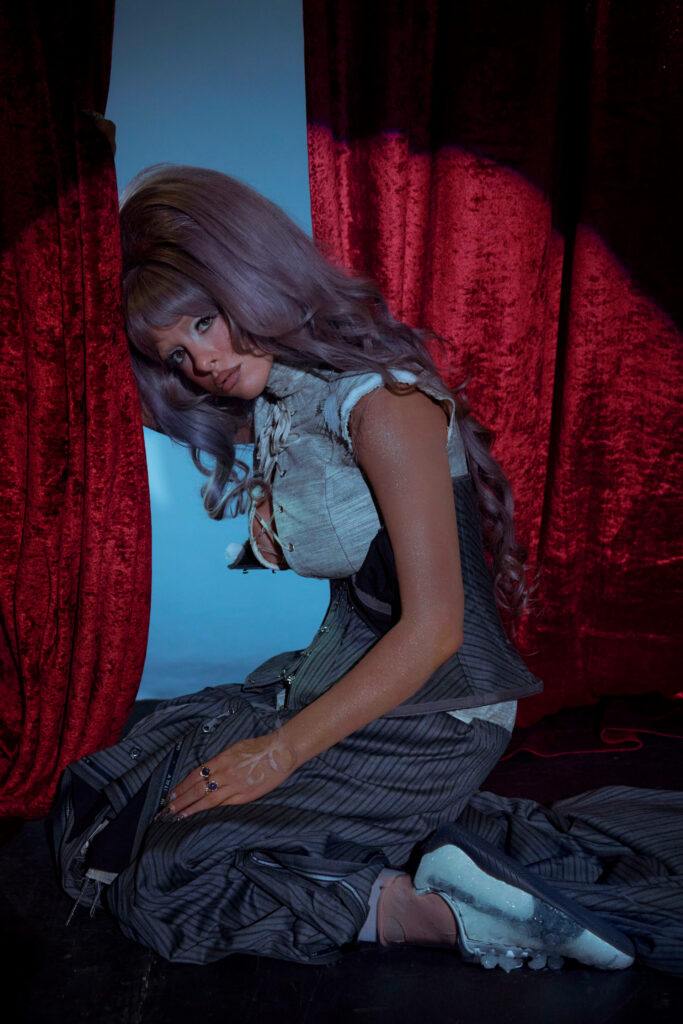
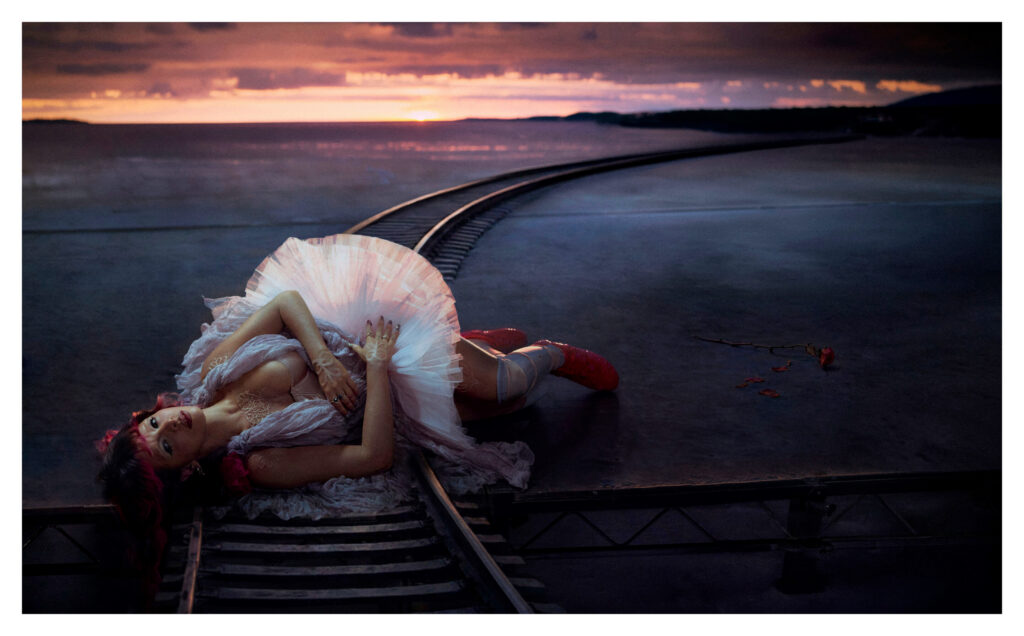
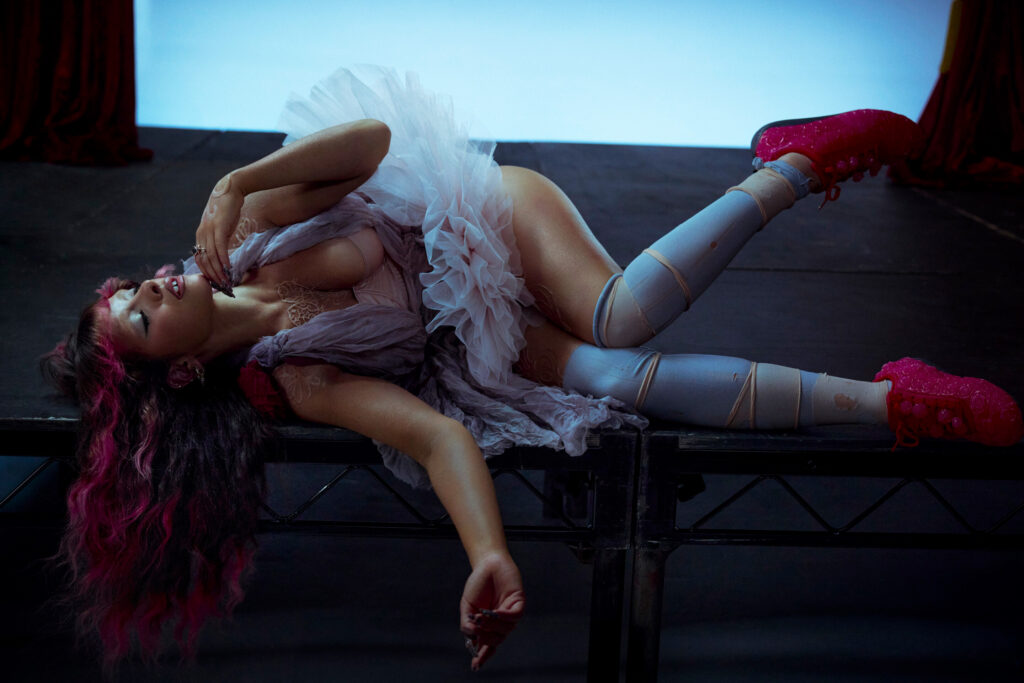
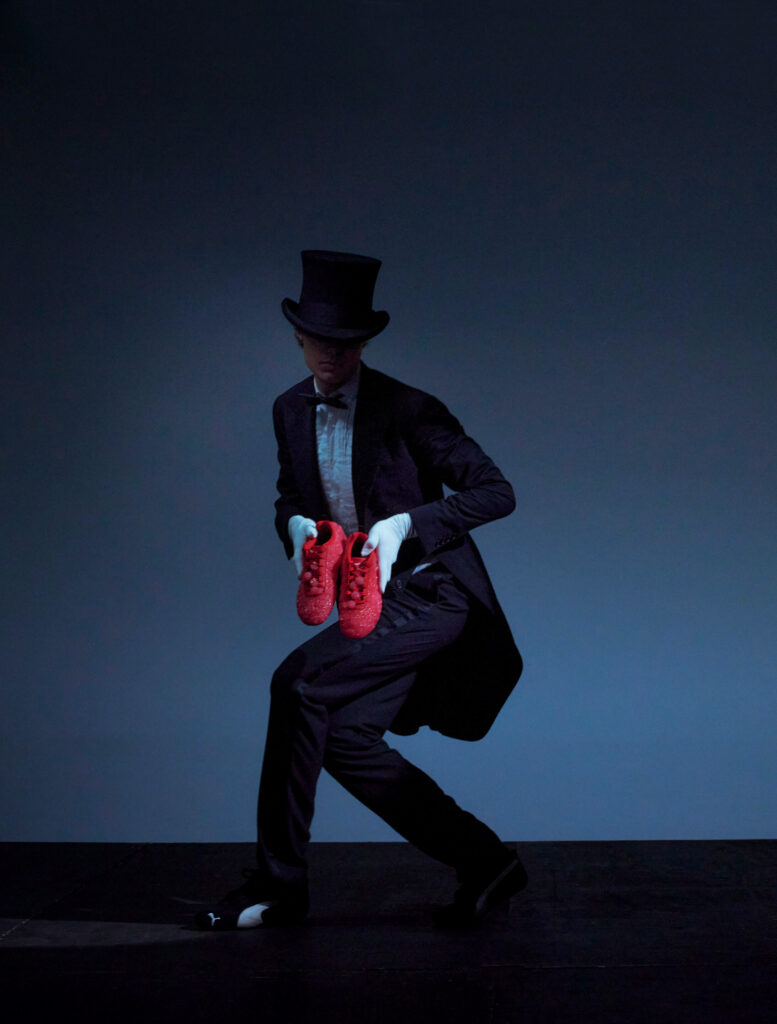
Her artistic surrender—the complete giving-over of the self to the work and world-building—is the animating idea of The Red Shoes, the 1948 film by Michael Powell and Emeric Pressburger, in which a ballerina, possessed by a pair of demonic red slippers, is consumed by her hunger for greatness until it kills her. It became the governing theme of our shoot with Martinez, whom I reached on one of her rare days off, somewhere out on the Hades tour.
MATHIAS ROSENZWEIG: I am dying to get into Hades. I’ve been driving around the Portuguese countryside re-listening to the album and really having a moment with it. I wonder what it was like to spend so much time creatively immersed in this album’s darkness. Did writing it ever become a huge bummer, or did it actually feel empowering to harness that darkness into music?
MELANIE MARTINEZ: The feelings that came up when writing the album were complex and dynamic, because some days there were real things happening in the world simultaneously as I was writing, and it felt cathartic to be able to shed light on those events. Some days, I’d come into the studio, and I’d be like, “It’s a dark album day.” There’s a dark album and a light album. I was writing both simultaneously. Some days I felt really future-oriented. My mind was in this hopeful place, and it was very light and airy. Me and [producer] CJ [Baran] would go into the studio Monday through Friday. We treated it like a work schedule. I’d go into the studio at 11 a.m., and I’d leave at midnight or something. We’d make a song every single day, and recorded everything fully. And a lot of the songs—actually every single song that you hear on Hades—were all first-day recordings of my vocals. We didn’t re-record anything. The emotions were complex, but ultimately very cathartic. I’m really proud of the album and that we pushed through all those weird feelings because there were some magical moments as well, like “The Vatican.” I had not known about the crash that happened on Grindr in Milwaukee during the Republican National Convention. I literally was just writing, and then that happened, or we had just found out. I was like, “This could not be more perfect timing.”
MR: I was thinking that when someone is younger, their work is naturally more internal. Our internal emotions and feelings are the entire world. With this album—and Portals was definitely a stepping stone—it feels much more external. There is political commentary and social critique alongside more intimate songs like “Possession.” Did you know from the beginning that the album was going to be this meeting ground between your world and the world we live in?
MM: I had this intuitive feeling that if I started to write about some dystopian fantasy world, it was gonna reflect in some way—the only influences I have are what’s happening around me. The world does feel very dystopian and scary all the time. It’s constantly flooded with news. You’re scrolling, and you’re like, “Holy shit! This happened, and this happened.” As an artist, you often don’t know what to do with that feeling. You want to be able to express it and make sure you don’t hold it in because it can really affect you. This album naturally leaned in that direction. At a certain point, I got super aware and was like, “Okay, I want to just put down a list of all of the things that I want to talk about.” I love having double meaning and making sure that the titles are all consistent. I love aesthetics, themes, throughline, and story. I was like, “Climate crisis, health systems crisis.” I want to think about all the things I could possibly think of that everyone is collectively witnessing and grieving over. It was very cathartic to do that because afterward you feel such a relief. I don’t know what to do with it other than just express the pain of it, because I think that can be something people will resonate with and hold for themselves.
MR: I wanted to bring up “Possession” again, because I know you love double meanings. It made me think about the idea of ownership and intimacy, and especially the term “public figure.” When something is public, there is this implication that it belongs to everyone. I pay taxes; therefore, I have the right to go to the “public park.” For someone in your position, there can be a similar sense that because you are “public,” people somehow have ownership over you. I have always thought it was such a strange term. What do you make of it?
MM: I think it is a strange term, but I do think that it’s sadly reflective of how people in the spotlight are treated. There’s so much reflection that I do with that. I journal about it a lot. I try to make sense of it. Painters often get to make art and people look at the art, and that’s the main focus. But with music as a medium, you end up being the focus rather than the music. A hard thing with being in music is that I feel more like an artist, not like a celebrity. People put that public figure thing on me. It’s strange for me because I don’t resonate with that. It’s a tricky thing to figure out, especially if you’re starting out and all you want to do is make music. It’s really easy for people to go down the path of, “Well, maybe this is what I have to do in order to have my music seen,” or, “Maybe I have to be more in the spotlight, or go to this party, or do this thing, or hang out with this person, or go to this red carpet event.” I think being an introvert naturally has steered me in a direction of being introspective and spending a lot of time alone creating and focusing on the art. I’m grateful for that because I know my nervous system is very sensitive to everything: people, sounds, textures.
MR: I’m quite literally interviewing you from a cabin alone in the Portuguese woods, so I understand that sensitivity to surroundings.
MM: Exactly. I don’t think my nervous system would be able to handle that lifestyle, and I don’t think it was ever meant for me. But it’s important to talk about when discussing a dystopian world, especially since I am an artist in music.
MR: You wanting to do these two sister albums of hell and heaven, it really reminds me of The Divine Comedy. Have you read it?
MM: No, but a friend has been trying to get me to. By Danté, right?
MR: Exactly.
MM: I don’t know anything about it, but I’ve heard of it, and now that makes me want to. This is also, by the way—I love the alignment of anytime I create something or whatever, and then someone will talk to me about it and their perspective. There are always new things to discover that keep informing the process. It’s a long journey of inspiration, so it’s really exciting having conversations that can just keep it building.
MR: How is it going with building the world of your next album, Elysium? Where is the album at the moment?
MM: I have one more song. Last minute this year, I decided to replace three songs, and now I’m trying to replace one more. Once Hades was released, I was like, “Okay, now I really want to get to the details of the Utopia and make sure that it’s everything that I want it to be,” because I felt really complete with Hades. Elysium is a harder album for me in general because I’m used to writing about heavier topics and themes. With Elysium, I have to really hone in on a level of hopeful intention for the future of the world, and that can feel really difficult when you’re living in bleak times. With Elysium, there’s no real structure. It’s free-flowing and fluid. I chose to use words that felt light and sweet and airy. I would have a word like “purification.” What does that word mean to me? And then I would write a song that had that energy. It could be something so simple. It was a completely different process for me. The tone of my voice and the sonics are different. It feels like a breath of fresh air, like being in nature, rolling the windows down, and the sun is peeking through. It’s something I’ve never written before. It’s beautiful, and so wholesome, in a way. At the same time, it taps into a deep instinct of the soul. It feels otherworldly while still tapping into human emotion and connection—the more important things in the world—community, any form of togetherness, love. Just basics.
MR: Maybe it’s like when I have a really shit day, at the end of the day I try to make a gratitude list and be like, “Okay, everything is really, really tough, but there are still these things, and thank whoever for that.”
MM: It’s very much that. All the most important things are the simplest. It’s so different than anything I’ve ever written. I’m excited for people to hear it. With that excitement comes a level of nervousness because I’ve never written anything so light. People are used to hearing me talk about heavy topics. I was like, “Am I going to stay inspired with this album to continue writing it and figuring it out?” I’m still figuring it out.
MR: Because your work is so theatrical, do you ever think about expanding into other forms of live performance as a creator? I could even see you doing Marina Abramović-type work.
MM: I’m inspired by everything, and I never want to limit myself to different mediums. I can have a spark of inspiration in seconds, and it’ll lead towards some project I never thought I would do. Making a film, even with K-12, I’d never written a script. I was like, “I’m just gonna try.” A lot of what I do comes from a sense of wonderment for the world and art, following your intuition and not second-guessing your instinct to create. It’s a current I try to tap into every day, even though it’s scary sometimes, because you have the world telling you, “You’re not a filmmaker, you don’t know what you’re doing. You didn’t go to school for that.” I do my best to ignore that and follow whatever instinct there is to create, even if it’s with the limited tools I’ve gathered from my life experience. I’m reading a lot of books right now. I’m having such a great time reading. I started writing more, too. It’s been inspiring me to write more journal entries; maybe in the future, I’ll decide to write a book or a weird series. I love that idea that any little thing can inspire you to create a project you never thought you would make. There are endless possibilities.
MR: I was listening to an interview you gave recently where you mentioned feeling quite happy lately. What is the correlation between happiness and success for you?
MM: My idea of success is the ability to create and make a living from my art. So I’ve never had an idea of external validation dictating what success is. With the success of creating and making a living off of my art, I can help out my family or take care of friends and be there for people in my internal community. I feel really lucky and grateful to be that person for people and to take care of myself and feel stable. My parents grew up in the projects, and I grew up in such a different way from how I’m living now. I’m very aware of where I come from, my family, and how much sacrifice they made for me to do what I love. My mom wanted to do things she loved when she was younger, and she got pushed in a direction for the necessity of making ends meet. She’s very creative, but she didn’t get to express that. So I’m very conscious of that. I’m like, “Okay, my parents sacrificed so much so that I could be able to just create freely,” and it’s a huge deal for me. It makes me emotional, even when I’m around my family. If I talk to my grandmother and hear about her stories, her life, what she’s gone through, I feel such a big responsibility for me to stay grateful and focus on that aspect of success and what that means to me. The way it coincides sometimes or collides with being happy is isolation more than anything. I’m someone who really loves talking to people and connecting. It can be really difficult when you’re leading projects and looked at as the boss in a lot of ways. At the end of the day, I’m a very sensitive, creative person who wants to connect with other like-minded people, but [being in charge] can push you into isolation because they’re like, “You’re the boss.” That aspect plays a role. I do get lonely. That’s the one thing I’m currently working through, even in therapy, trying to understand how I can connect more.
MR: That makes so much sense. A musician friend once told me after a big show, “You don’t understand. I go from the crowd and the screams to silence.” She was tearing up telling me that. I joked, “I hosted a perfume launch once,” but of course I couldn’t relate. It must be incredibly isolating because there are only so many people who can fully understand that experience.
MM: I don’t really have many artist friends either, so I think that also comes into play. I have my closest friends. I’m so lucky that I’ve been building a solid community of people for 10-plus years. My closest friend is now going on 20-something years of friendship, since we were five. I love that aspect, but it’s also like they [don’t] even know all the time. I’m always talking about, “Oh, I wish that I could really explain to you how weird it is to go on stage and have so much stimulation and people just screaming and yelling.” Your nervous system’s shot; it’s all cortisol. It’s so intense.
And then you go back to your hotel, and you’re alone, and you’re in the shower zoning out, and you can hear your ears still ringing.
MR: I have one last question for you. I’ve become really obsessed with Stendhal Syndrome where, basically, people would go to Florence and see works of art they’d encountered through iconography their entire lives, and become so overwhelmed by the beauty that they would faint. What piece of art—a painting, a movie, a song, anything—would give you the biggest, almost physical reaction?
MM: This is actually gonna sound so silly and really quite stupid, but I’m gonna say it anyway.
MR: Tell me.
MM: If I was standing on the fully built practical set of either Edward Scissorhands or The Grinch—wow. I still don’t even understand or comprehend how all of that was practically made. It’s the most inspiring thing to me. I think about that all the time. I’m like, “Fuck the effects. Can we please build it?”
MR: There was no AI-ing it in back then.
MM: Exactly. Yeah. I think that’s probably the thing for me.
MR: I love that. You had such a quick response. I’ll bring this up with people, and they’ll come back to me an hour later and be like, “I have it.” And you were like, “No, it’s The Grinch.”
MM: It’s been so impactful in my life, and I still come back to it. I love tactile, practically built anything. That’s why I love stop motion movies so much. Have you seen this movie, The Wolf House? A Chilean film.
MR: I’ve seen The Wolf House, and I was also looking at the stop-motion artist you had on your Instagram.
MM: Yeah, Phoebe [Jane Hart]. She’s so talented. I’m just obsessed with that. Especially now, with AI, it feels more important than ever to keep showing people and the younger generation possibilities of different art forms and different mediums they can tap into because stop motion is such a lost art at this point. You don’t see kids being like, “I want to get into stop motion.” But if I have kids, you best believe I’m gonna be like, “Listen, let’s make some stop motion. Let’s make some clay.”
Melanie Martinez is currently on tour for her latest album, ‘Hades.’
Photography An Le
Fashion Matthew Mazur
Creative Director / Editor-in-Chief Stephen Gan
Interview Mathias Rosenzweig
Hair William Scott Blair using Living Proof
Makeup Laurel Charleston (OPUS Beauty)
Prosthetics Malina Stearns
Movement Director Marly Phillips Nicol
Set Designer Colin Phelan (Andrew Gethins)
Director of Editorial Film Mynxii White
Executive Producer Kevin Warner
Production Manager Nick Lambrakis
Production Coordinator Drew Bosset
Production WAK Creative
Digital Technician Nelson Castillo
Art Direction Clement Condat
Fashion Market Editor Gabby Buchan
Photo Assistants Daniil Zaikin, Will Cherry, Patt McLain
Fashion Assistants Zander Slayton, Luna Legaspi, Dekai Blount, Kelsey Kuefner
Set Assistants Matthias Heumeier, Aman Singh, Oliver Meechan
Makeup Assistant Nikia Antoniou
Hair Assistant Zenobia Teague
Additional Cinematography Ryan Valdez
Location Untitled NYC
Discover More