Where Fashion and Tennis Meet, Jessica Schiffer is Holding Court

With her newsletter ‘Hard Court,’ the writer fills a void in traditional sports coverage
In all truth, tennis wasn’t Jessica Schiffer’s first love. Though she took lessons in the sport through her teen years, and her mother was always a big fan, for a long time the sport just didn’t take up a lot of space in her life. However, after a severe and life-altering chronic pain diagnosis in 2022, the writer–also a contributor to Vogue, Time, and The Business of Fashion, among many others–found a renewed love for tennis. “I found it very soothing,” she says. “There was something really satisfying and appealing about watching strangers figure out their own physical and mental struggles.” By Schiffer’s own description, she was soon consumed. “I was so steeped in it, and I had all these thoughts about it, and I was just looking for a place to put those feelings down and share them with other people,” she says. Last year, this love translated into what’s now a successful newsletter called Hard Court, one of the few media outlets that looks explicitly and only at the relationship between tennis and fashion in addition to tennis news, business, interviews, tech, and more.
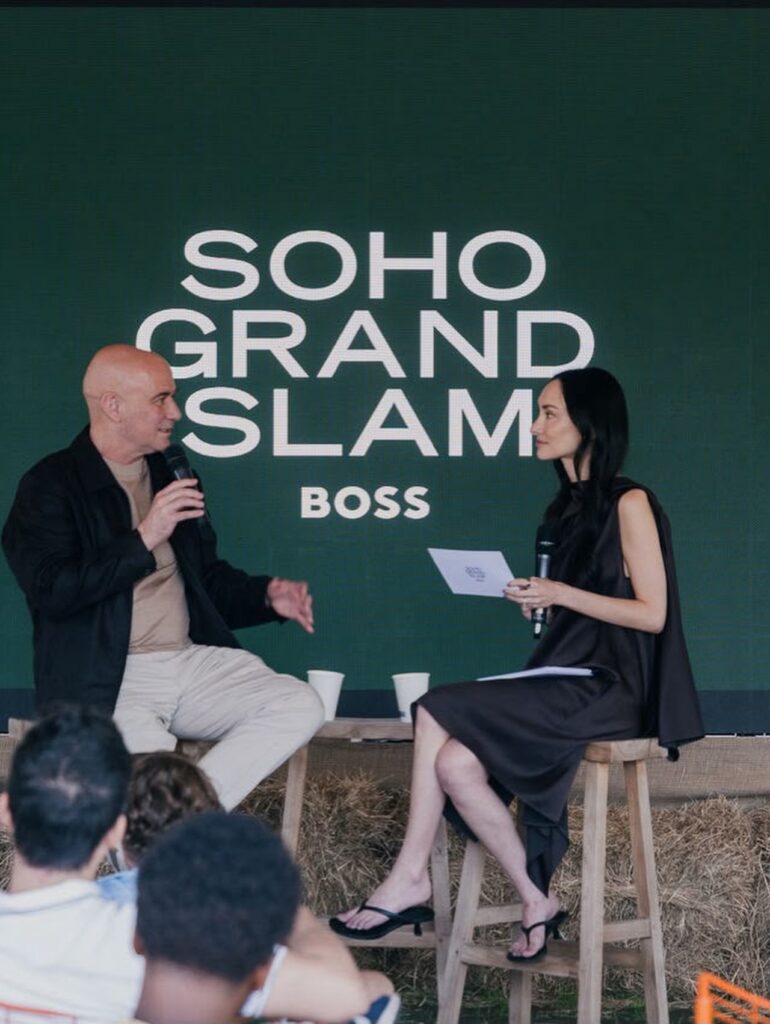
In the year that Hard Court has existed, Schiffer has interviewed Andre Agassi during Wimbledon in a Soho House event sponsored by Hugo Boss; been linked to by The New York Times; and become a go-to breaking tennis news outlet referenced by a multitude of publications. “It was really just supposed to be like a fun passion project,” Schiffer says, “and it’s obviously turned into so much more than that.”
This year, Schiffer is attending the U.S. Open as media for the first time. In advance of the tournament and its associated Fan Week, Schiffer spoke to V about the relationship between tennis and fashion, about kits and couture, her tips for what not to do at the U.S. Open, and more.

V: As I was preparing for our call, I was both surprised and delighted that very few other people have this beat.
JESSICA SCHIFFER: I know it’s crazy, right? You would think it’s not that novel of an idea, and yet few people have talked about it so explicitly.
V: Why do you think that is?
JS: I think tennis, as an industry, is a little bit slower to get with the times compared to other sports, so it’s embraced the fashion industry, creators, and influencers a lot later. Obviously we’ve had Anna Wintour loving tennis for decades, and there have been people in fashion who have loved it, but I don’t think anyone’s isolated it into being the only topic. Vogue covers a million different things. So yes, it covers tennis and fashion, but it’s covering that within the larger scope of Vogue. Tennis and fashion is the only thing I’m talking about. It’s becoming a hotter topic for sure, which is great for me because there’s been more interest in having me talk about it.
V: What do you think makes tennis’s relationship to some of these things outdated?
JS: It’s such a traditional sport. The people running tennis are set in their ways and have been involved in the sport for decades, which I think has not allowed for as much change and transformation as we see in other sports. It’s a male-dominated field, in terms of the executives running the different tours and tournaments. That comes with its own biases. Tennis is also a fragmented sport. There are so many rights holders involved in deciding what tennis looks like, which can make it difficult to have a unified vision of the sport–so many people with power have to meet in the middle and sign off on recommendations for change.
V: I was curious about this idea of fashion starting to take notice of tennis. In your piece for the Financial Times, you talked about Naomi Osaka signing with Louis Vuitton and how tennis players being sought out by luxury brands is a relatively new phenomenon. What do you think has made luxury brands and fashion in general start taking notice of tennis?
JS: I think brands have started taking notice of sports more in general. Honestly, I would have thought tennis would be one of the first sports they would look to because it lends itself so well to fashion, I feel. Compared to basketball or football, tennis seems an individual sport where you have one person or two people walking onto court in an outfit. It feels much more like a runway show, and it also feels like a lot of the tennis aesthetic codes are tied up in fashion trends at the moment. But it’s been one of the last sports they’ve conquered. You have these stars like Naomi Osaka or Coco Gauff who fit so well with certain fashion brands today. But yes, fashion has been in the DNA of tennis for a while. I don’t think fashion realized until the last decade that sports was a fruitful playing ground.
V: The tennis walk-on is taking up space in a similar way to the tunnel fit.
JS: Yeah, definitely. That’s been such a great shift we’ve only seen in the last year or two. I’ve been wanting tennis to do it for so long. Naomi Osaka has led the charge and taken it to a whole new level. She’s walking on court in couture gowns, and then undressing, having her custom Nike kit underneath. In a sign of what tennis is, some people have reacted super negatively to that, which is so funny to me. I’m like, how can you be that upset over a dress? In tennis, people apparently can. But it’s been great for the rest of the sport. Even though players beyond Osaka aren’t doing it necessarily to the degree she is, they’re still taking notes from her and starting to walk on court in tailored suits or custom jackets, doing a light version of what she’s been doing. It’s drawn a lot more eyeballs to the sport and made people pay more attention.
V: How is the world of tennis apparel different from other aspects of fashion you’ve covered?
JS: It’s such a different landscape because tennis apparel has been pretty one note for a long time. We’re in this transition period where it’s becoming a lot more exciting, and we have all of these new brands entering the space. It feels like tennis is finding its fashion identity for the first time on a global stage. When I was talking about the fashion industry and not looking at it through the lens of tennis, it was like no one understood how fashion worked, how brands were run, and what was trendy. In tennis, it feels like an infant discovering these things for the first time. As I’m writing about fashion and tennis, I’m looking at it with those fresh eyes. What’s happening is so new in this particular category, and it wasn’t as new or novel when I was writing about it purely from a fashion standpoint.
We’re talking about clothing people can perform in on the court, playing a high intensity sport. That eliminates so many categories of fashion that we’re not going to be talking about like fur jackets or gowns. Obviously in the case of Naomi walking on court, we might be, but it’s generally pretty limited to t-shirts, tank tops, short skirts, and certain silhouettes. In some ways, that makes it more exciting to see how designers at these different athletic wear companies innovate within those boundaries, coming up with creative silhouettes people can still move in.
V: What are you most looking forward to at the U.S. Open? When you attend a tournament, what are you looking for besides the game itself?
JS: I think it’s going to be one of the busiest and most crowded U.S. Opens ever. There’s so many brands wanting to be involved. There’s the U.S. Open, but then there’s also Fan Week before the U.S. Open, where fans can go on the grounds of the tournament for free. Surrounding that are tons of events hosted by fashion, food, and beauty brands. There’s lots of influencer events or player-hosted parties. It honestly feels akin to Fashion Week, where there’s so much happening in a short period of time that’s all related to tennis. I’m curious to see what the actual tournament is like, because what we’ve been dealing with in tennis over the last few years is that as it’s grown in popularity, the tournaments have been compared to Coachella, and not always in a complimentary way.
V: To see and be seen.
JS: Yeah. On the one hand, it’s great for tennis that even more people are showing up and paying attention. On the other, it does impact the overall vibe of these events, and longtime tennis fans can get annoyed by it being so crowded or by people taking photos of themselves during matches. Tennis is a sport that, for a long time, was known for being super quiet. No one spoke or moved during the matches. That does not stand anymore. People are not following those rules, so you’re seeing the face-off between the traditionalists in tennis and these newer voices coming into the sport. I’ll be looking at all of those little sideshows to see the temperature of the tournament.
V: What will your coverage of the U.S. Open include?
JS: I’m attending for the first time as media, which is exciting. That means I’ll get to be in the press conferences interviewing players and have much closer access to them. Over the past year I’ve been building up those relationships and starting to cover the tournaments up close and personal. But I’m always looking at it through a fashion and a business lens, not purely on the basis of how someone is playing. This is an interesting time of year because a lot of players’ sponsorships are coming up for renewal, so they’ll either stay with their current apparel sponsor or they’ll sign with someone else. I’m always interested in tracking those stories and figuring out where some of the top players are going to end up. I’m doing a few photo shoots with players for the first time, which will be exciting, and also following what brands are doing around the tennis tournaments. It’s always interesting to see how they’re showing up in these spaces.

V: How does the U.S. Open and its style differ from other tournaments?
JS: New York is so much more diverse, in every sense of the word, from a lot of the other tournaments. You have people showing up to the tournament from all walks of life and also with different senses of style. That’s always one of the most fun aspects of it. At Wimbledon, you can nail down how people are going to dress in a few words. Whereas with the U.S. Open, I can never sum up to people, “Oh, this is what you should wear,” because you can honestly wear whatever the fuck you want, and it’s fine. No one’s going to look at you sideways, and I think that’s the beauty of New York and the U.S. Open.
You will see the largest number of players taking the greatest fashion risks at the U.S. Open. Unlike Wimbledon, we don’t have a dress code they need to follow. There are some rules for their kits, but for walk-on outfits, they can wear any color they want. They don’t have to wear all white. They can pretty much do whatever they desire. It’s going to be exciting to see what Naomi Osaka does. I’m curious to see what Coco Gauff does. She has a longstanding partnership now with Miu Miu and New Balance, so seeing what they come up with will be fun. A lot of the men are getting involved in this fashion side of things, which is cool. We saw a lot of suiting and tailoring on the court [at Wimbledon], so I think we’re going to see a lot more of that.
V: Do you have advice for first-time visitors to the U.S. Open?
There’s so many, but I would say do not take an Uber. You will regret it. You will hate your life. The traffic is unbearable, so definitely take the subway, even though it seems like a long journey. Wear comfortable shoes. I know that’s such typical advice, but it’s advice I don’t always take and often regret. And make sure you bring layers because the weather can shift on a dime. Make sure you have your hat and wear something that’s hot weather appropriate for the day, but bring a jacket or even a pair of pants to change into for the night sessions. It can feel like two totally different climates in one day. The food is extremely overpriced and, in a lot of ways, overrated. I would eat a meal before you go.
Discover More