Works on Paper: Behind the Seams with the Designers of ‘Crafting Joy’
Chatting with the designers of V162’s custom “Crafting Joy” garments about how they came to be
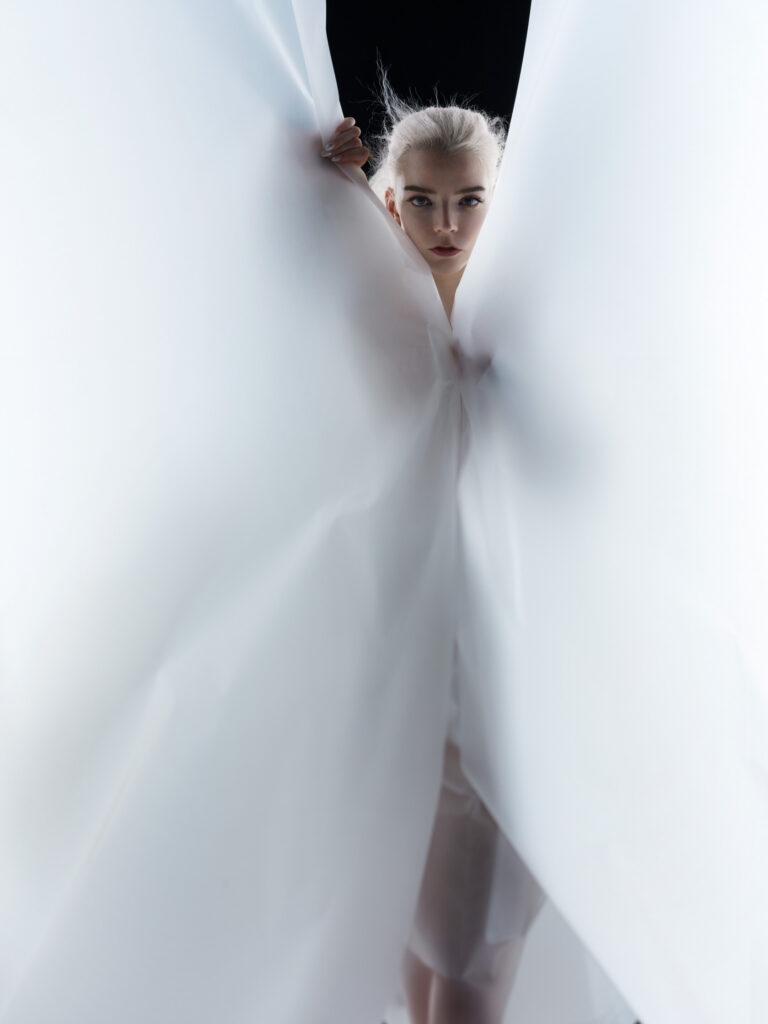
What does it take to make a custom garment come together, especially if it’s made of paper? For our September issue, V approached nine designers to construct original garments–Zac Posen, EVP and Creative Director of Gap Inc.; Thevxlley; Mugler Creative Director Miguel Castro Freitas; Matthew David Andrews; Gaurav Gupta; AGRO Studios; Macy Grimshaw; Jenny Beattie; and Noel Stewart–for Anya Taylor-Joy to wear and they joyfully accepted the challenge. Photographed by Nick Knight, these paper garments exist nowhere else in the world. In celebration of our cover with Anya Taylor-Joy and the power of design, the garments will be on display at the iconic Librarie 7L in Paris on October 2nd, at the height of Paris Fashion Week, for a special viewing in partnership with Montblanc.
Here, V talked to the aforementioned designers about exactly how they made these extraordinary works, from their beginnings as tracing paper to their evolution into flowers, frills, hats, and more.
GapStudio: Zac Posen, Executive Vice President and Creative Director of Gap Inc.
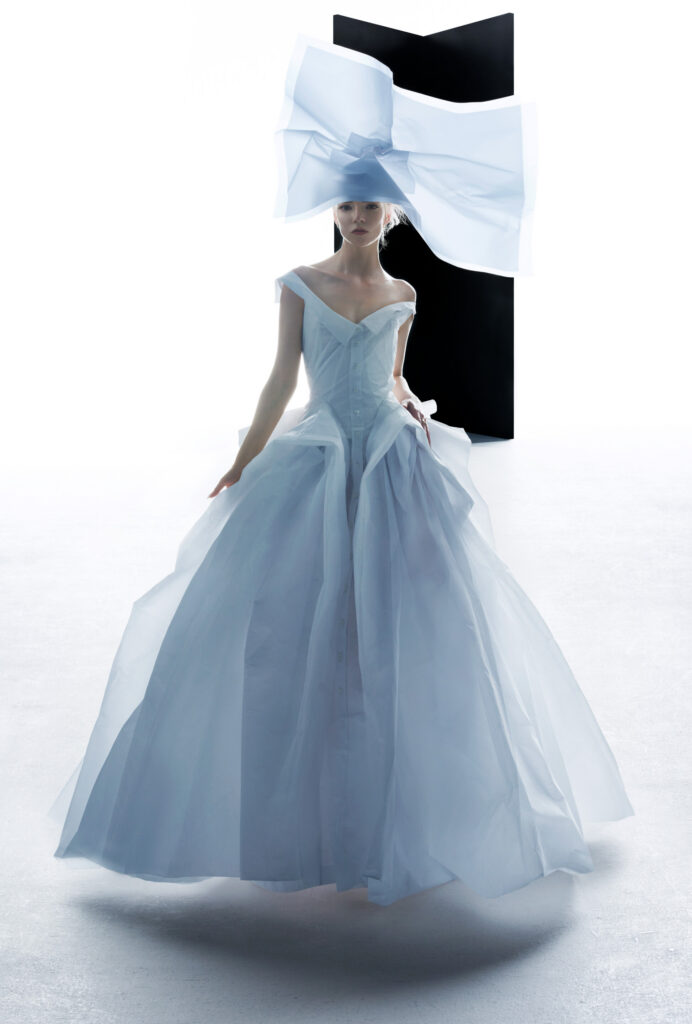
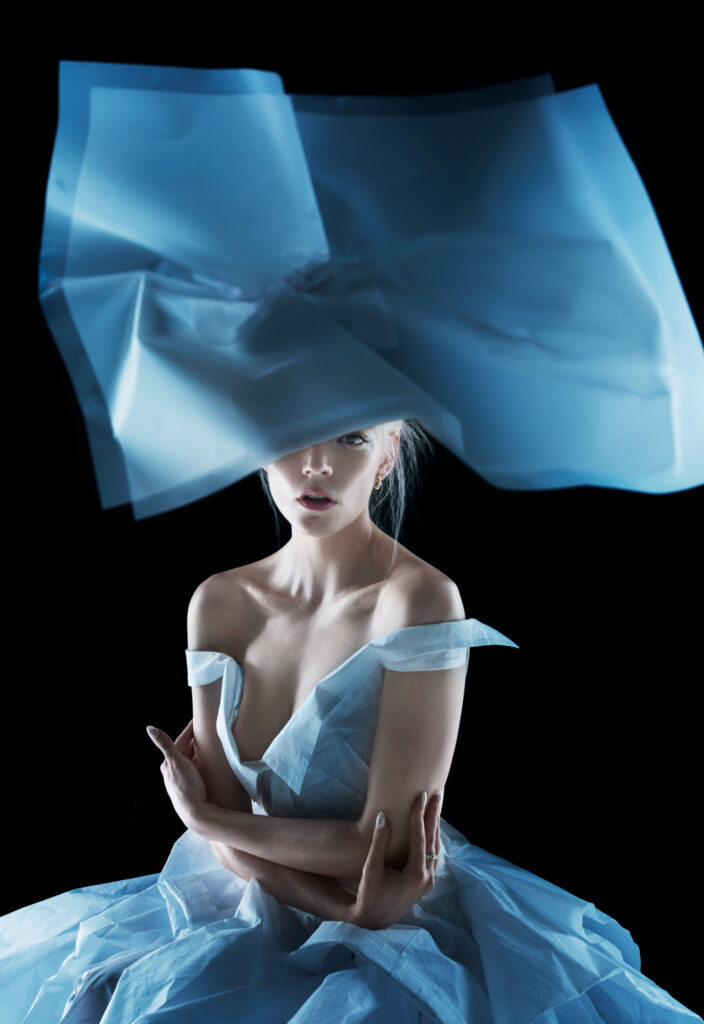
Since he began at Gap in 2024, Zac Posen has brought his signature New York glamour to the brand and formed the in-house design atelier GapStudio. Making a splash attiring Anne Hathaway in an elegant cotton shirtdress-style gown in 2025, GapStudio’s projects have only increased, from the Met Gala (Da’vine Joy Randolph, Kendall Jenner), to the Oscars (Barbie Ferreira), to the Golden Globes (Claire Danes) to the BET Awards (Chase Infiniti), and so many more. For our September issue, Posen’s modern style takes the form of this initial shirtdress, this time worn by Anya Taylor-Joy with a new paper twist.
V: Why was working on a project like this interesting to you?
Zac Posen: Anya Taylor-Joy is an incredible artist and a true lover of fashion. She’s a friend, but I’d never had the opportunity to create something for her before. Combine that with the magic of Nick Knight’s art and the opportunity to make a dress out of paper was inspiring.
V: Can you tell us about the process of making it? How did it all come together?
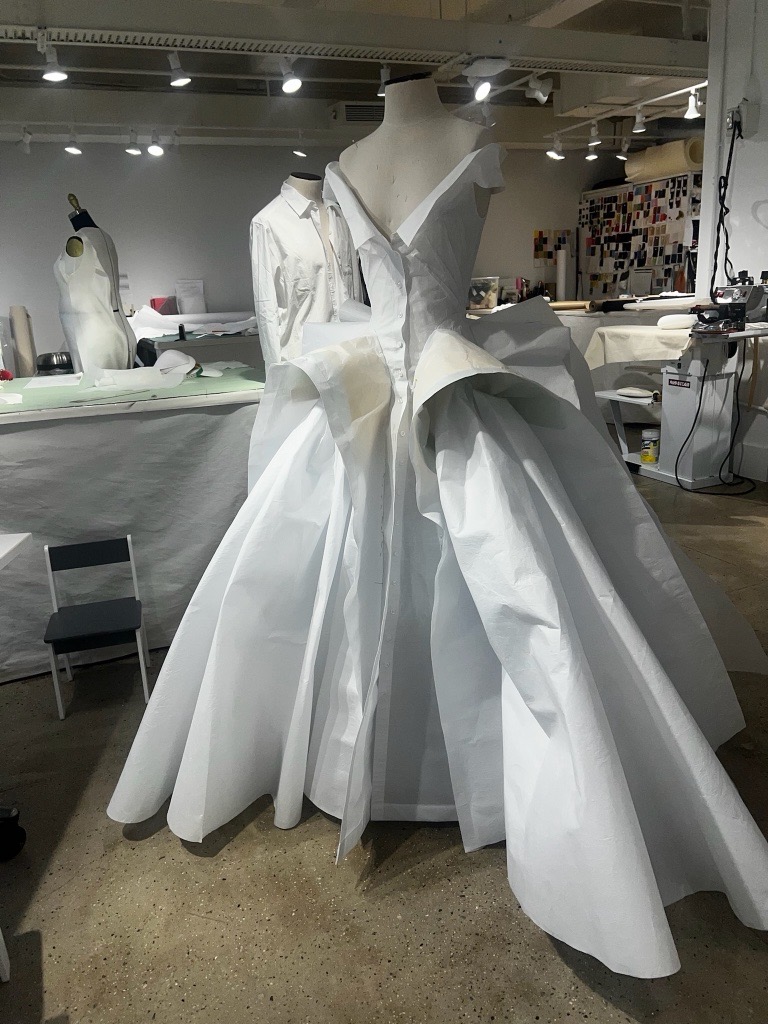
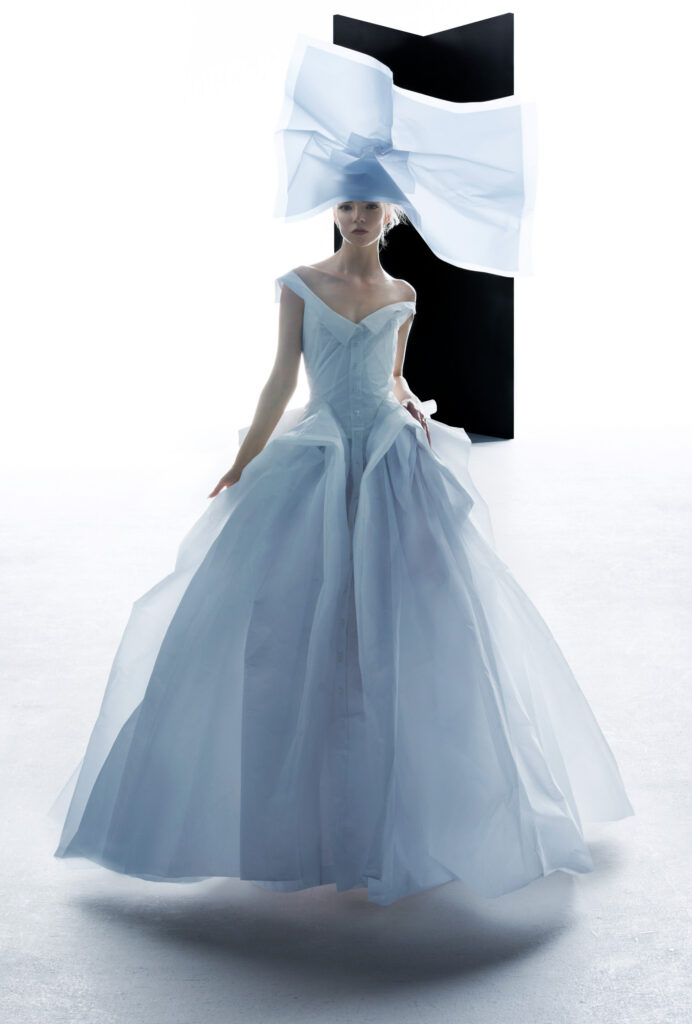
ZP: The process started with an exploration into Gap’s iconic white big shirt and the development of a cotton white ball gown. The timing of this project aligned while that piece was still in development. It felt like the perfect opportunity to take that idea further, reimagining it into paper.
V: What was your experience of working with paper to make the dress? How did the material surprise or challenge you?
ZP: I love working with different mediums and pushing materials into unexpected shapes. Paper has an entirely different architectural and structural quality than traditional poplin, which created this sense of modern romanticism, strong shapes balanced by the fragility of a single sheet of paper.
V: Was there anything new you learned about design in the process of working with paper that you hadn’t previously considered?
ZP: I learn something every day, that’s the secret to growth. This was an exciting project because working with a new material always challenges you to think differently.
Matthew David Andrews
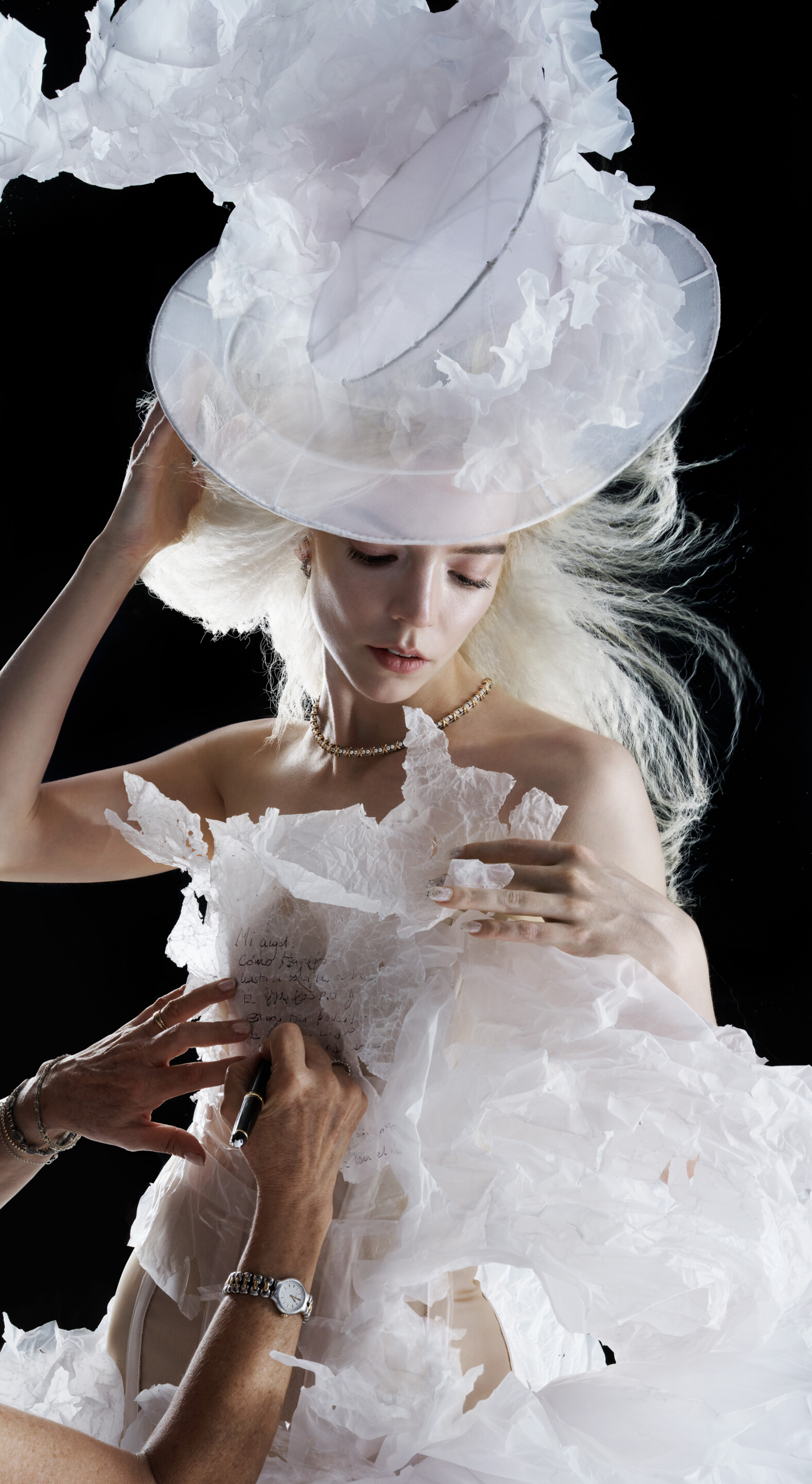
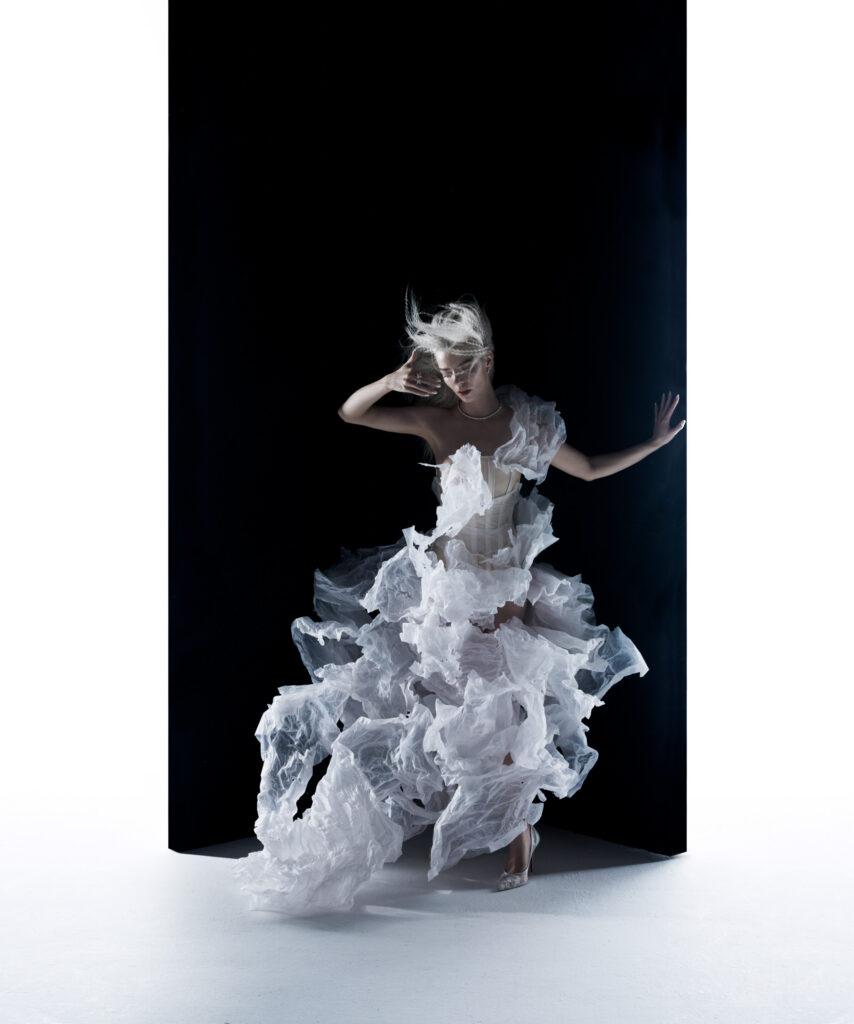
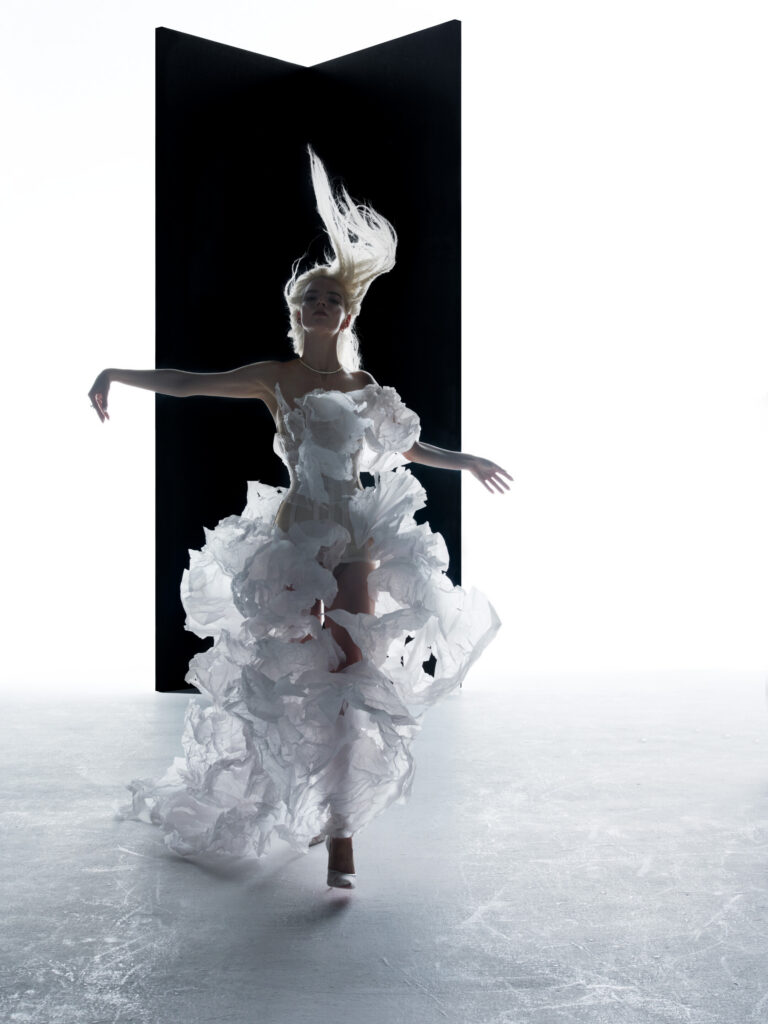
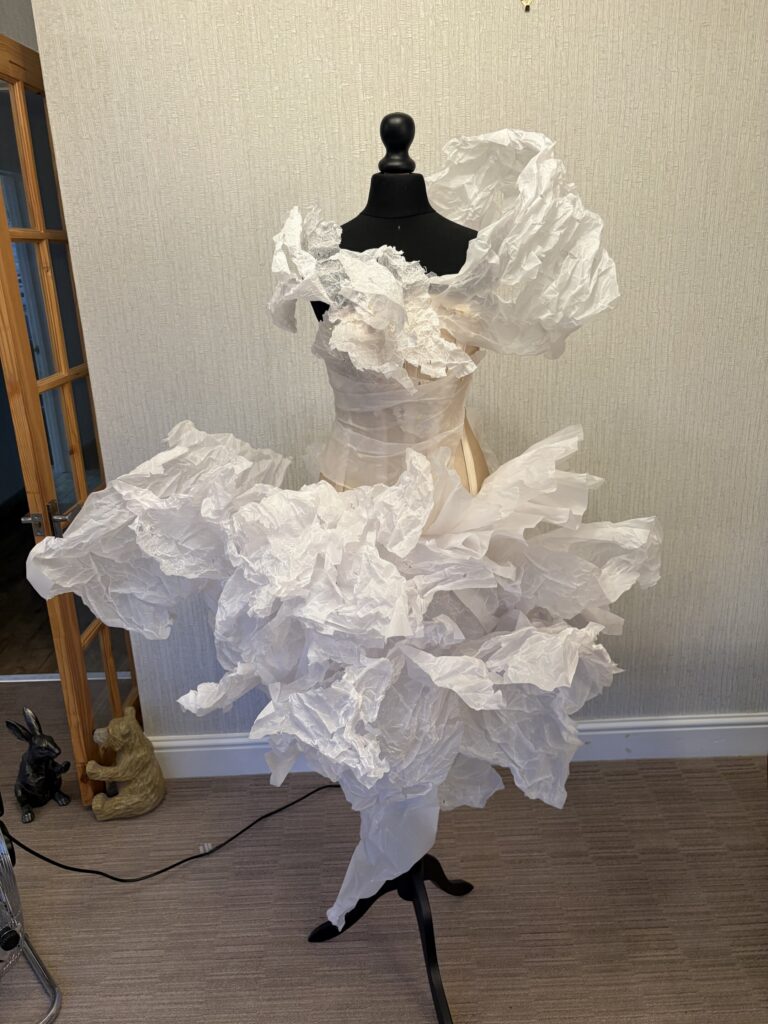
Since graduating from Central Saint Martins in 2025, Matthew David Andrews’s avant-garde constructions have already drawn comparisons to great couturiers like Alexander McQueen and Martin Margiela. These comparisons have not gone overlooked by Lady Gaga, who wore one of Andrews’s designs–made by milliner Jenny Beattie, also interviewed here–to Netflix’s Wednesday Graveyard Gala celebrating the show’s second season in December 2025. Andrews also recently showed a collection at SXSW London at a show in partnership with Fashion District London. The young designer loves to experiment with structure and innovative fabrics, which made a perfect pairing for our September issue. For V162, Andrews has constructed a crinoline corset dress draped with tracing paper, amplifying and reimagining their visual signatures in a new format.
V: Why was working on a project like this interesting to you?
Matthew David Andrews: Anytime [V Senior Fashion Editor] Anna Trevelyan approaches me about a project I get super excited because of her incredible imagination and ambitious ideas. As soon as she rang me and mentioned using tracing paper to make a dress, all I could say was “YES YES YES!” I had absolutely no idea how I would achieve it initially…which was exactly the reason why I wanted to be part of it. It is rare to have such a fun, creative project come through, using unconventional materials that challenges your approach and construction of a garment. It is these projects that make this job so much FUN!
V: What was your inspiration for this dress?
MDA: It wasn’t a singular inspiration, it really came more from a feeling and atmosphere I wanted to create. I knew I wanted to create texture with the paper and let its sculptural nature guide the creation of the piece. I was briefed by Anna that they wanted the dresses to play with light, transparency and silhouette, so this all went into my decision making.
V: What was the process of making the dress, and how did it all come together?
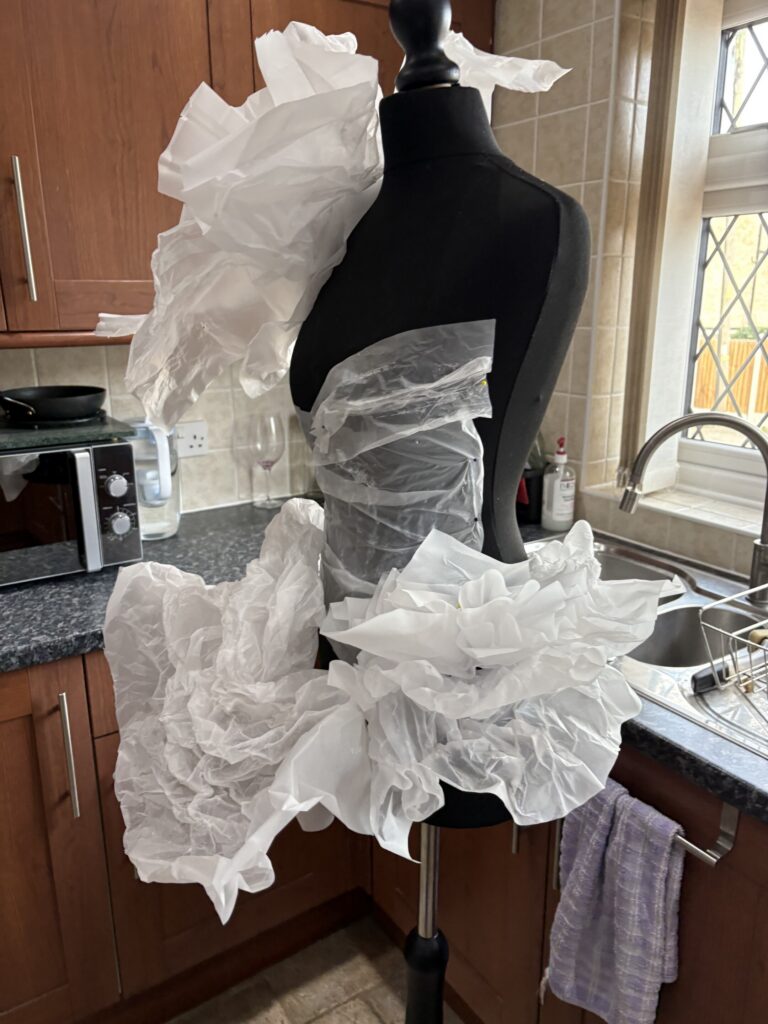
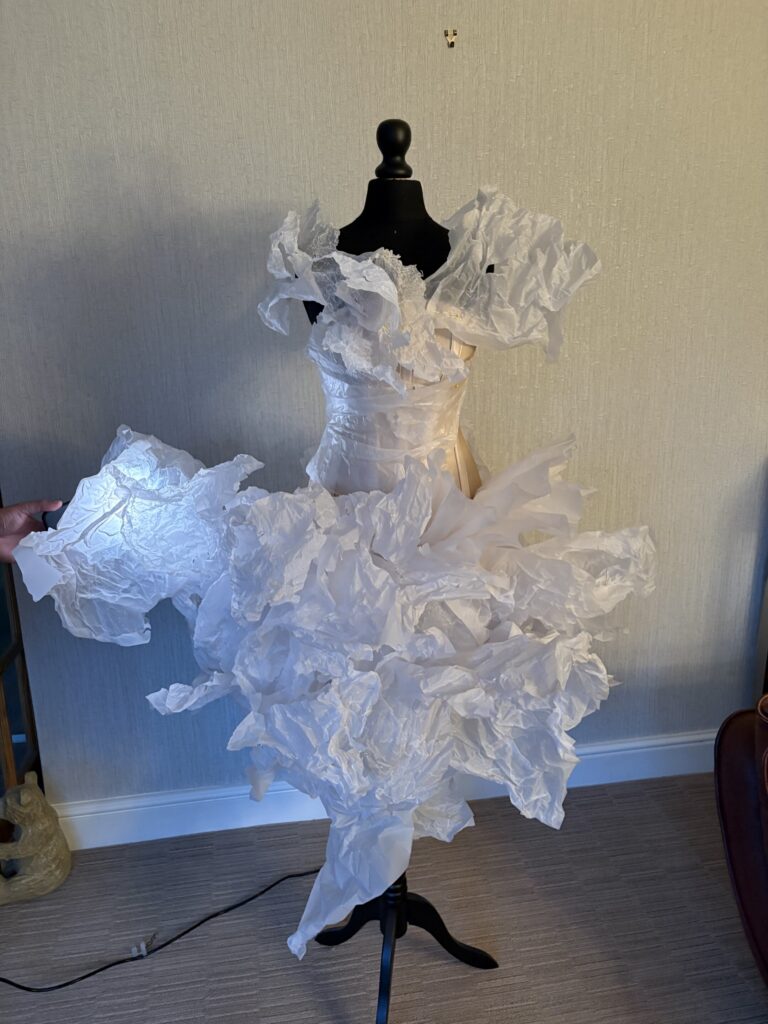
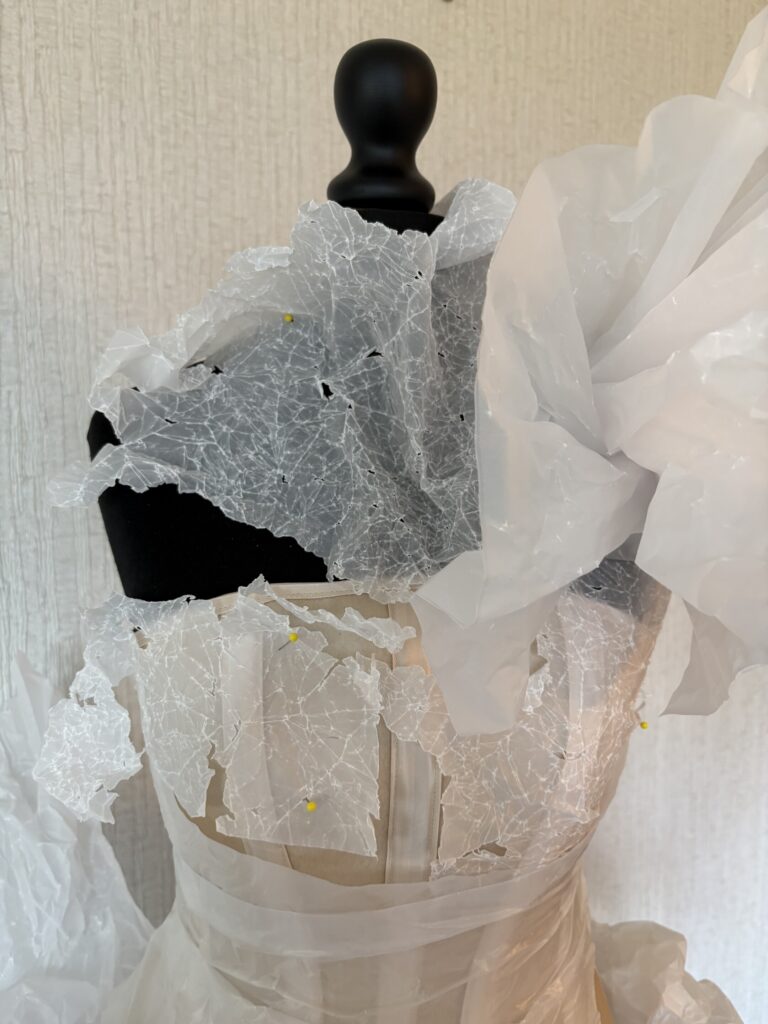
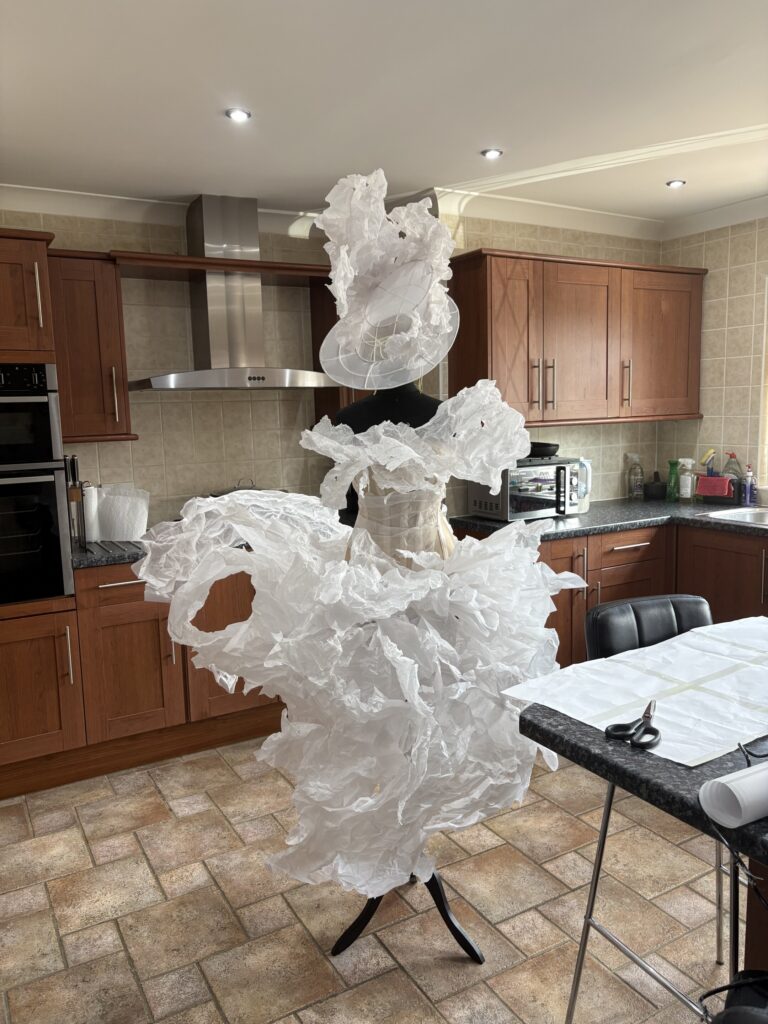
MDA: I knew I needed to start with a solid base to build the paper on. I started by constructing a corset that would match Anya’s skin tone, giving a nude illusion when worn. Once this was done, it was just a matter of creating a range of samples with different types of tracing paper. We tried pleating, scrunching, pasting and ripping it to see what textures proved most effective. Ultimately we landed on the scrunched technique, which was achieved through wetting the paper, scrunching it and leaving it to dry. We found the paper was most malleable when wet–we were then able to use it like fabric, moulding it around the corset so it felt closer to the body. Once dried, it beautifully kept its shape. This process of experimentation propelled the look creatively and ultimately led to its final shape, which felt effortlessly ethereal.
V: Was there anything new you found yourself thinking about design while working with paper that you hadn’t previously considered?
MDA: Usually we are designing for a runway or real life which is completely different to designing for an editorial–on a runway, we consider movement and practicality, if a model can walk, and that the garment can survive more than one wear. For editorial, we are looking at creating frozen images that need to evoke a story and sense of emotion. It really is more artistic and can be more unrealistic or fantastical. I absolutely took to this when making the dress: I kept photographing light shining behind the dress to know how the studio lights would react with the tracing paper. I also pushed the silhouette into a larger scale, thinking how it would command the studio space and frame the body to create the most compelling image possible.
Jenny Beattie
A frequent collaborator of Matthew David Andrews, rising milliner Jenny Beattie created a “wire and wire powder mesh-adorned hat with tracing paper embellishments” for Anya Taylor-Joy to wear in V162. The London-based designer’s work lives at the intersection of art and fashion, and she loves a nontraditional material–indeed, her own background is nontraditional, with a former life in classics, craft, and novels. Now, people like Ashnikko, Lady Gaga (see above, designed by Matthew David Andrews), and Mason Alexander Park have worn Beattie’s creations, which are just as fantastical and whimsical as they are splendid.
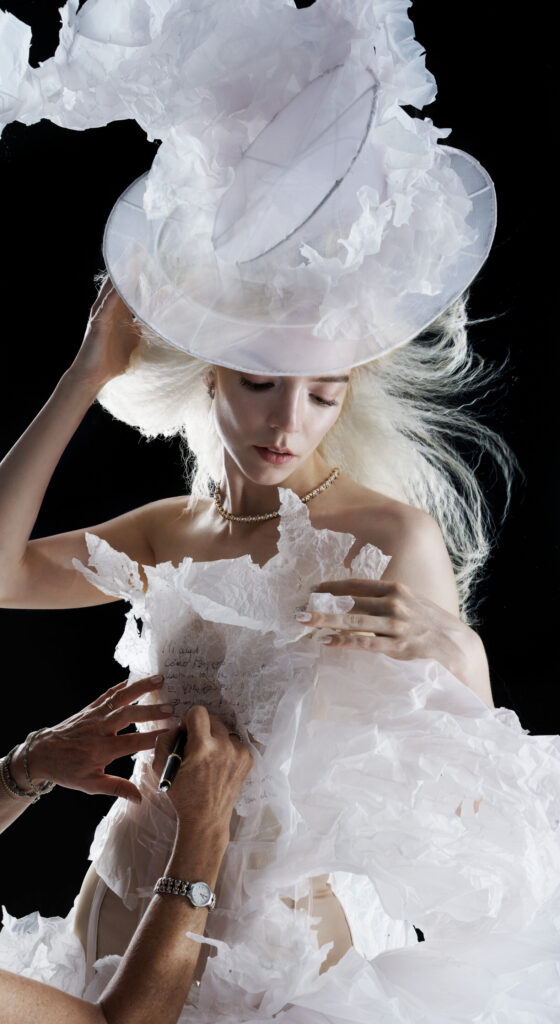
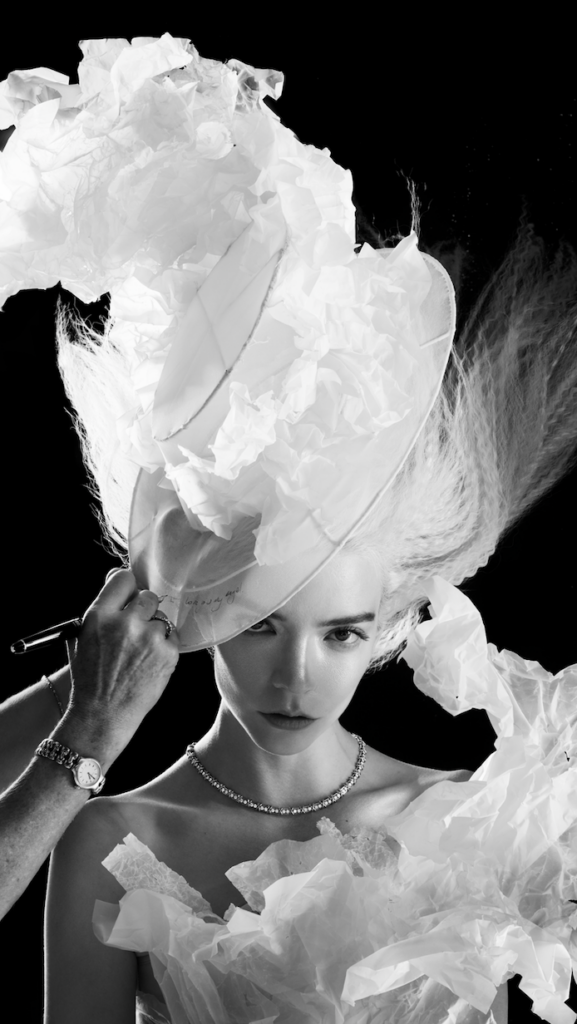
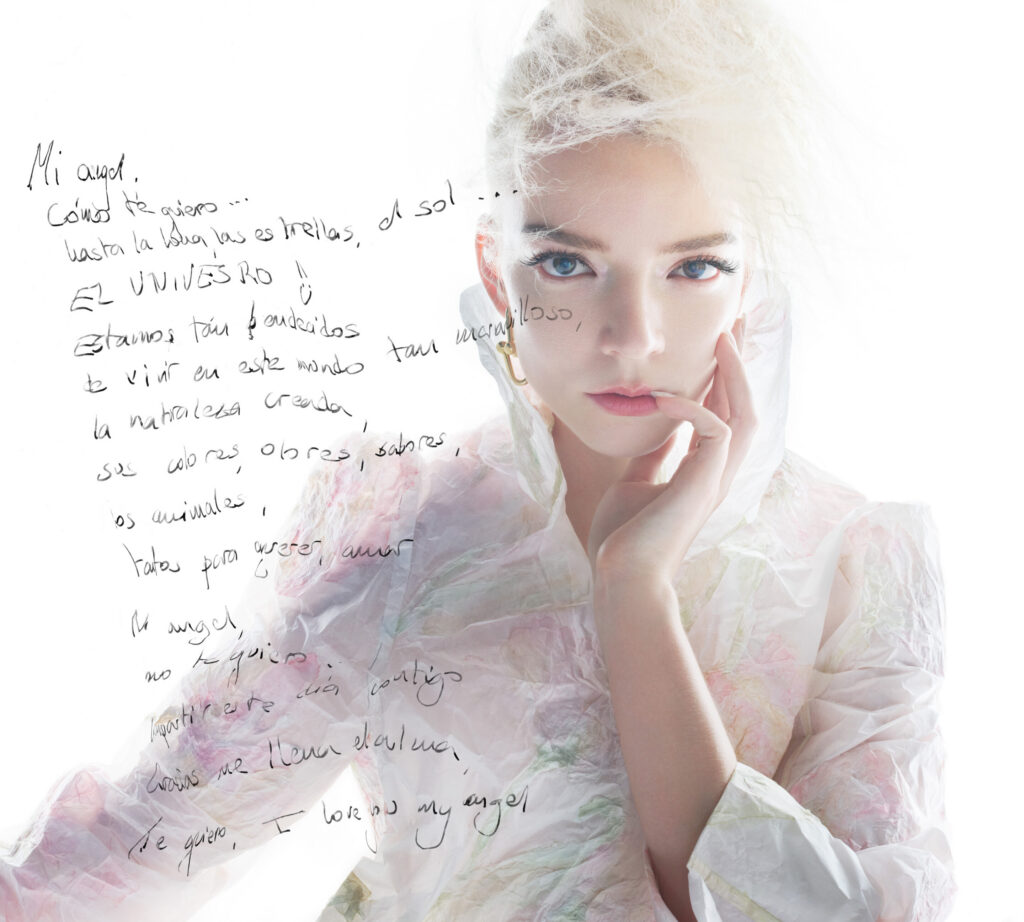
Jennifer Marina Joy-Morancho uses Meisterstück Gold-Coated LeGrand Fountain Pen MONTBLANC
V: Why was working on a project like this interesting to you?
Jenny Beattie: It was really exciting to work with this team even when I’m not actually in the room. It never fails to amaze me what can be accomplished: from being alone in my studio with a single headpiece to seeing what’s achieved by everyone at the end; it’s so very exciting. Millinery is all about the challenge for me and my work is very materials-driven, so I was particularly excited by the brief to work with paper.
V: What was your inspiration for this hat?
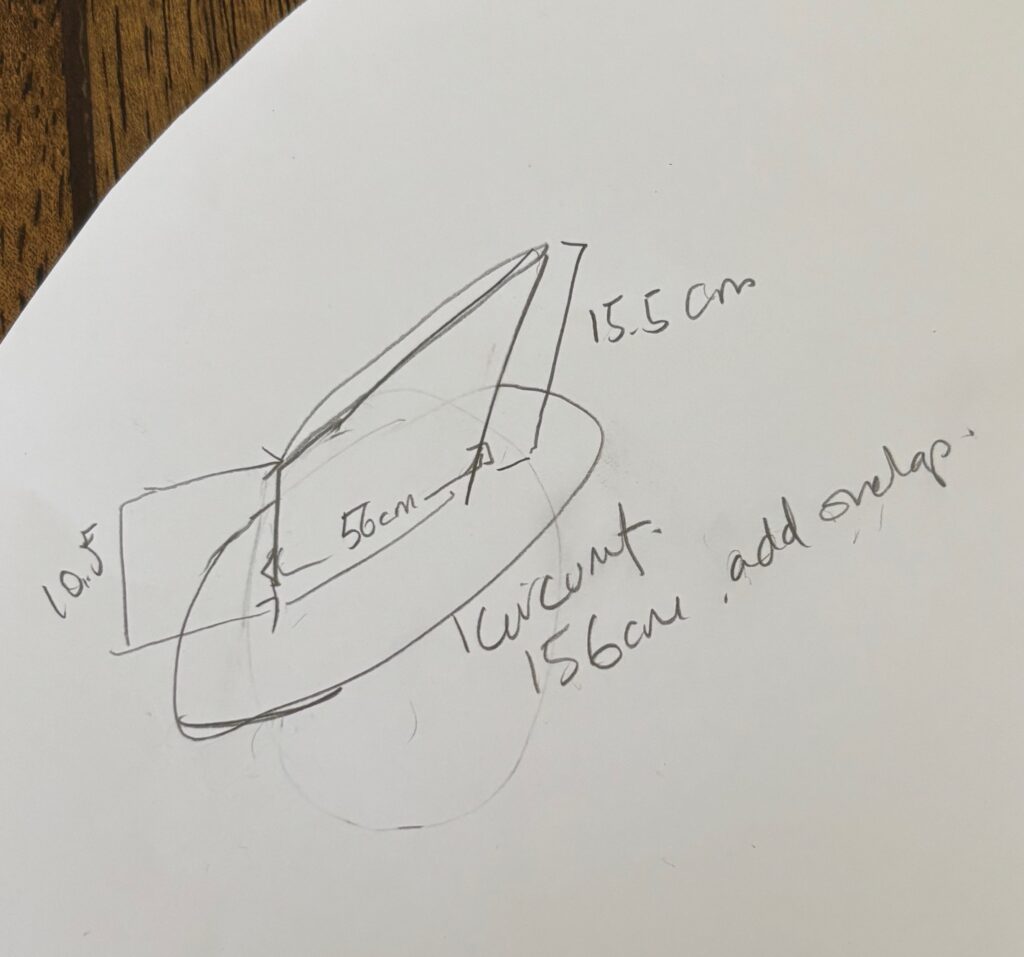
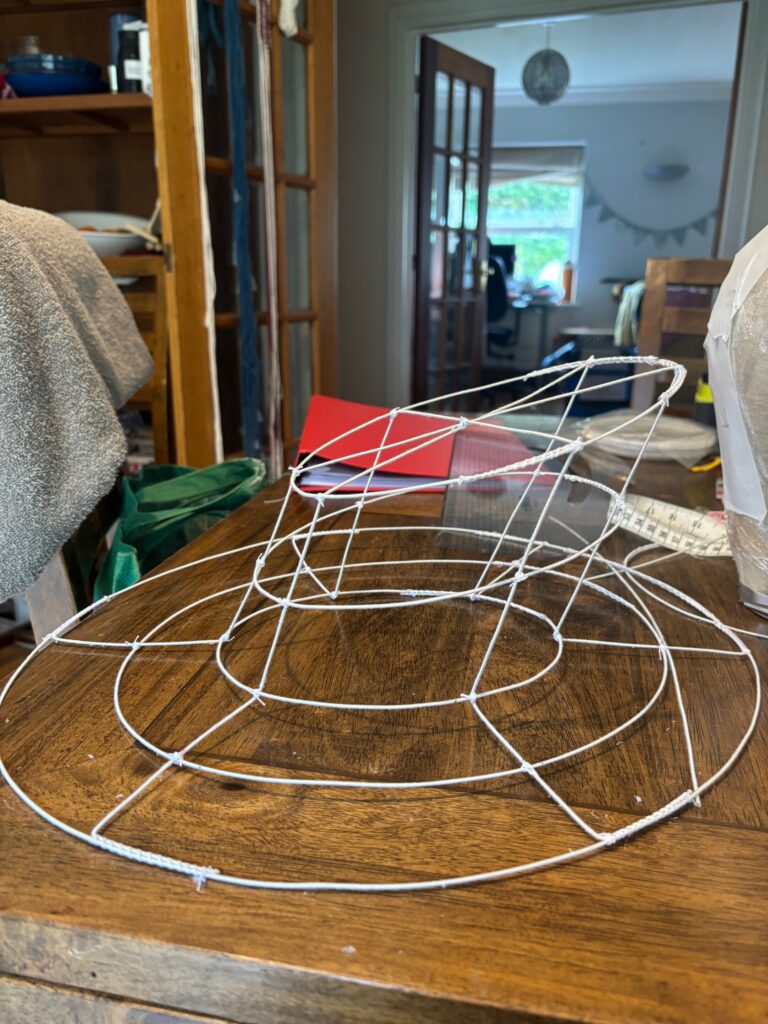
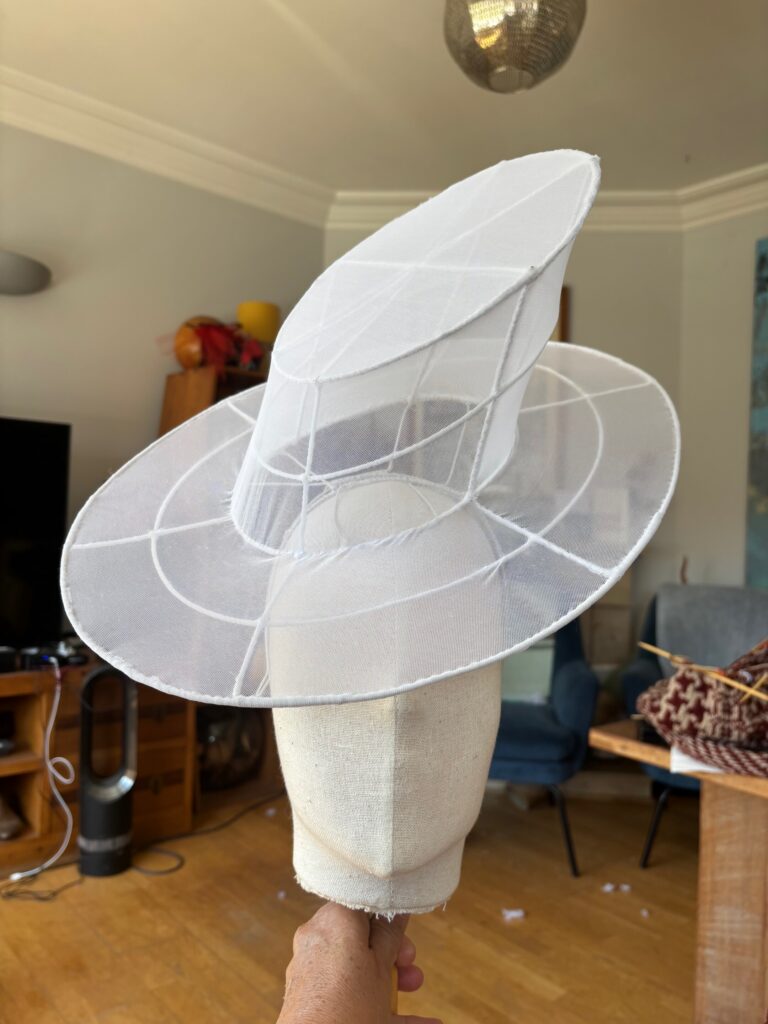
JB: The design came from Matthew David Andrews, via a drawing which helped me work out what was required. Matthew referred to the shape of this crown as a ‘lipstick’ which immediately resonated with me. Many of the headpieces and props I’ve made for Matthew have shown the structure and technicalities of the making because he loves it and we both feel it’s worth celebrating. And because the paper is diaphanous, we wanted a similar effect on the fabric of this hat.
V: Can you tell us about the process of making it? How did it all come together?
JB: I rarely draw a structure on paper first because my brain doesn’t understand a 2D image. I can see the 3D design in my head so I refer to that and ‘draw’ with millinery wire. I need to keep referring to the head of course: putting the hat on, checking angles. Matthew’s hats are distinctive by their positioning: usually up in the air above the head. From a technical point of view, I have to think about how to get the hat to stay on the person but also to appear to float. I’ve done this quite a few times now so it was much less stressful for this piece.
V: What was your experience of working with paper to make the hat? How did the material surprise or challenge you?
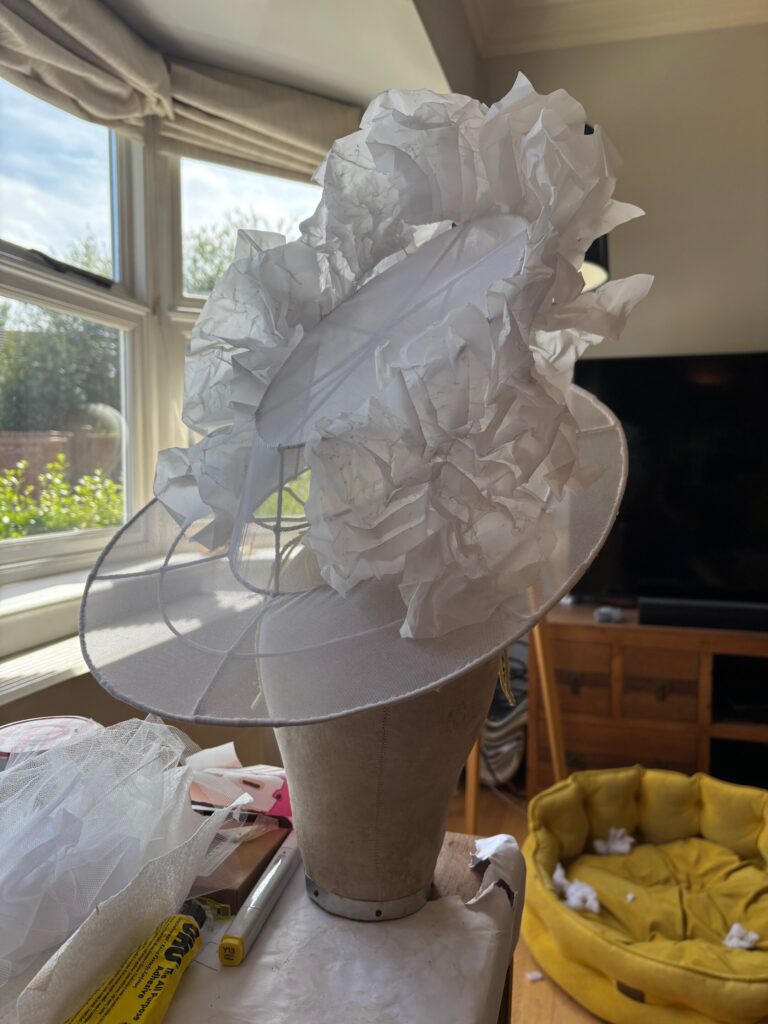
JB: I’ve worked with tea bag paper before but I developed a way to coat it for reinforcement so I could stitch into it. I’ve never worked with such fragile paper and that did worry me a little. Matthew worked out how he wanted the paper to look on the dress and then I began pleating, wetting and scrunching! Once dry, I stitched the paper on with tiny stitches to anchor it in place.
V: Was there anything new you found yourself thinking about design while working with paper that you hadn’t previously considered?
JB: This process makes it a fragile piece and the trim won’t have longevity, but on the plus side the paper decoration can easily and cheaply be made again. I’d not thought before about how the structure of the hat contributes to the paper’s overall stability. A garment moves with the body and stretches which means the paper is much more vulnerable on an outfit than on a hat.
AGRO Studio
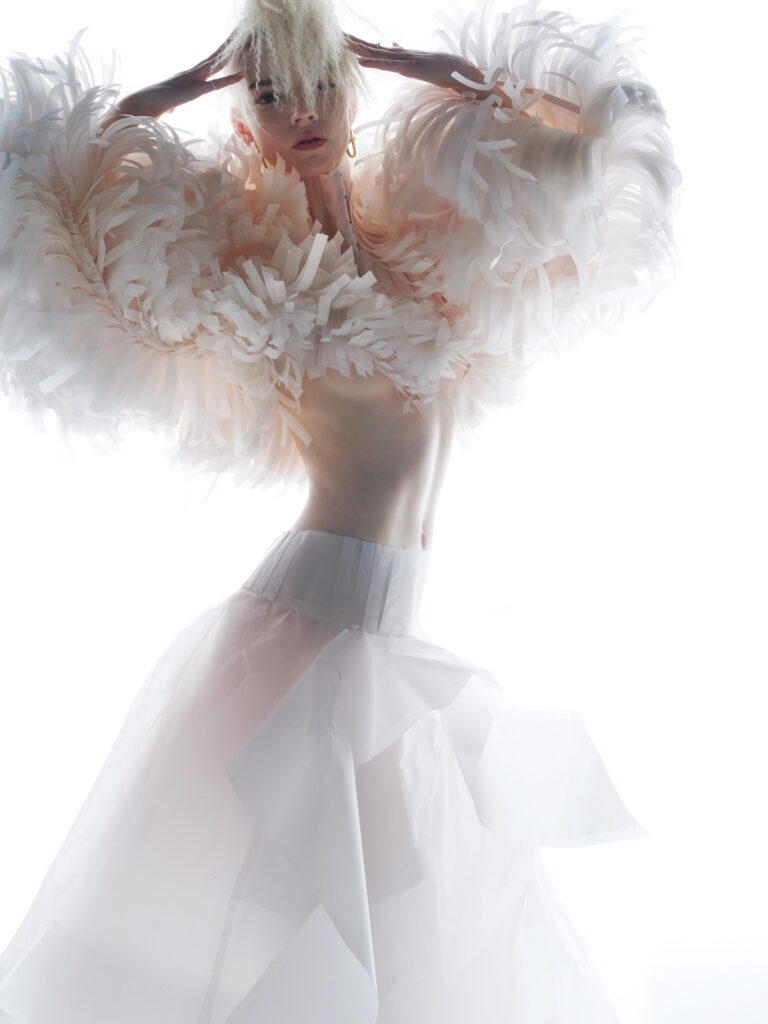
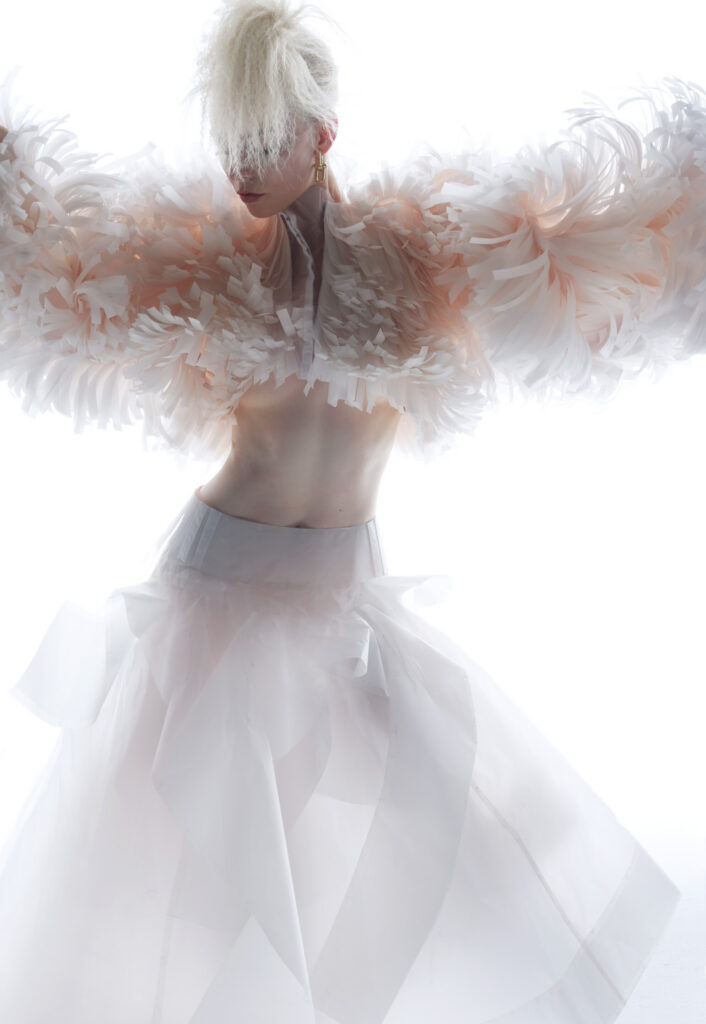
When George Oxby and Angus Cockram founded the design house AGRO Studio in 2021, it centered bespoke creations. Their work has since expanded onto runways and into costume design. At once punk and glam, historical and modern, they count among their wearers Charli XCX, Zara Larsson, Naomi Campbell, Raye, and many others. In particular they’re known for their deft and creative use of delicate materials, whether rhinestone or faux fur, tinsel or lace. In our September issue, AGRO Studio formed a jacket made of crinoline and tracing paper and a skirt to match. It was an exciting prospect, they said, especially as they embark on an exploration of transparency in their next collection.
V: Why was working on a project like this interesting to you?
AGRO Studio: We’re always excited by opportunities to explore unfamiliar textiles and surfaces because that experimentation inevitably feeds back into our wider practice at Agro Studio. This project felt particularly timely because our upcoming SS27 collection for London Fashion Week, Glass Body, explores different forms of transparency, both conceptually and through materiality.
V: What was your inspiration for this dress?
AS: The inspiration came partly from our ongoing exploration of transparency, but also from the material itself. Rather than forcing the paper to behave exactly like fabric, we wanted to respond to its inherent qualities: its translucency, its crispness, the way it curls and crumples. The final look emerged from allowing those characteristics to guide the design.
V: Can you tell us about the process of making it? How did it all come together?
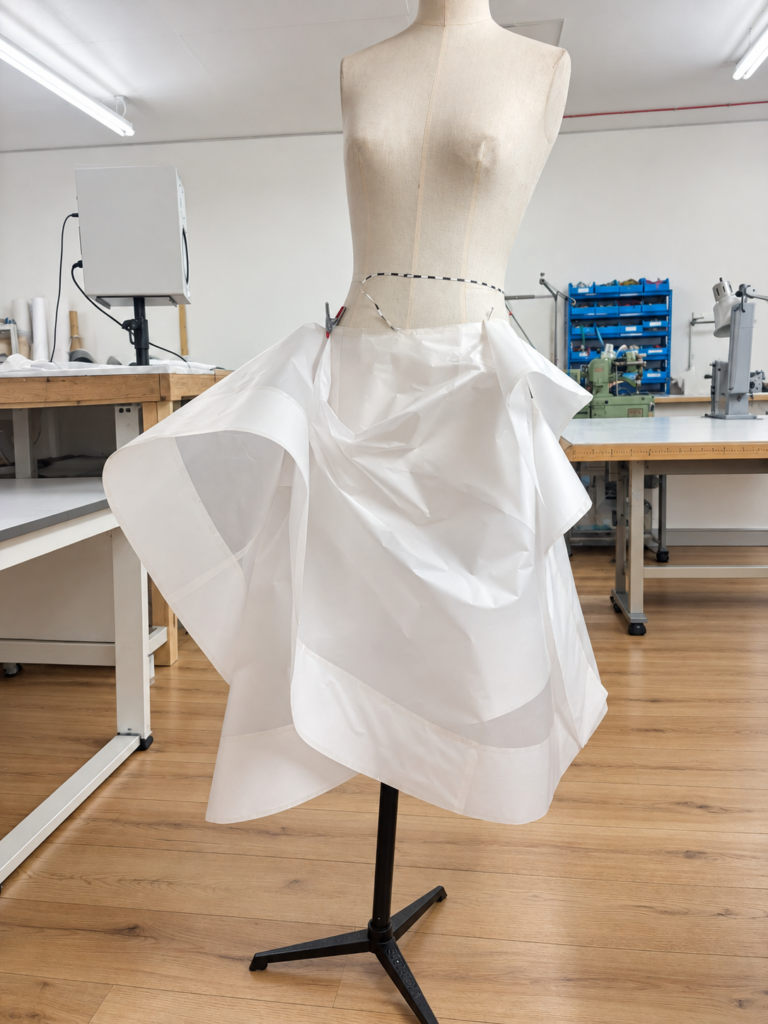
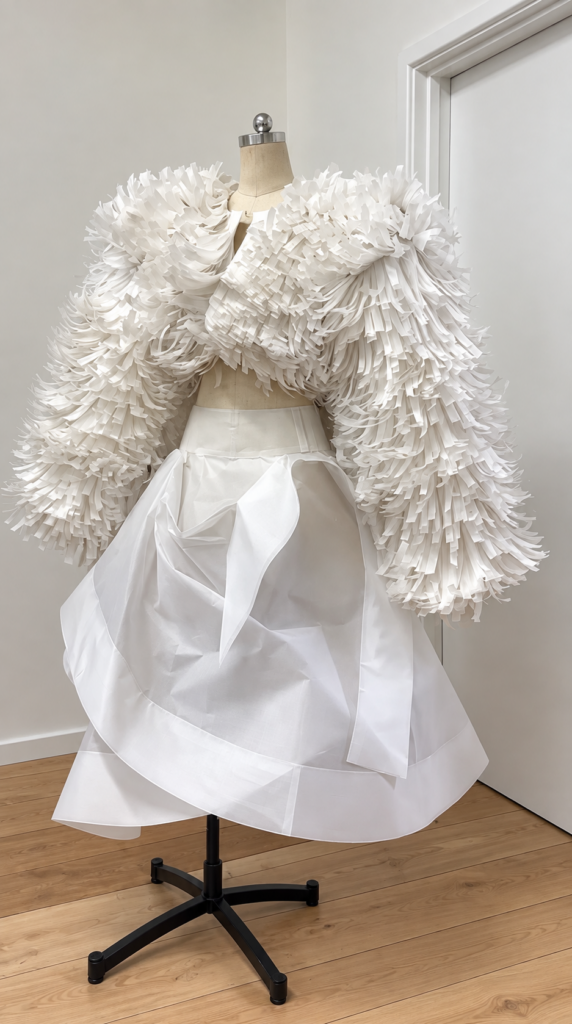
AS: The two pieces were developed in very different ways. The skirt was approached almost exactly as we would construct a fabric garment. It was built flat and included traditional details such as facings, pocket jets, and belt loops made from paper, with paper and glue forming the core of the construction. As we worked, it began to crumple in ways we hadn’t anticipated, but those creases ultimately gave it a wonderful sense of movement.
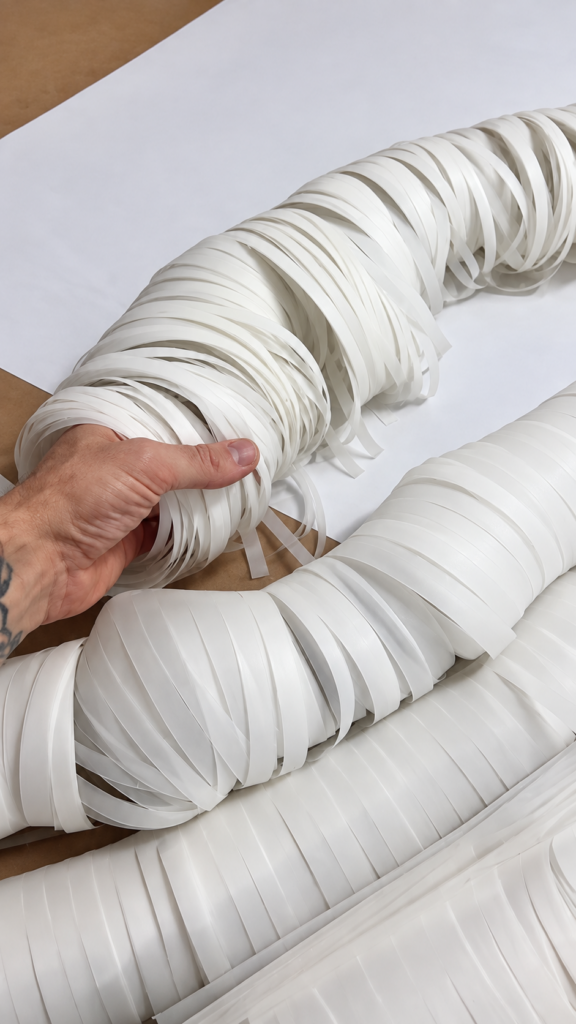
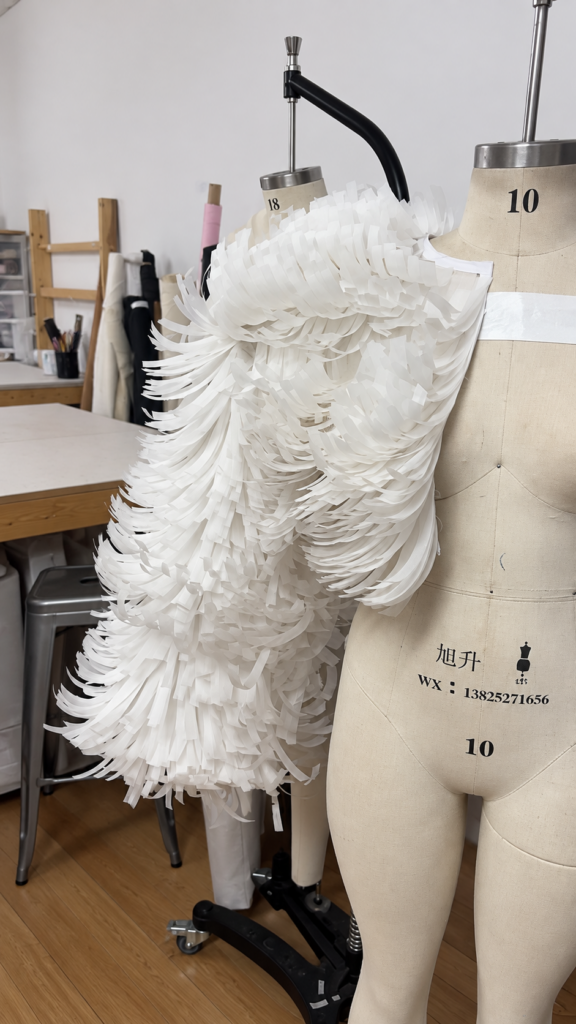
With the jacket, we wanted to explore bounce and volume. Because the tracing paper had been stored on a roll, it retained this natural, almost ostrich feather-like curl. Repeating and layering those curled pieces created an unexpected depth and texture across the garment.
V: Was there anything new you found yourself thinking about design while working with paper that you hadn’t previously considered?
AS: Working with paper taught us that the material is really in charge. You have to listen to it and work with its behaviour rather than against it. Its limitations became its possibilities. The qualities that initially appeared challenging, like the memory of the roll, the creasing, and the rigidity, became some of the strongest elements of the finished look. The biggest revelation was thinking beyond how a garment looks and feels to consider how it sounds. The jacket makes an incredible noise when it moves, and that sonic quality feels inseparable from the material itself. It made us want to find ways of bringing garments onto the runway that retain the sound of paper capturing its phonic qualities alongside its visual and tactile ones.
Macy Grimshaw
Before she even finished her Master’s Degree at Central Saint Martins, designer Macy Grimshaw had already made garments for PinkPantheress and Emma Corrin. Her garments have since been worn by the likes of Harry Styles, Simone Ashley, Lola Young, and Paloma Elsesser, among many others. She also collaborated with stylist Harry Lambert, Disney and Selfridges on a collection at the end of 2025. With specialties in paper and leather, Grimshaw became a natural choice for V162, forming what’s as much a dress as it is a custom wearable artwork for Anya Taylor-Joy. Grimshaw’s avant-garde pieces are both artistic and personal, leaning into storytelling from her own life.
V: Why was working on a project like this interesting to you?
Macy Grimshaw: The brief was refreshingly simple: work with tracing paper. I’d never been given something so open, so unconstrained, and I wanted to seize that freedom to create a sculptural piece for the body rather than a conventional garment. There was real excitement in that — paper moulding is deeply therapeutic and expressive for me. In those moments, I feel less like a fashion designer and more like a sculptor, shaping form rather than simply dressing it.
V: What was your inspiration for this dress?
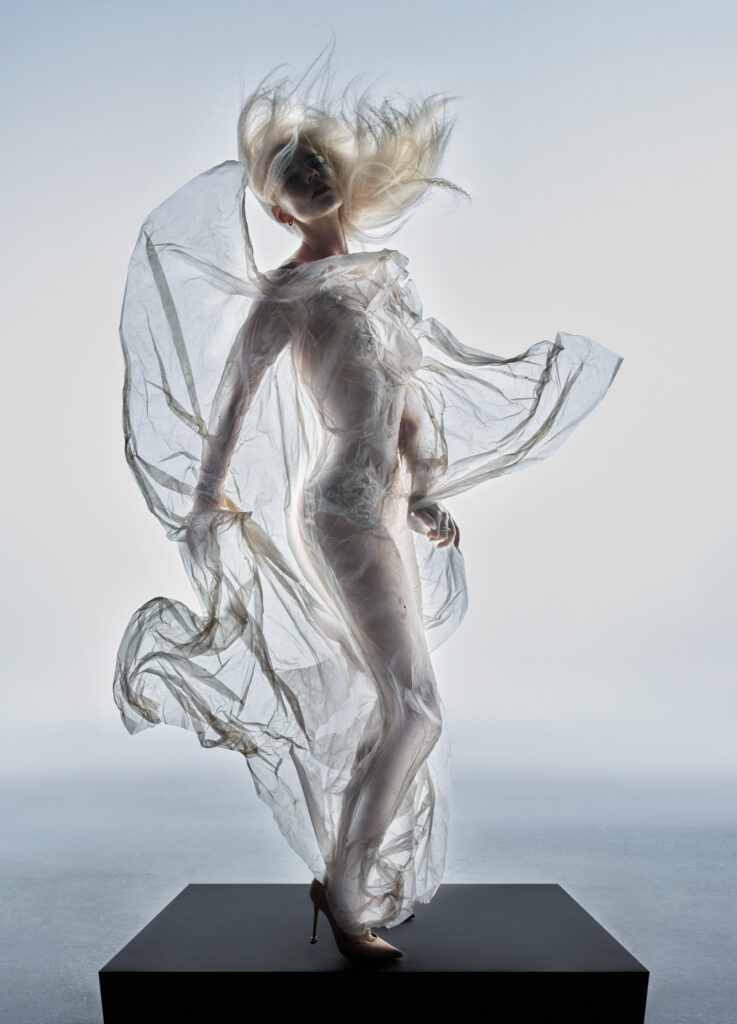
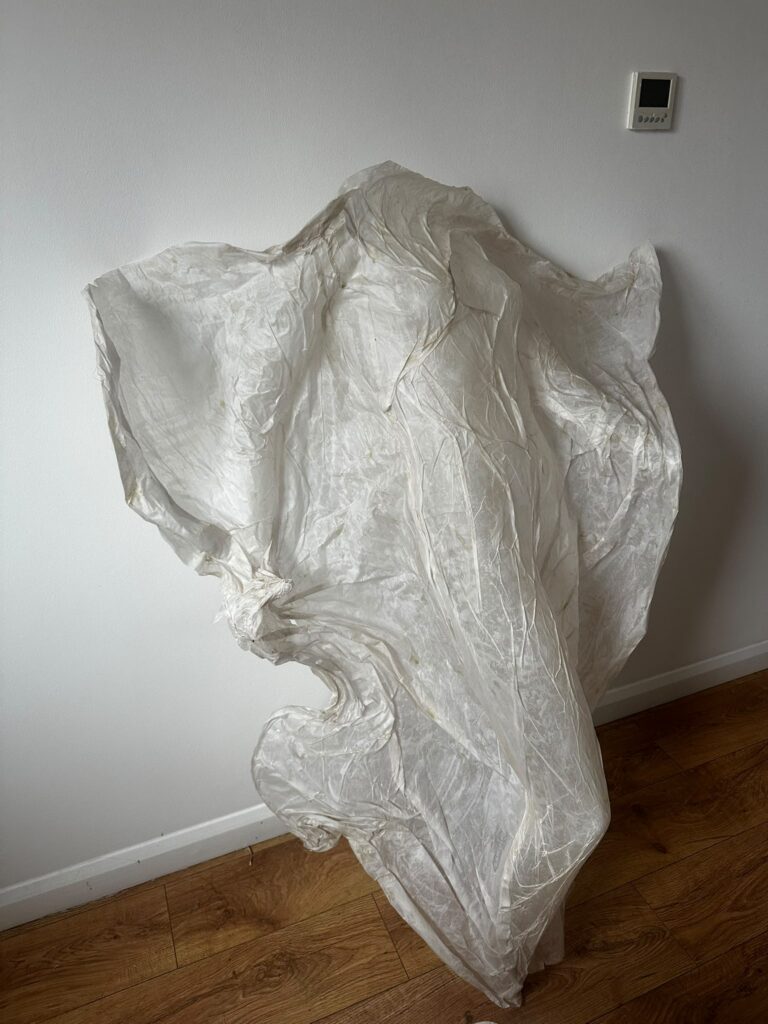
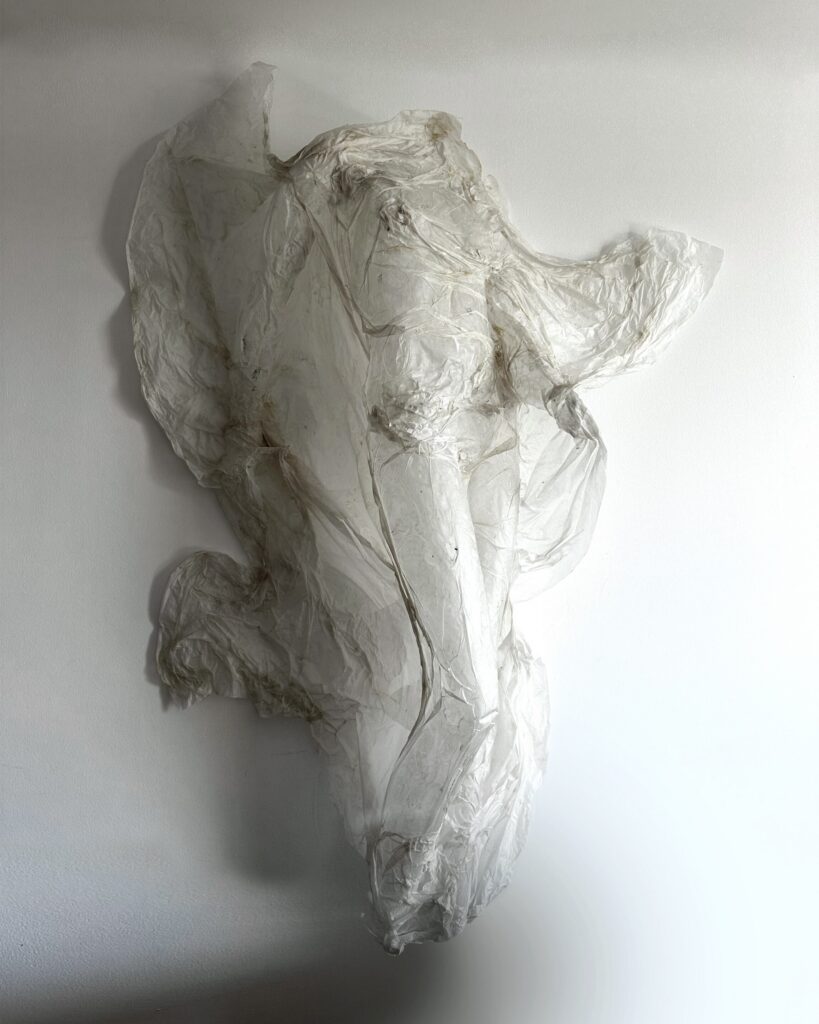
MG: In my practice, paper is one of the mediums that carries real personal meaning, and part of why I create at all. My grandmother, Mauricette, had Alzheimer’s, and it was hard to watch her memories fade. The life she could no longer remember had been beautifully photographed by my grandfather and printed onto paper — immortalised in a fragile medium whose very physicality echoes the fragility of memory. This is why I work with paper: to preserve my grandparents’ memory. I lost both my grandparents on my mother’s side last October, and I feel this piece represents an image taken by my grandfather of my grandmother — but now in the afterlife, or some kind of ghost dimension, physicalised by a sheet of tracing paper, draped elegantly, floating around a female figure.
V: What was your process of making the garment, and how did it all come together?
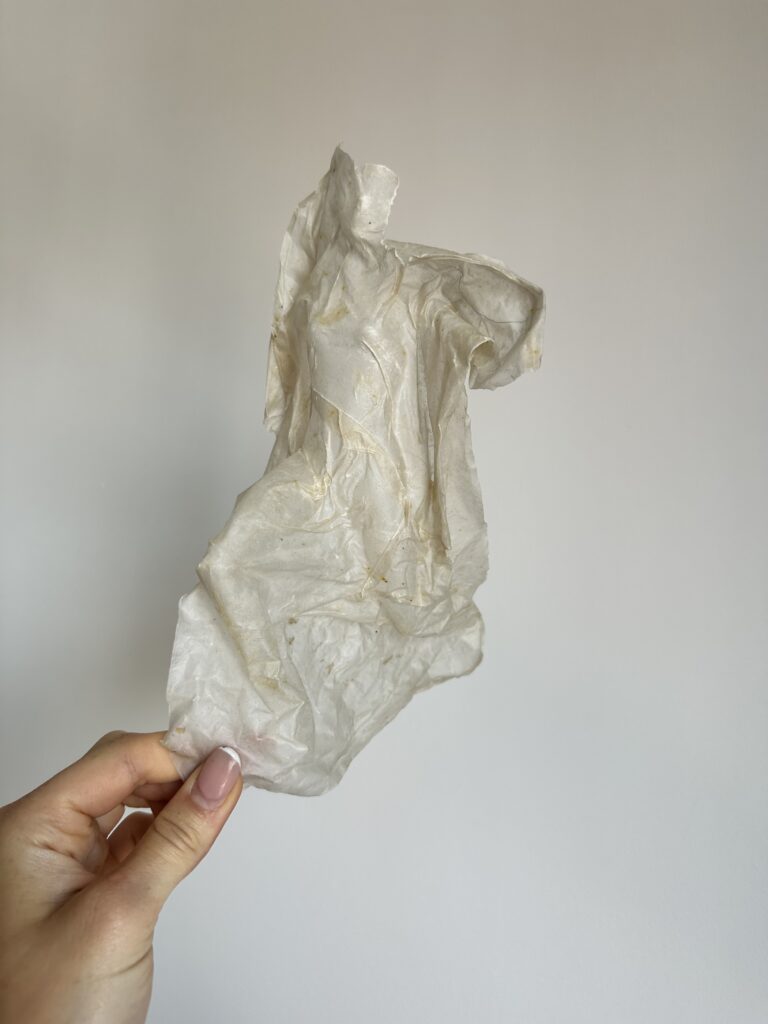
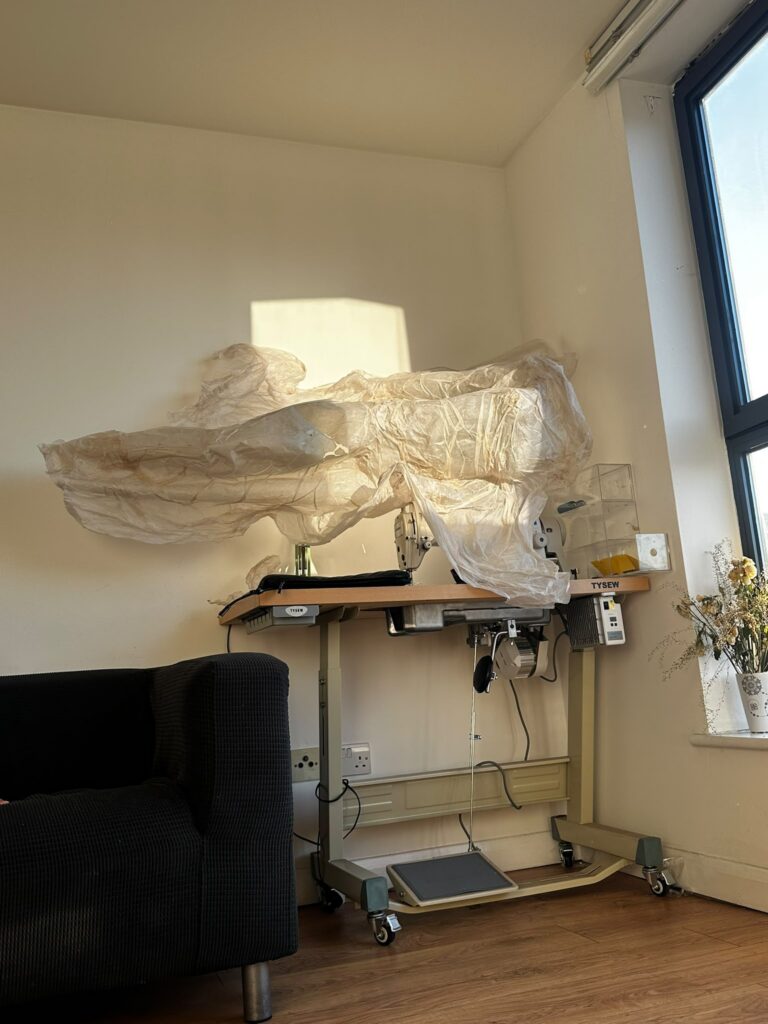
MG: I began small — a Barbie draped in a single A4 sheet of tracing paper, a scale model that came together with ease simply because of its size. Working at life size was another matter entirely. A vast sheet of tracing paper, a life-size cast of the body caught in a dynamic, elegant pose to mould against — sourcing that alone was a challenge in itself. And then there was the paper: wet, fragile, unwieldy at that scale, demanding total care in every fold and press, always working against the risk of a single tear undoing everything.
V: What was your experience of working with paper to make the dress? How did the material surprise or challenge you?
MG: Tracing paper was new territory for me, and it revealed something I hadn’t expected — a way of holding light and shadow that felt almost cinematic. It surprised me, too, with its strength: it was sturdier than I’d imagined, so much so that I trusted a single layer where I’d normally use two. That choice let the light move through the piece more freely than planned, as though the dress itself were woven from light rather than paper.
V: Was there anything new you found yourself thinking about design while working with paper that you hadn’t previously considered?
MG: What emerged felt less like a garment and more like a sculpture — a way of seeing my technique that I’d never quite allowed myself to consider before. It left me genuinely inspired, opening a door I hadn’t noticed was there: the possibility of paper sculpture as art in its own right, standing beyond the body, beyond the garment altogether.
Gaurav Gupta
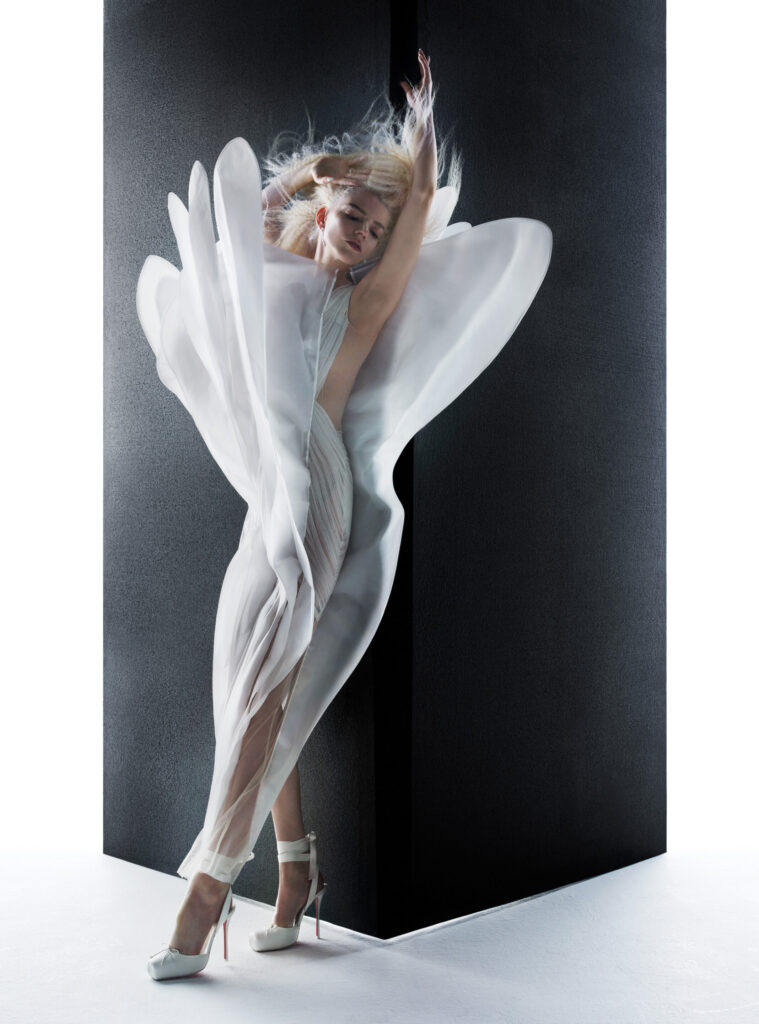
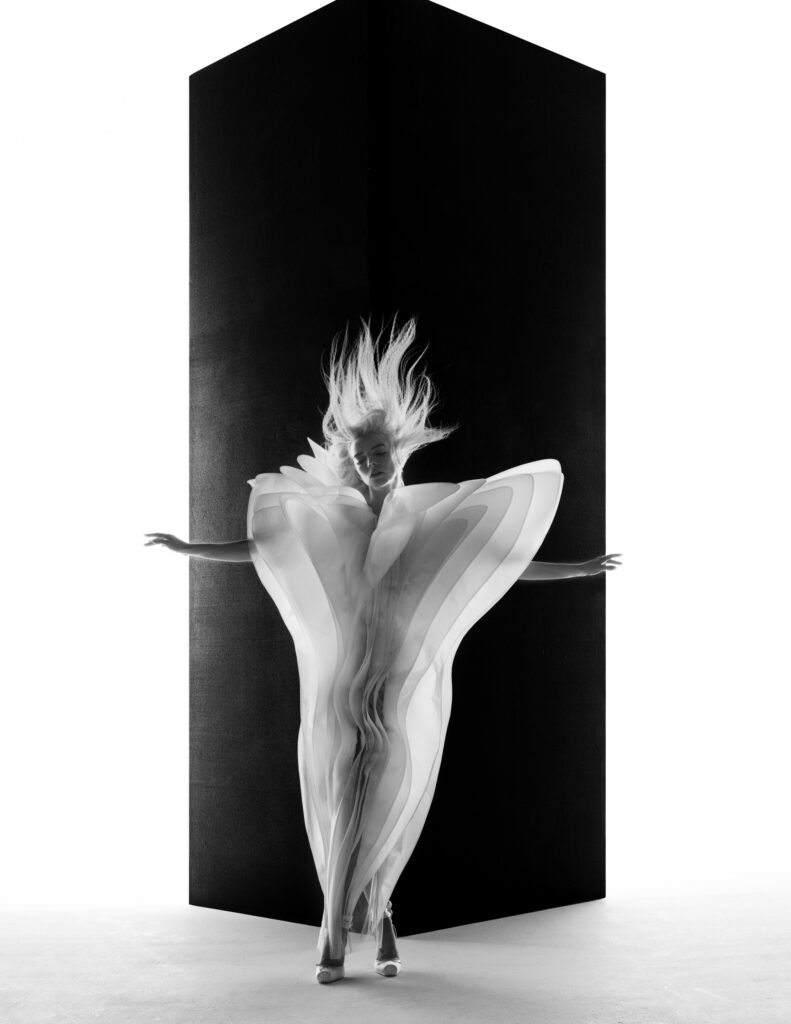
New Delhi-based designer Gaurav Gupta is a regular at Paris Haute Couture Week. He founded his brand over 20 years ago, and in that time, he has drawn a crowd of stylish insiders including Beyoncé, Maluma, and Priyanka Chopra, all of whom have worn his intricate and intelligent constructions. V is certainly among his admirers as well–you may recognize Gupta’s work from our Summer 2026 issue, worn by model Maria Klaumann and photographed by Nick Knight. Gupta became a clear selection for V162’s “Crafting Joy,” and his layered, sculptural gown in our pages is sophisticated and forward-thinking.
V: Why was working on a project like this interesting to you?
Gaurav Gupta: It was exciting because it brought together so many creatives I deeply admire. I’ve always been a huge admirer of Nick Knight’s work, and collaborating with V Magazine, stylist Anna Trevelyan, and Anya Taylor-Joy, who has such a mysterious, otherworldly presence, made it a very special project. It felt like the coming together of people who all share a love for experimentation and storytelling.
V: What was your inspiration for this dress?
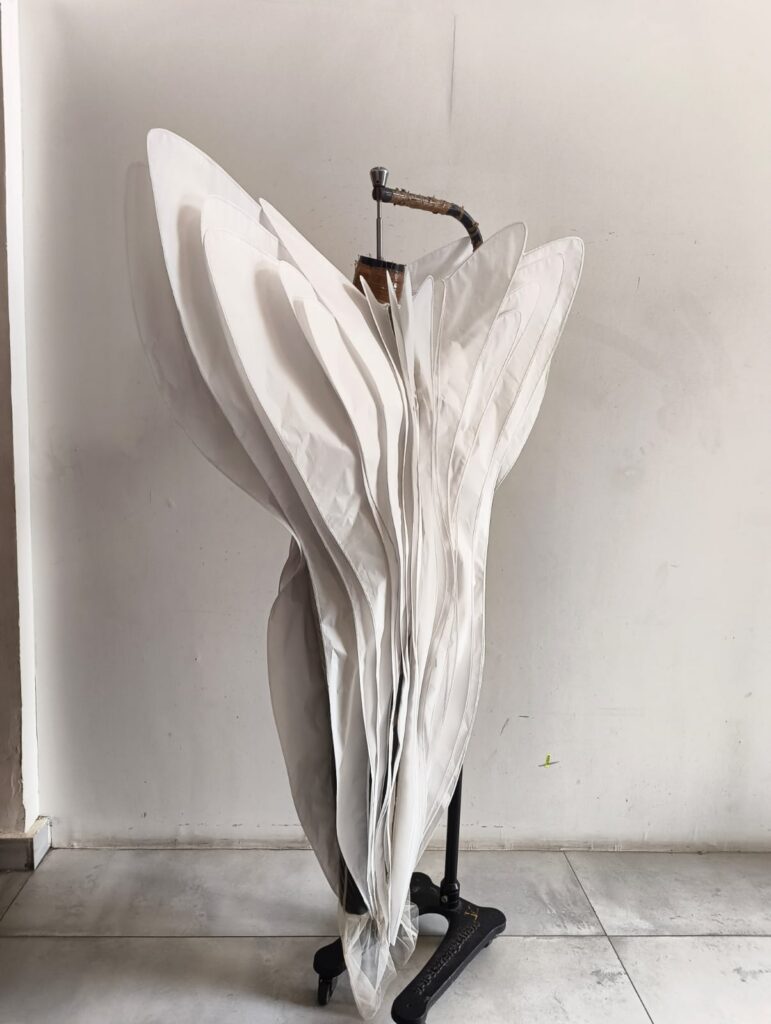
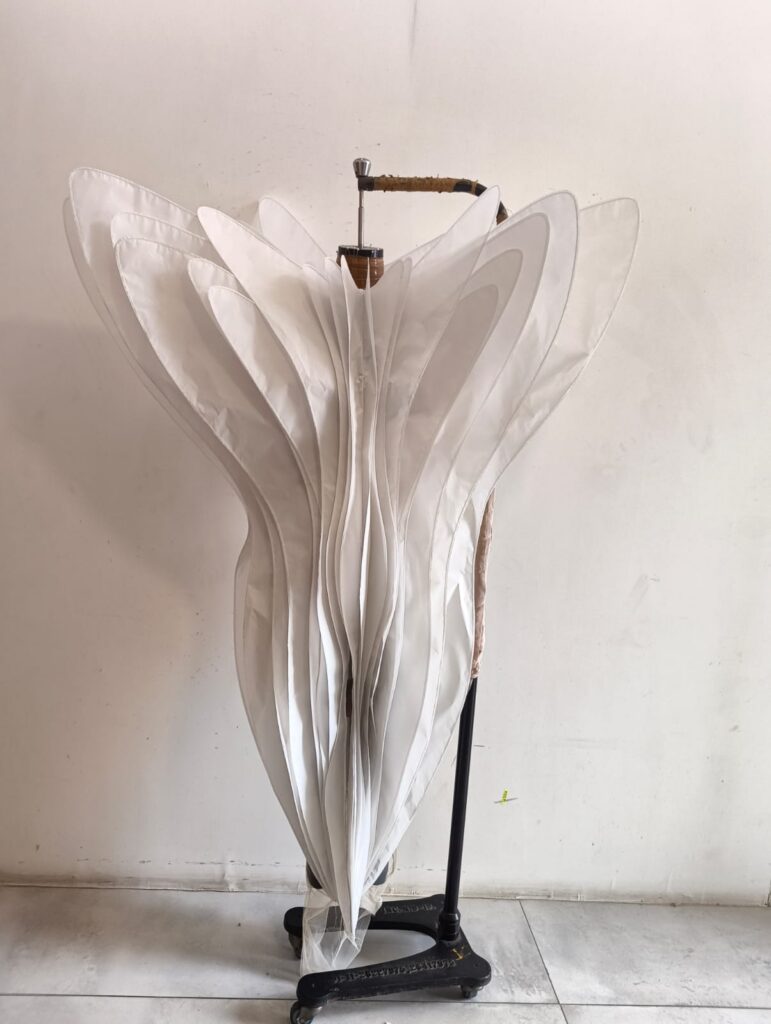
GG: The starting point was actually the brief itself. When Anna and Nick asked me to create a dress entirely out of paper, it was an opportunity I simply couldn’t refuse. From there, the idea evolved around exploring light, how it moves, reflects, refracts, and reveals the many layers of our inner selves. The dress became an expression of those multiple auras and dimensions that exist within each of us.
V: Beyond the wonderful description you shared, can you tell us about the process of making it? How did it all come together?
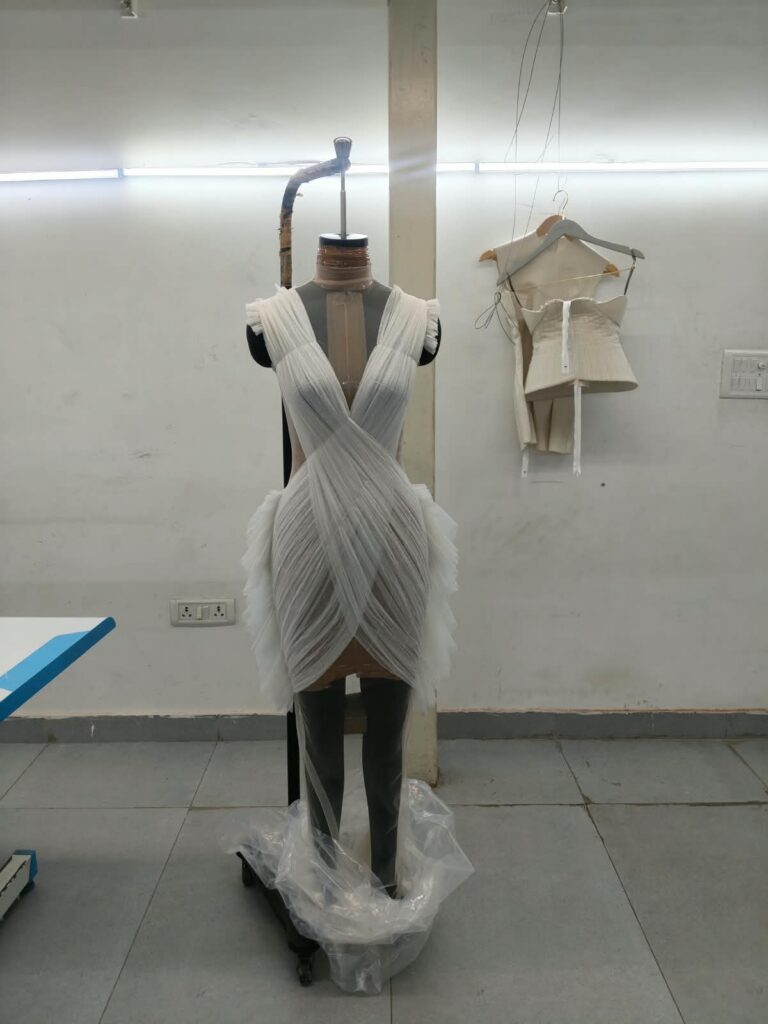
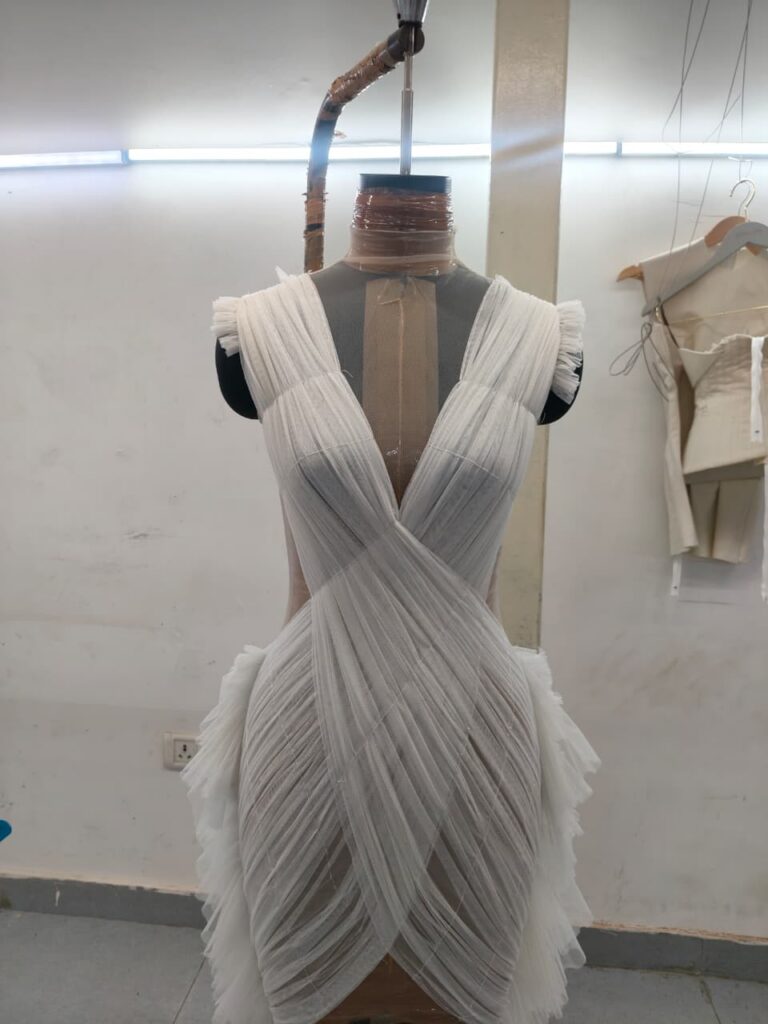
GG: This was the first time we had ever created a garment entirely from paper, so the process was driven by experimentation. We began by testing different ways of sculpting and manipulating the material, exploring how far we could push it. Through multiple iterations, we discovered a technique that best translated the original sketch into reality. It was a process of trial, refinement, and constant discovery until the final form felt true to the vision we had imagined.
V: What was your experience of working with paper to make the dress? How did the material surprise or challenge you?
GG: Paper behaves very differently from fabric. It doesn’t stretch, it doesn’t drape, and it creases incredibly easily, so every stage of construction demanded far more precision and care. Even handling a single panel required multiple people to support it while it moved through the machine to prevent unwanted creasing or distortion. Working with paper forced us to rethink our entire making process and adapt to the material rather than expecting it to behave like textile.
V: Was there anything new you found yourself thinking about design while working with paper that you hadn’t previously considered?
GG: Absolutely. It made me think much more deeply about refraction and reflection, how light interacts with a surface, and how structure can shape that interaction. Those ideas became central to the design and opened up an entirely new way of thinking about form and materiality.
Noel Stewart
Decorated milliner Noel Stewart, mentored by the great Stephen Jones, is no stranger to custom design: Stewart has developed bespoke hats since founding his own brand in 2003. He’s since partnered with brands like Valentino, Givenchy Haute Couture, and Mulberry, and counts among his wearers Céline Dion, FKA Twigs, and Kylie Minogue, as well as many others in both categories. He was once named the UK Fashion and Textile Association’s Accessory Designer of the Year, and is a founding member of the British Hat Guild. For V162, Stewart, who is also the Creative Director of foundational UK brand Christys’ Hats, developed a “custom tracing paper smash headpiece,” which rests delicately atop Anya Taylor-Joy’s head on our September pages.
V: Why was working on a project like this interesting to you?
Noel Stewart: Many reasons: the opportunity to work in paper was a gift. It’s always exciting to play with materials we don’t usually use for hat making–unexpected and surprising results are a big reason I love what I do. To be invited to be a part of Anna and Nick’s work is an honour and super fun. I’m also an Anya Taylor-Joy fan. We made some of her bonnets for Emma with [costume designer] Alexandra Byrne, so these hats being the polar opposite of those is a thrill.
V: What was your inspiration for this hat?
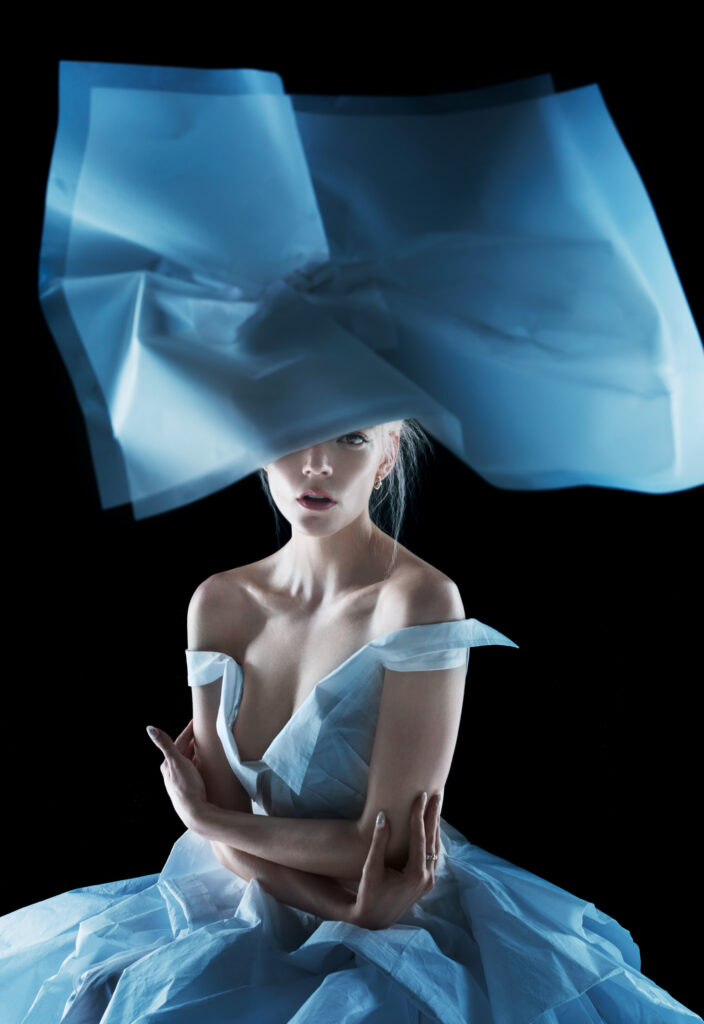
NS: I wanted to subvert paper’s usual format of being a pristine, smooth sheet for words and pictures, and make its structural properties the star. Anya has such a unique look and way of carrying herself I felt she would enjoy playing with a large dramatic abstraction in exciting ways. I also wanted to disrupt the ‘canvas’ as much as possible and crush it into a shape that danced around her head and framed her face.
V: Can you tell us about the process of making it? How did it all come together?
NS: Once Anna gave me the brief, I knew I wanted to work with tracing paper. It combines all the obvious qualities of paper with a subtle translucency that I wanted to explore, as that can be so great on the head. Traditionally this could be a light veil that creates mystery or a fine straw that diffuses light across the face and body, so the opportunity to play with these aspects of headwear with something so much more architectural than conventional hat materials was magic.
V: What was your experience of working with paper to make the hat? How did the material surprise or challenge you?
NS: Tracing paper is very unforgiving, you crush it and it remembers forever so there’s no ironing out any mistakes. I’m a believer in letting the materials tell you how they work best and prefer not to force things to do what they don’t want to do. Paper was made to be a canvas for marks but it was also made to be crushed and disposed of. I found there is something quite punk and poetic about a giant crushed shape on the head. It also neatly refers back to some hats I made for Hussein Chalayan SS09, where we crushed metallic and neon crin to evoke crashed car parts. I enjoyed evolving that idea. There was a brutal drama to the pieces I made for Hussein, and in the paper there is a sleek elegance to these iterations that I enjoy.
V: Was there anything new you found yourself thinking about design while working with paper that you hadn’t previously considered?
NS: I really love a beautifully made hat, garment, shoe, accessory. Finding the perfect way to realise an idea for a person to wear is intrinsic to what I do, but sometimes it’s good to burn the rule book and make something less physically precious and purely idea- or image-focused.
Thevxlley
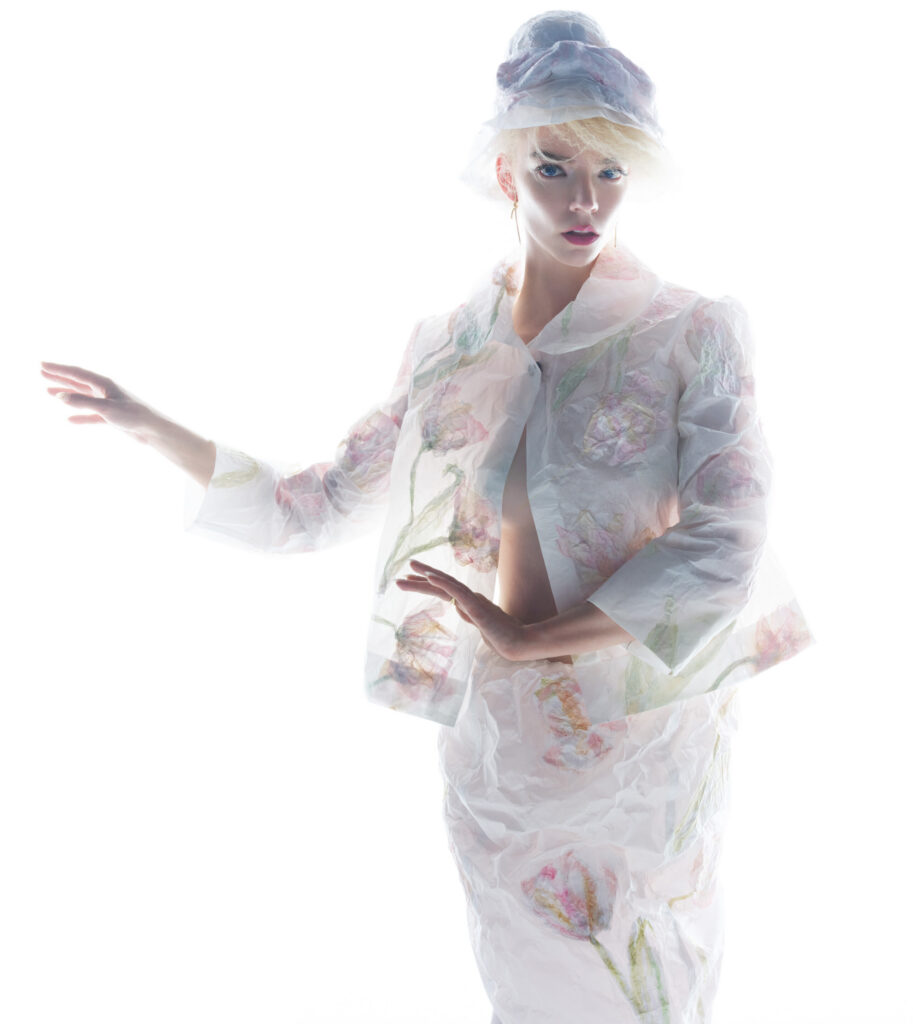
Since its founding, Daniel del Valle’s namesake brand Thevxlley has been traversing the boundaries between fashion and art, not unlike once-upon-a-time collaborator Michaela Stark. Del Valle’s work as an artist also transcends artistic media, incorporating sculpture, mosaic, collage, and more into each garment. In 2025, he was a finalist for the LVMH Prize, and his star continues to ascend. For V162, del Valle created a paper suit and hat patterned in florals. Because his work lives among atypical materials, always with a twist on nature, an ensemble like the one he created for Anya Taylor-Joy became an exciting challenge.
V: Why was working on a project like this interesting to you?
Thevxlley: When I was introduced to the project, I immediately fell in love with the idea of creating an outfit entirely out of paper. It’s actually not the first time I’ve worked with paper, cardboard, and otherunconventional materials, so it felt very natural to me. What I love about paper is how delicate and unexpected it can be. I’m fascinated by its lightness and transparency, and by the way you can build up so many layers while still allowing the ones underneath to show through. There’s also something very hypnotic about the cracks, the texture, and even the sound it makes when you put it on. I find that paper always offers endless possibilities for experimentation and creativity.
V: What was your inspiration for this dress?
T: Flowers and botanics are always part of my imaginary, as well as the classic silhouettes of the 1950s and 1960s. I was particularly inspired by the floral patterns and elegant forms of suits, skirts, and blazers from these decades. For this project, I decided to reinterpret these references through paper as my only material. I reworked my own patterns and experimented with layering different pieces of paper to create those floral details. I wanted to keep the paper delicate and lightweight, allowing light to pass through it. This creates a sense of transparency and softness, while maintaining the structure and elegance of the original silhouettes.
V: Can you tell us about the process of making it? How did it all come together?
T: The process came together quite naturally. I always like to go straight into experimenting, so I started working with the paper straight away, exploring the different ways I could shape and layer it. From there, the look gradually developed. It was quite an organic process, where each step helped to shape the next. I allowed myself to experiment and respond to what was happening with the material, rather than having everything planned from the beginning.
Mugler: Miguel Castro Freitas, Creative Director
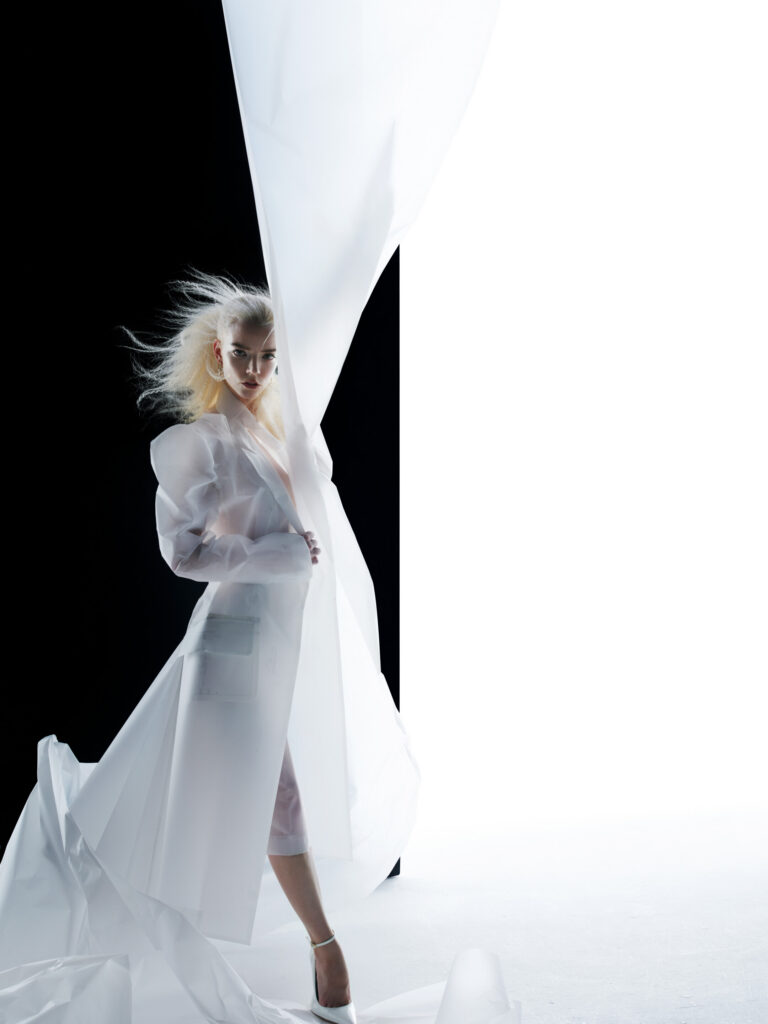
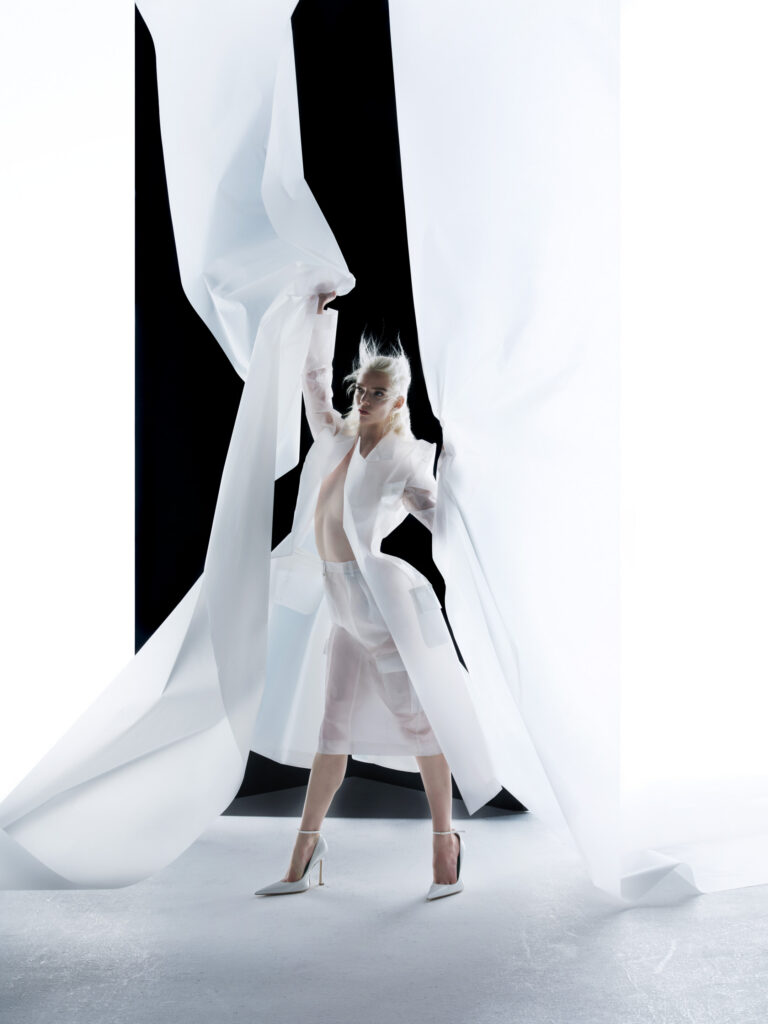
Appointed Creative Director of Mugler in March 2025, Miguel Castro Freitas has since cast his own light on the house’s signature glamour, theatricality, and sensuality, combining it with an appreciation for transformation and the power of vulnerability. You’ll spot celebrities like Chappell Roan, Paris Jackson, and Naomi Watts in his front row; Emma Chamberlain also wore a showstopping custom ensemble designed by Castro Freitas for Mugler at the 2026 Met Gala. For V162, Castro Freitas brings his eye for precision and innovation to the custom skirt and coat created expressly for this shoot.
V: Why was working on a project like this interesting to you?
Miguel Castro Freitas: I was immediately drawn to the tension between [Fall/Winter 2026/27 Mugler collection] “The Commander” and paper. That collection is about power, so taking those silhouettes into something as unexpected and ephemeral as paper felt instinctively right. I liked the contradiction. Knowing the project would be led by Anna Trevelyan and working with Nick Knight brought another dimension to the idea, which made me even more excited to see where it could go.
V: What was your inspiration for this dress?
MCF: It comes directly from “The Commander.” The court coat was one of the defining silhouettes of the collection, and it felt right for Anya. It has something very powerful and glamorous about it, but also a certain theatricality. I wanted to preserve that attitude while making it feel completely of the moment.
V: Can you tell us about the process of making it? How did it all come together?
MCF: We took the existing patterns from “The Commander” and returned them to their most elemental form: paper. What excited me most was that sense of coming full circle — returning to the material and language of the initial stages of building a garment. It sounds counterintuitive, but the collaboration became a cycle: taking a finished silhouette back to a phase it had already passed through, and then allowing it to become something new. I wanted the construction to remain visible, so we kept the markings and labels of the pattern intact. The process itself became part of the piece.
V: What was your experience of working with paper to make the dress? How did the material surprise or challenge you?
MCF: I expected the paper to be fragile, but it had an unexpected strength. It held the volume beautifully and gave the silhouette an almost sculptural quality. The challenge was to respect the material rather than fight it. That is always where the most interesting things happen.
V: Was there anything new you found yourself thinking about design while working with paper on the garment that you hadn’t previously considered?
MCF: It made me think more about structure than fabric. The paper dictated its own behaviour, so I had to work with the shape rather than impose one on it. The result became more architectural than I had anticipated. Sometimes the limitation is what gives a garment its identity.
This cover story appears in the pages of V162: now available for purchase!
Photography Nick Knight
Fashion Anna Trevelyan
Interview Miley Cyrus
V Editor-in-Chief / Creative Director Stephen Gan
Creative Director Calum Knight
Makeup Lisa Eldridge (Streeters) using Dior Makeup
Hair Sam McKnight (Premier Hair & Makeup) using Hair by Sam McKnight
Manicure Chisato Yamamoto (Caren) using Dior Le Baume
Set Designer Andrew Tomlinson
Seamstress Ellie Grocott
Casting Greg Krelenstein (GK-LD)
Editor Kev Ponce
Fashion Market Editor Copelyn Bengel
Camera Operator Raquel Couceiro
Photo Assistants Lara Sugar Hughes, Gil Warner, Madison Blair, Max Lancaster
Digital Technician Joe Colley
Fashion Assistants Aleena Klug, Valentina Monterrubio
Set Assistant Patrick Dempsey
Hair Assistant Valerie Benavides
Makeup Assistant Nilofar Mussa
SHOWstudio Art Director Michael Gossage
Photo Intern Oldnightkid Wang
Studio Intern Flora Ritblat
Discover More