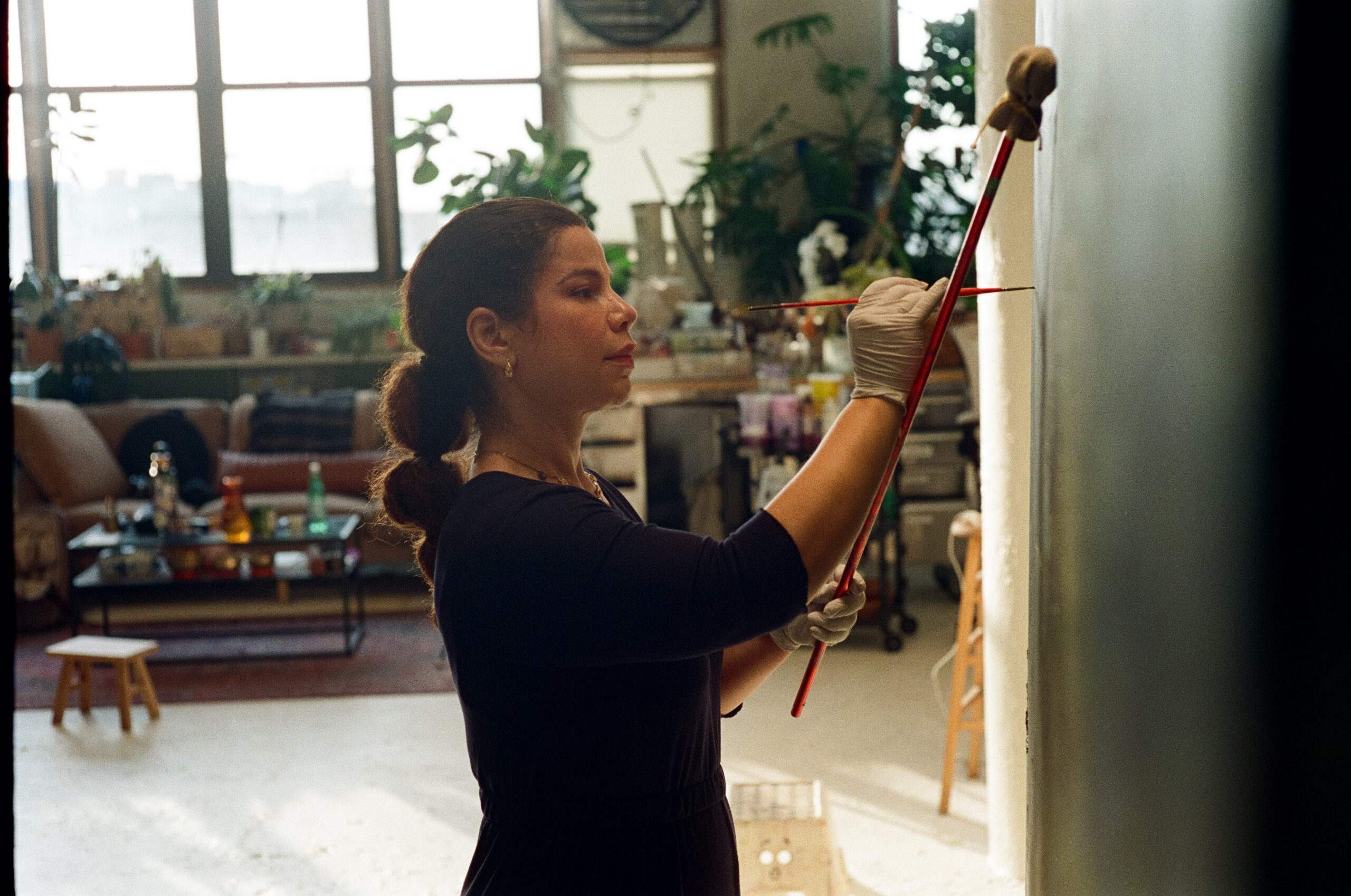
Artist Firelei Báez Wants You to Think Bigger
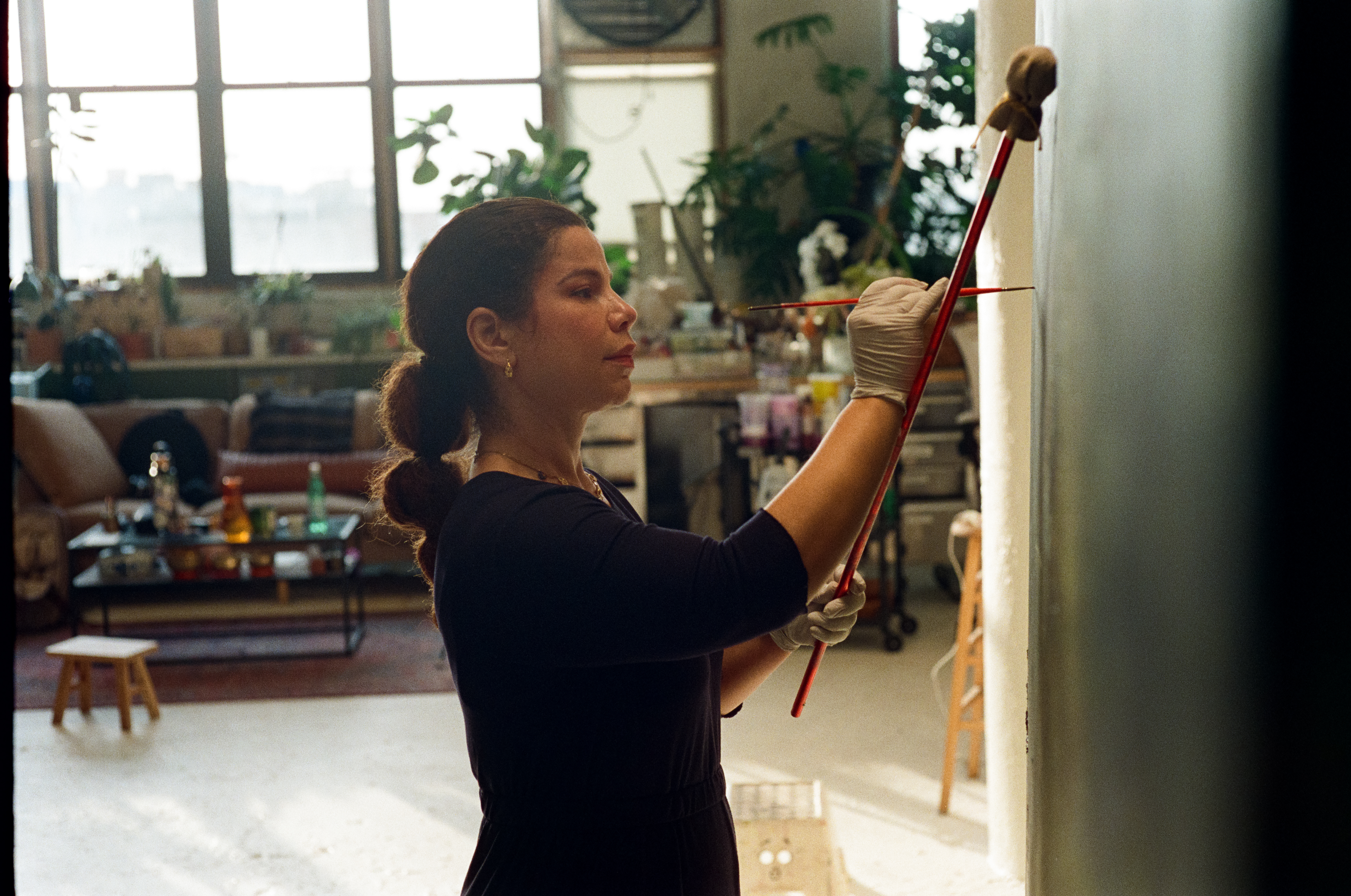
The multimedia phenomenon questions art history’s past and present
Through dynamic hues and powerful symbology, multimedia artist Firelei Báez regularly contemplates the African diaspora’s past and present. In doing so, she creates opportunities for both viewers and herself to question the world they live in, the world they inherited. A veteran of solo exhibitions at the Institute of Contemporary Art and The Museum of Modern Art, Báez’s new exhibition, “feet squelching on wet grass, nourished by uncertainty,” continues her inquiry at the Hauser + Wirth gallery in New York.
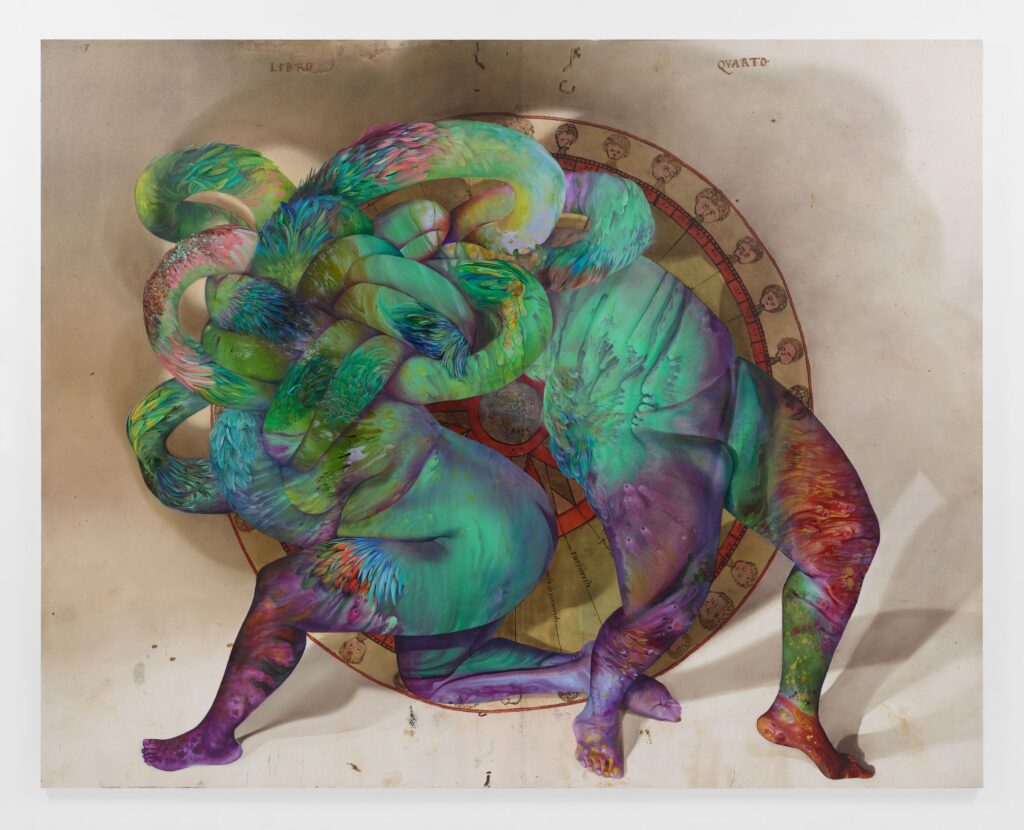
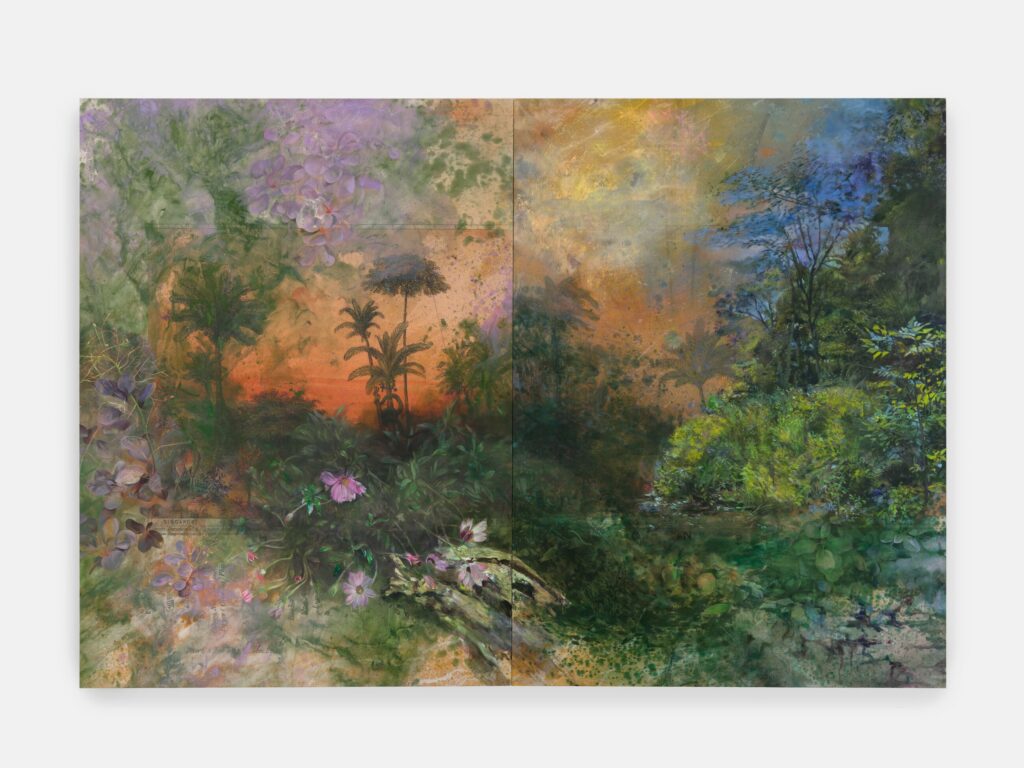
One series in the exhibition features paintings made atop a series of 19th-century diagrams and maps that considered the world in an arguably two-dimensional and colonialist way. Her brushstrokes create juxtaposition with a vivid embrace of nature and personhood, asking us to consider a world, and a worldview, bigger than ourselves. But it doesn’t stop there– interwoven bronze sculptures of ciguapas, female Taino tricksters, explode reality; another series of paintings in explosive color evoke expansive universes.
V spoke to Báez about reclaiming artistic space from the Western canon, avoiding Main Character Energy, and finding bliss in visits from the creative muses.
V: What first interested you in creating work based on these 19th-century documents?
FB: I’m constantly in research mode. I love finding things that can provide doorways for understanding. I find it generous to point at something to show what’s missing because it’s as important as what’s there. Then you start a dance or a conversation. A lot of the documents in the gallery have a 19th century hubris of containment, or even a panoptic surveillance. The feeling that you can contain whole systems and work in the two dimensional image just seemed like…maybe that’s how we got here to the present. Not in a condescending way, but if they, in their full capacity, and in this document that’s supposed to be as comprehensive as they possibly could be at the time, could not see what was missing, what potential do we have for seeing more?
What I love about [writer] Sylvia Wynter’s work is that she, in her nearly 100 years, has given so many doorways for seeing–how do you move beyond a universalized being, beyond essentialization, beyond being the central figure? What do you gain? What can you access if you move beyond hierarchy? There seems to be this tenderness around uncertainty, like we feel we will be rudderless if we cannot navigate from a point of power–almost asking, if you cannot be “Main Character Energy,” what kind of life can you have? Every other model shows how a singular centrality is such a poor life to live. We’re always in a more complex, interwoven system. The healthier system is one where you’re actively engaging with the world. Stagnant water is dead water; to be in flow and connection is to be alive.
V: What aspects of colonial legacy and the African diaspora did you want to explore here?
FB: I kept thinking of the inception of Cubism and how a lot of the artworks we take as early modernism were themselves looking at vestiges of colonial history–at an African sculpture or Indian painting, Mesoamerican painting or sculpture, and their methodologies, thought processes, the world views. The objects themselves were embodied ways of looking at space, time, and reality. Science was being affected by those same ideas. It was a circular way of seeing a more expanded view of the world that was then theorized into quantum physics. Having that quantum physics now, we’re seeing, again, a rematerialization via AI or Nvidia chip, but it’s always been the recipe. The source code, if you want to be reductive, has been these other, more expanded ways of looking, being, and experiencing time. What does it mean to open up, to see the multifaceted itself. Like Picasso and his Demoiselles [Les Demoiselles d’Avignon]–that was a light lift, an easy gesture in a West African sculpture. I want to be gathering flowers and laying them where they actually belong. We could also take in that part of our worldview in a more generous, more generative way.
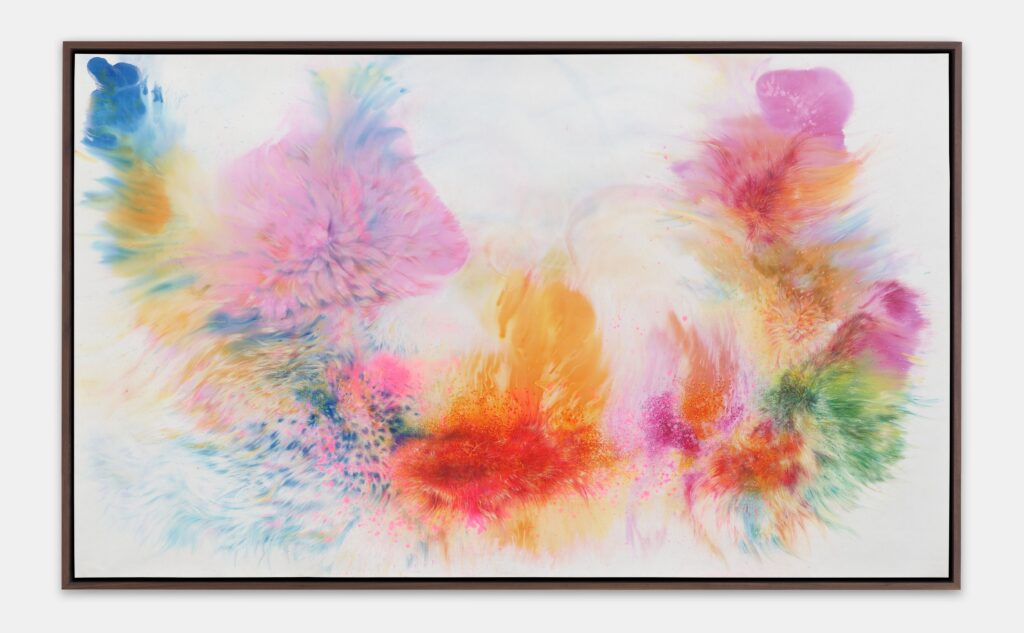
V: When I saw the panorama, it almost seemed like your answer to Monet’s Water Lilies. Were you thinking about reclaiming that space from Western art?
FB: Yeah. And I love Giverny. I love that whole practice. I think about how unpopular those paintings were when they were first made. They were forgotten. But what I also love about them is that Monet was always embedded. I wanted to feel what it would be like to have a similar gesture, but to exert less control, to be a collaborator rather than impose a certain view. Like the rain, the crickets were painting with me. The entire symphony of that space had to be as present as myself. I was a co-creator. I think, who paints landscape and is not thinking about [Monet]–especially if you’re aiming for something extremely epic to be immersed in?
The same blue in Monet’s work was used by Andō Hiroshige. We’re so used to thinking of this hierarchy of time, like Monet being more modern, and Japanese prints as this ancient thing. But they were creating equally, at the same time. That discourse is always so exciting. I’m sure there will be many outcomes after this where people are like, what was I creating at the same time as someone else? Even though I’m looking at history, I’m also looking at the present. I want you to feel as much as you see when you look at the work. I always want to give you a certain level of empowerment to feel. There’s no way we can be in this present moment and not be like shit, we’ve inherited so many bad, weighty realities. But we also have in our arsenal whole other world views that have created and continue to create escape routes. We have so many models for interacting with the unknown, including within ourselves. I wanted to have places where we can unfold internally and access things that might feel scary, but are fuller ways of being.
V: How have you grown as an artist with this show from your last?
I always lay my whole heart out. I always want to have some vulnerability because I feel like it’s the only way you can grow. If you’re not feeling just a little bit nervous, you’re not challenging yourself. For this exhibition, I wanted to be as free as I was in that last exhibition at James Cohan Gallery in 2020, where there were unknown bits and there was an expansion of what people thought of as a language I could access. That’s why I’m so happy the sculpture gets to be more experimental and there is a full expression of abstraction. There were abstract paintings in that exhibition, but because people are usually familiar with my more figurative work I wanted to stretch out.
V: As a multimedia artist, how do you decide what medium you want to use for each work?
FB: You know what, it’s like they choose me. I think the worst thing I can do for an artwork is be prescriptive with it. Even if I start with a specific idea, if I stick to it, the work isn’t as full as it could be. There’s a certain complexity in being ready to accept the muses on their own terms. Usually, most sparks will come with a little flash of like, this is what it could be. And you try to be as clear as you can to express it. If you’re prepared in the moment to capture what is being said, to expand as clearly as possible, that’s the gift.
Discover More