As New York City Ballet’s Adrian Danchig-Waring Retires, He Imagines Ballet’s Future
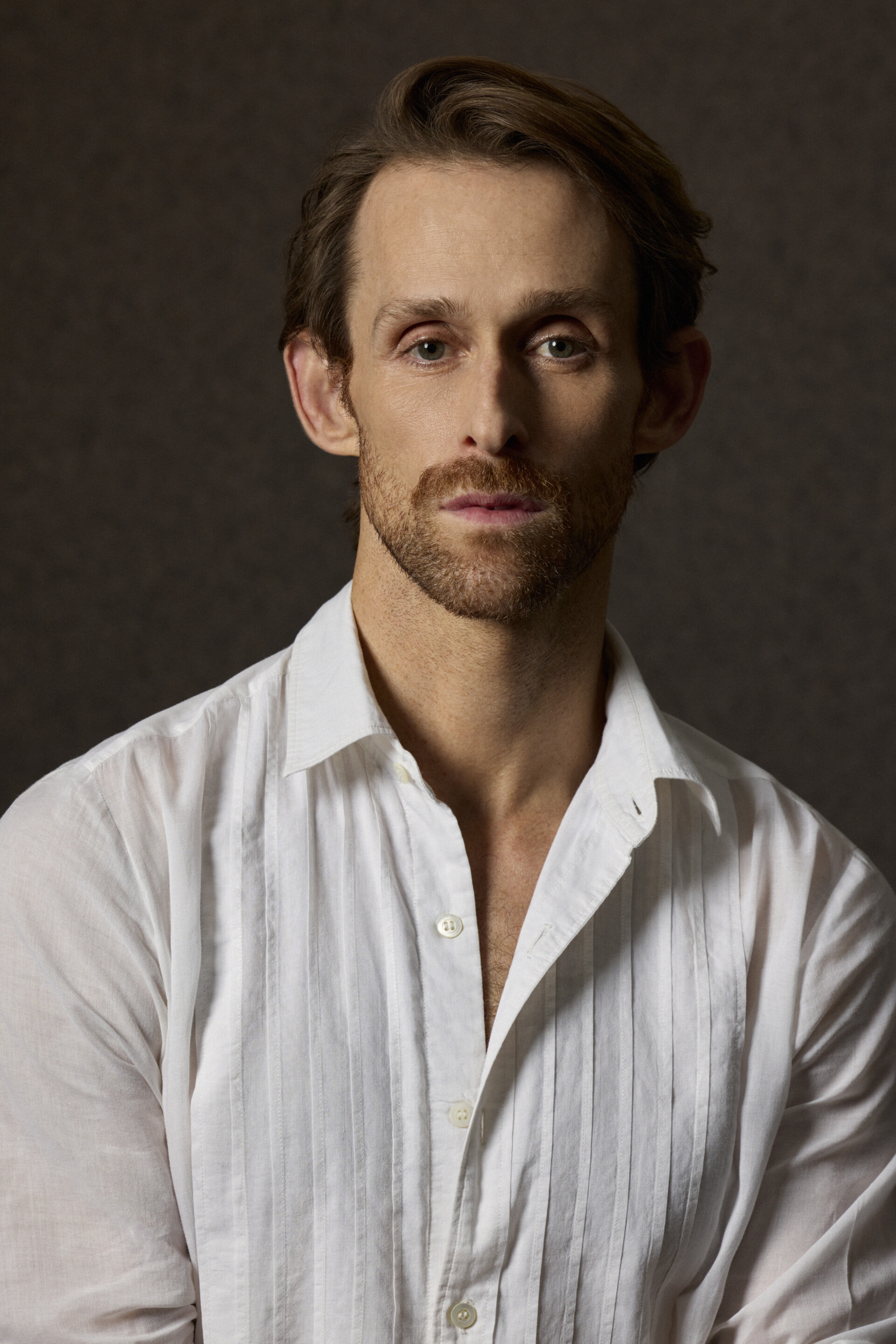
The dancer’s Farewell Performance arrives October 18
On the fifth floor of David H. Koch Theater at Lincoln Center, there’s a long hallway leading to a New York City Ballet rehearsal studio. Under fluorescent lights, its gray marley floors and metal barres are absent of dancers save for Adrian Danchig-Waring. In less than a month, Danchig-Waring, a Principal Dancer at the New York City Ballet, will perform with the company for the last time, officially ending his career of 24 years with a Farewell Performance on October 18.
Before then, though, there’s work to be done. This rehearsal space is one Danchig-Waring has known for over two decades, one where legendary NYCB co-founder and Artistic Director George Balanchine created many works the company still performs today. In the process, Balanchine helped craft the shape of ballet in America and made NYCB one of the leading ballet companies in the world.
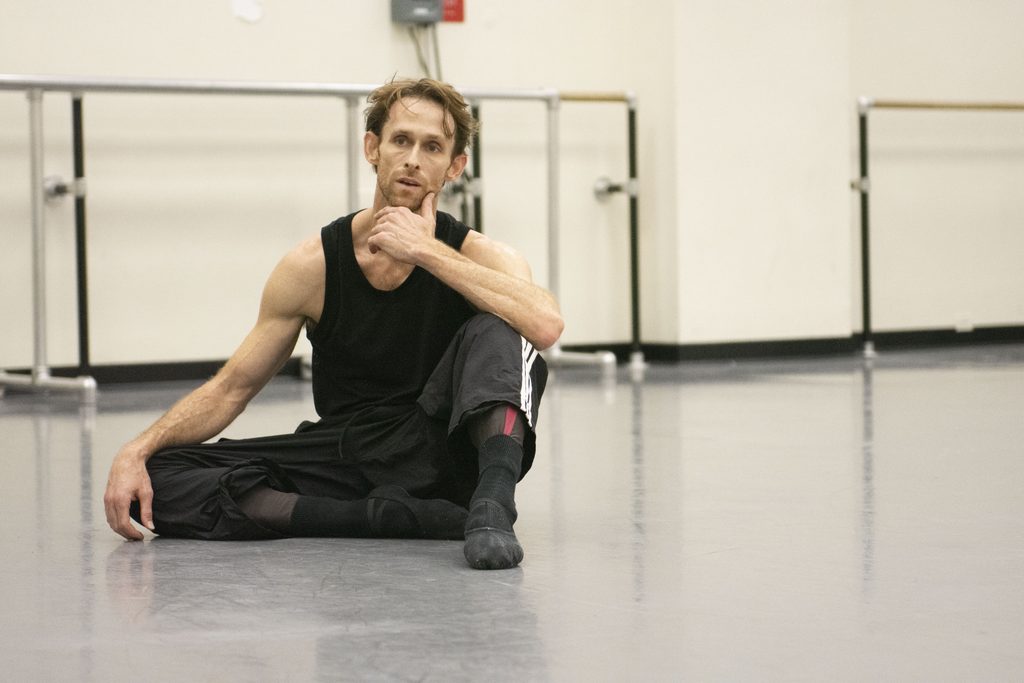
Danchig-Waring has danced 21 of Balachine’s ballets during his time at NYCB. Today he is in black track pants with warming booties on his feet, and his rehearsal with lauded choreographer and NYCB Artist-in-Residence Alexei Ratmansky is about to begin. The piece in question is “Solitude,” Ratmansky’s piece addressing grief and loss during the war in his native Ukraine. I’m not even in the room for a minute when Danchig-Waring welcomes me in, explains the piece at hand, what they’re working on that day, and the lore of the space. There used to be a mural on the wall called “Dancers at the Bar,” by Robert Crowl, he says, that was painted in the 1970s and featured great dancers of the day hanging out at the local watering hole at Lincoln Center (then called O’Neal’s, it’s now a P.J. Clarke’s). It’s since been painted over, but Danchig-Waring feels the presence of those dancers, and all those who came before, in the room. He’s warm and genuine, speaking softly and looking directly into my eyes when he talks. The walls pulse with history. Soon Danchig-Waring will leave his legacy here, as well.
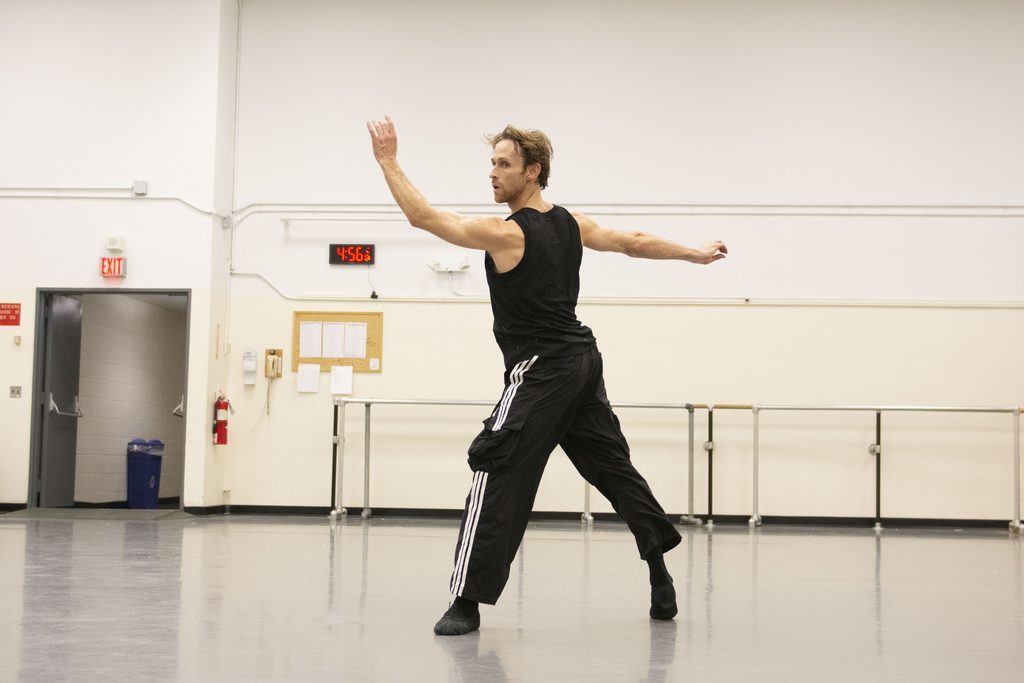
A red digital clock keeps time on the wall, which is adhered to with as much precision as the ballet’s choreography itself. With the pianist and Ratmansky, Danchig-Waring rehearses the piece, every movement not just a moment but a reason: lifting from the ribcage, legs brushing upward, curling the body onto the ground, talking through how to make each part of the story deeper. By the end of rehearsal 30 minutes later, Danchig-Waring is covered in beads of sweat. Ballet is supposed to look effortless and indeed it does, but what’s really happening is that dancers use every muscle in their bodies to throw themselves through space, against the laws of physics (or sometimes in concert with them), maintaining composure the entire time. As Balanchine himself famously said, “First comes the sweat. Then comes the beauty — if you’re very lucky and you’ve said your prayers.”
Danchig-Waring has built a career creating that beauty, starting at age 11 in his native San Francisco. He moved to New York to join the School of American Ballet at 17 in 2001, and in the year it took him to become an apprentice, he lived in the School of American Ballet dorms and ate at the cafeteria, “living a life that could be defined as: eat, sleep, dance, repeat,” Danchig-Waring says. He was promoted to Soloist in 2009, and then became a Principal Dancer in 2013. He remembers the day.
“I got a call asking me to come in for a meeting in (my then-Artistic Director) Peter Martins’ office. When I arrived, I sat down on the sofa. He sat in a chair across from me and said, ‘Today, you’re a Principal Dancer,’” Danchig-Waring says. He needed Martins to repeat himself at first. And then he left the office a Principal Dancer, which he has remained ever since. Until October 18.
Danchig-Waring’s Farewell Performance features a program he designed. It will include Balanchine’s The Four Temperaments, where Danchig-Waring will dance the third movement entitled “Phlegmatic.” It’s a piece close to his heart–“Each role ignites a different way of being,” he writes in his Farewell program essay. “You never act the part. You discover its essence.” Agon is another work on the program, devised by Balachine in collaboration with the great Igor Stravinsky; being trusted with this work, and other late Balanchine collaborations with the great composer, is among Danchig-Waring’s greatest accomplishments as a dancer, he says. The program rounds out with a duet for two men, the first of its kind in City Ballet’s repertoire. It is choreographed by Lar Lubovitch, whose work combines elements from both ballet and modern dance. The program concludes with a world premiere piece choreographed by modern choreographer Pam Tanowitz specifically for Danchig-Waring on the occasion of his retirement, and will also feature three ballerinas in the company who have most inspired him.
But there’s a lot that has to happen before that day, including an entire City Ballet season of performances that runs from September 22-October 18. Danchig-Waring maintains “the familiar rhythm of rehearsals and performances, keeping my body tuned,” he says in the midst of the season. There will have to be additional rehearsals for the Farewell performance as well, “but it feels worth it to see these bright young people arriving into their roles just as I’m saying goodbye to mine,” he says. “I’m savoring it.”
When I arrive for a City Ballet performance this season, I see Danchig-Waring’s face on the exterior of the Koch Theater announcing his farewell. The Four Temperaments is also part of the NYCB repertory this season, so I get to see a preview of Danchig-Waring at work in one of his favorite pieces. Balanchine’s embrace of modernism and reimagination of classical ballet’s possibilities live in this work, embodied in the choreographer’s minimalist, angular movements. Performing the “Phlegmatic” variation of the ballet, Danchig-Waring commands space with coolness, and there are moments where, yes, there are other dancers on stage, but you can see only him. He’s a person you could never imagine as scenery–almost the platonic ideal of what you’d imagine a male ballet dancer to be, imbuing the work with this sense of both lightness and power at the same time. I write the word GRAVITAS in all caps in my notes. I wonder if this is what Muhammad Ali was talking about when he said “Float like a butterfly, sting like a bee.”
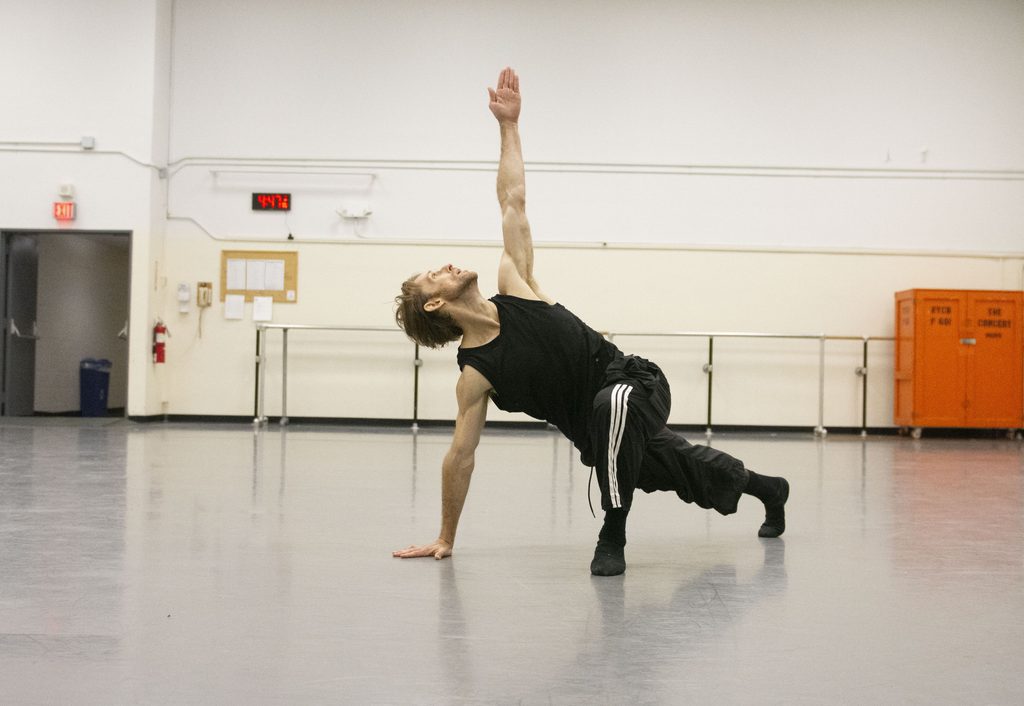
“Sometimes with the dancers, it’s hard to tell who is a person, but after him, through his movements, you see him right away. He’s very open on stage and very individual,” Ratmansky said of Danchig-Waring when we spoke a few weeks later. “He opens his heart when he dances. That’s a beautiful quality…He’s like no one else.” To bring such openness when such precision is also demanded is an act of true artistry.
Ballet is a famously exacting artform, where the body is both a tool and a means of communication. Accordingly, it can take its toll. For Danchig-Waring, it became a broken foot at 19, one year after joining the company; spiral stress fractures–“with a flair for the dramatic, I would say I danced on broken legs for about three years,” he says; and most recently, a herniated disc that escalated into an illness that almost killed him.
After contracting a bacterial infection at the site of an epidural he received for this herniated disk, he could no longer walk. He was in bed for five weeks and lost 25 pounds. The bacteria, it turned out, was Enterobacter cloacae; if untreated, the mortality rate is extremely high. “During that period, I kept saying, ‘I just feel like I’m fighting for my life,’ and it turns out I was, and it wasn’t immediately clear if I’d ever walk again, let alone dance,” he said. But Danchig-Waring was able to get treatment that saved him, adding a titanium fusion to his lumbar spine in the process. He was able to not only walk again, he also returned to the stage.
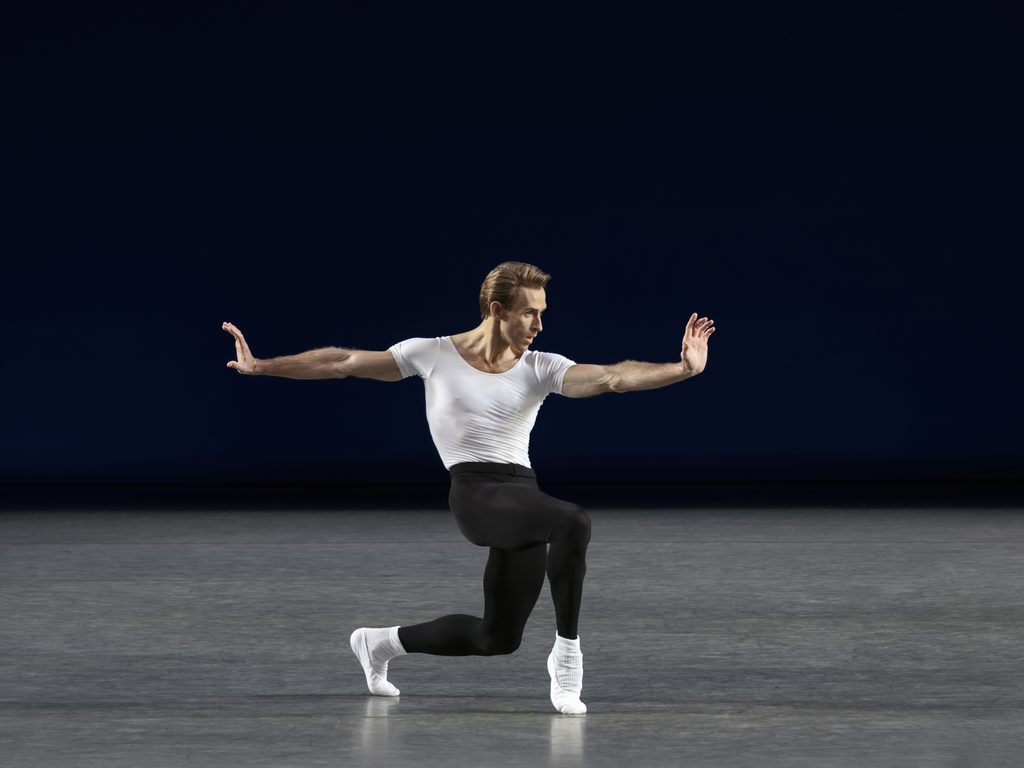
“My commitment to myself, which was really my commitment to God or to the universe, at the depth of that grief, in the part of grief that I would call bargaining, was that if I had the grace to return to dancing that I would wrap it up in a year,” he said. “And I would only do the dances that brought me both pleasure and meaning. And so this October is the end of that year, and I am making good on my commitment to God and to myself.”
When we speak over Zoom after the Ratmansky rehearsal, Danchig-Waring relays these details with an almost surprising calm. My eyes water as I imagine what it would be like to have your life, let alone your entire career, taken away from you in a medical mishap entirely out of your control. What would it feel like if you had also been practicing and maintaining control on your body to a meticulous degree for some 30 years? Danchig-Waring claims not to be enlightened but talking to him feels like he must be. “I think my frame of reference became so much more existential, where–and this is not to be reductive–I was making decisions about how much I could let something affect me, and the framework became, ‘Is it life or death?’” he says.
Perhaps surprisingly, conversations about dancers’ careers ending aren’t necessarily woven throughout their lives. Danchig-Waring cites Martha Graham in this instance, who believed “a dancer dies twice–once when they stop dancing, and this first death is the more painful.” There can be a lot of fear around even having the discussion. Ending a career and taking up another path, when you’ve trained your entire life for one purpose, is daunting to say the least. Indeed, some don’t have the opportunity–some face a career-ending injury one day and an end to their performance lives the next. There are nights, Danchig-Waring laughs, when he has lain awake typing his skills and experiences into Claude, wondering where his career transition will lead. But maybe he should give himself more credit.
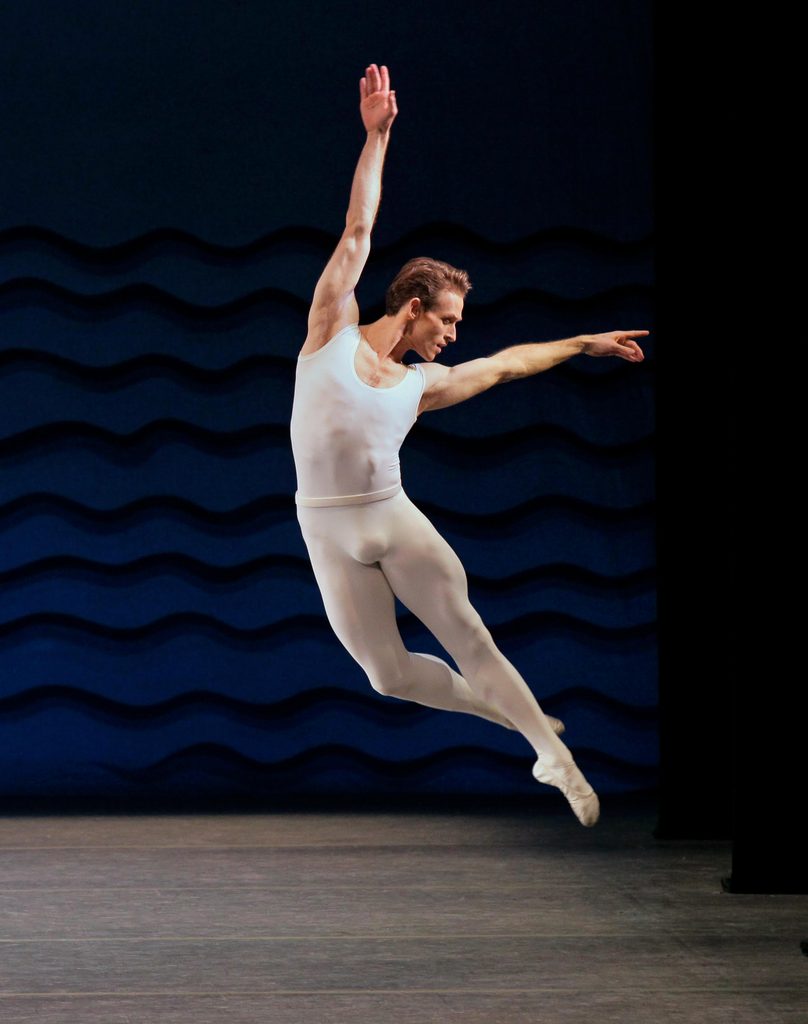
Wendy Whelan, Associate Artistic Director at New York City Ballet, was a Principal Dancer with the company previously, and danced many times with Danchig-Waring. She realized shortly after meeting him that not only did he have good technique, he was also “an intelligent artist,” she says. “He does his research. Not only through books and looking at history and looking at old films, but research into his body. He had excellent training as a young person, but he’s continued to evolve that training and to develop, to sculpt himself as an artist.” Growing up in an academic family, Danchig-Waring found value placed on the mind as well as the body early on, and that translated into autodidacticism throughout his life. Visiting his brothers attending Yale as a young person, he always knew there was more out there than just dance–something that can be rare within the ballet world, which Danchig-Waring (and many others) define as very monofocused. The term “bunhead” exists for a reason–many dancers, their hair in buns, are so obsessed by dance it becomes their only point of knowledge or even driving force. But Danchig-Waring was consistently interested in a world beyond dance and brought that into his work. “I am a little bit allergic to groupthink,” he says. “So I was always looking to supplement my diet.”
Danchig-Waring was a Jerome Robbins Dance Research Fellow at the New York Public Library, for example, where he analyzed the relationship between Robbins’s work and his personal history and philosophies, and how he crafted dance as a language. He has immersed himself in consuming creativity–a self-described “voracious reader,” he loves Rachel Cusk; he’s also an art collector; and he’s no stranger to the world of modern dance. A particular inspiration has been dear friend and architect Sumayya Vally. “Sumayya thinks endlessly about how [to] create cultural ecologies that allow for humanity and creativity and peace,” he says. “There are direct ways that that mode of thinking, which is very spiritual, becomes physical objects, becomes buildings, becomes social engineering. I think so much of what Sumayya does is [envisioning] new ways of gathering, new ways of creating community and facilitating dialogue.”
Such an experience already lives in Danchig-Waring’s relationship to ballet, and Ratmansky believes it lives in his personhood as well. “He’s humble and he has a nice sense of humor and he is intellectual, and there is nothing like me or look at me,” the choreographer said. “I’m sure he, like all of us, wants to be center stage, but he always sacrifices it to the work that we all do.”
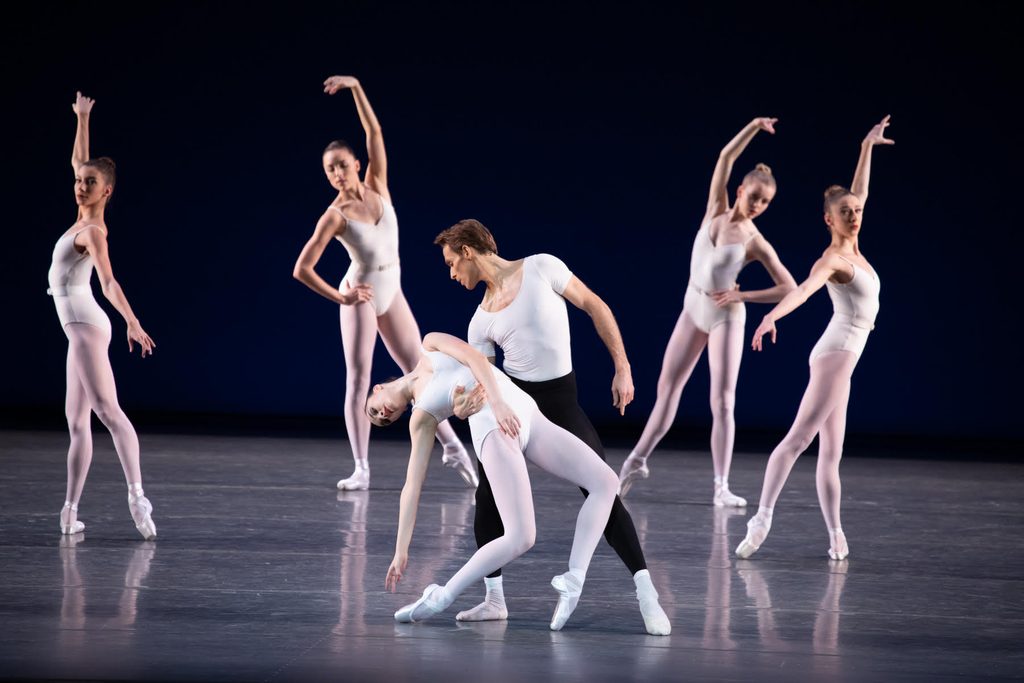
This connects directly to Danchig-Waring’s present work, which will be waiting for him upon his retirement from NYCB: he’s also the Artistic Director of the New York Choreographic Institute. The NYCI, a branch of the New York City Ballet, was founded in 2000 by Peter Martins and philanthropist Irene Diamond “to cultivate emerging choreographers who would shape classical ballet for the 21st century,” and to bring voices into ballet that might otherwise have been excluded. Danchig-Waring had participated in NYCI as a dancer for five years himself, and found the process inspiring. As a person amenable to collaboration, he often got cast in new work, he said, but working with rising choreographers also taught him about what being a dancer really means. “At first I thought the job [of a dancer] was merely to execute: just get the steps right and disappear into them. Over time, I learned the job is to have a point of view inside someone else’s choreography,” he said. “It was the first space where someone asked me to contribute meaningfully to the creation of a dance. That lit a spark in me, where I realized I didn’t need to compartmentalize who I was in the world from who I was in the studio and onstage.”
Danchig-Waring has been the Artistic Director since 2018, and his involvement sprung from another injury that left him off his feet for an extended period of time. He pitched his involvement in NYCI to Martins. Since beginning at NYCI, he has been working to offer rising choreographers space to expand their practices and thereby, potentially, the reach and accessibility of ballet. “I think that making ballet more accessible happens at a lot of different levels, and I think one of those levels is in inviting people into creative process and emphasizing that it is process, not product,” he says. Choreographers at NYCI are all given two weeks to produce a piece with New York City Ballet dancers, and at the end show their work. Since its founding, the NYCI has helped launch careers of some of the greatest working choreographers today, like Christopher Wheeldon, Justin Peck, and Alexei Ratmansky himself. Danchig-Waring also produced and conducted interviews for the forthcoming documentary Make Work, which follows choreographers working within NYCI and will show at the San Francisco Dance Film Festival in November. He hopes the organization can help ballet regain its footing in culture with that renewed accessibility as well. “I would like to see the athleticism and the artistic expression, and the invitation to feel and to feel deeply, become available and engaging and inspiring for anyone who cares to engage with it,” he says.
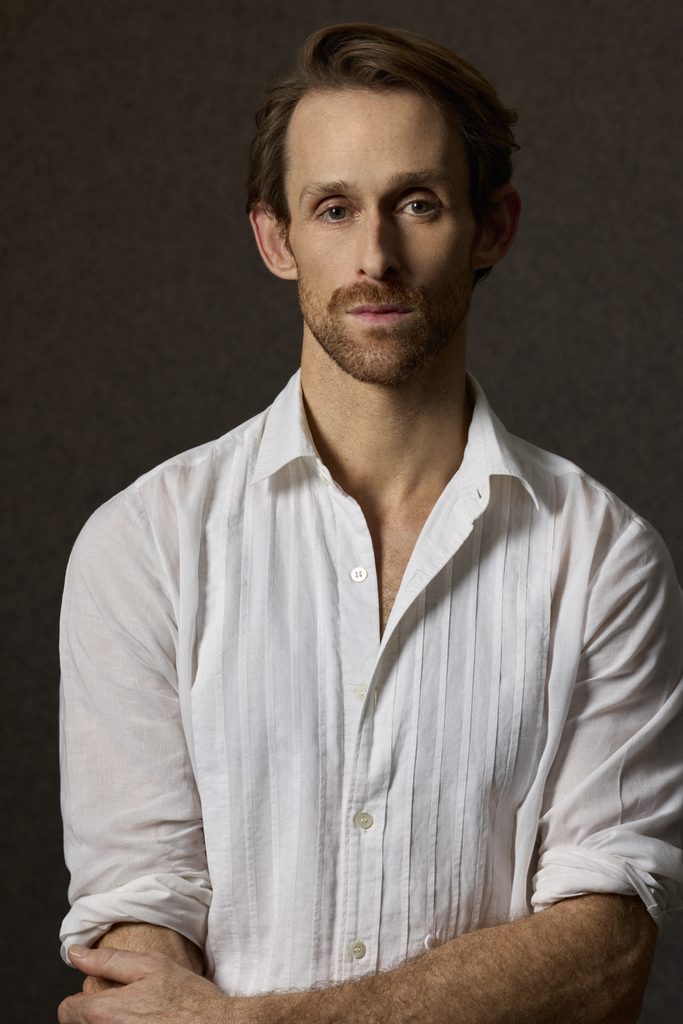
So Danchig-Waring has spent the last 24 years creating beauty, yes, but also forming his own path and philosophies as an artist. He’ll carry these experiences forward into his work with NYCI and wherever else he chooses to go next.
By the time Danchig-Waring wakes up on Monday, October 19, he will have danced in four ballets and danced the night away at his going-away party. “I’m sure I’ll feel like I got run over by a truck on Monday morning,” he says. “But I know I’ll relish every ache and pain. I’ll take it as a sign of a life well lived.”
Discover More