Can a Nomadic Gallery Change the Art World? Storm Ascher Thinks So
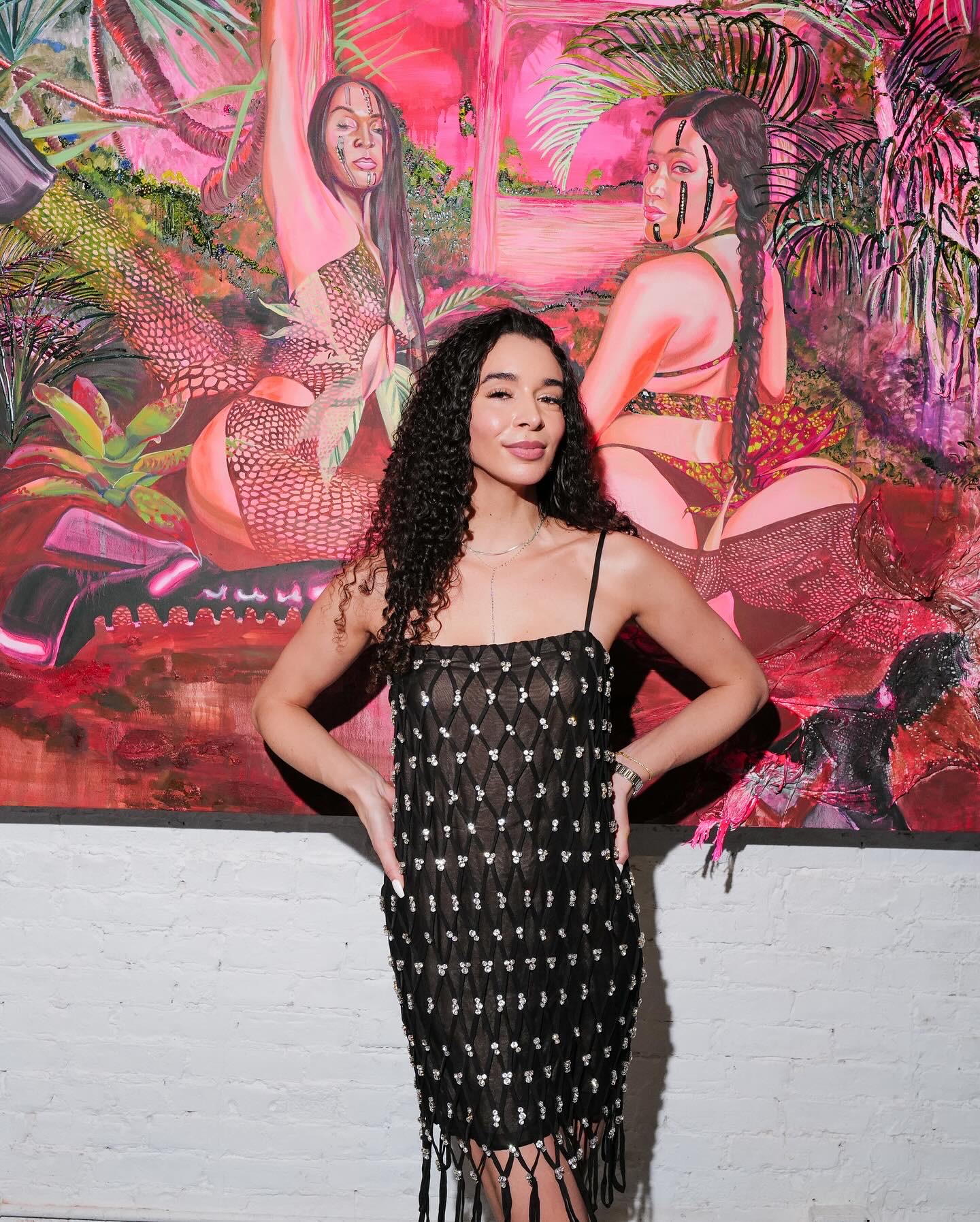
The gallery Superposition has no permanent home, and founder Storm Ascher wants it that way
Storm Ascher is a problem solver. When she began her nomadic gallery Superposition in 2018, she was seeking to create opportunities for artists to be more stable and potentially show work more than a few times a year; to work against gentrification; and to make space for herself in an otherwise notoriously exclusive field. At the beginning, she found the art world didn’t quite know how to respond to her–what do you mean your gallery has no permanent space? But now, as real estate becomes a challenging prospect in major cities and more galleries consider alternative models of presentation, work like hers has become an essential piece in moving the art world forward for both emerging and established artists.
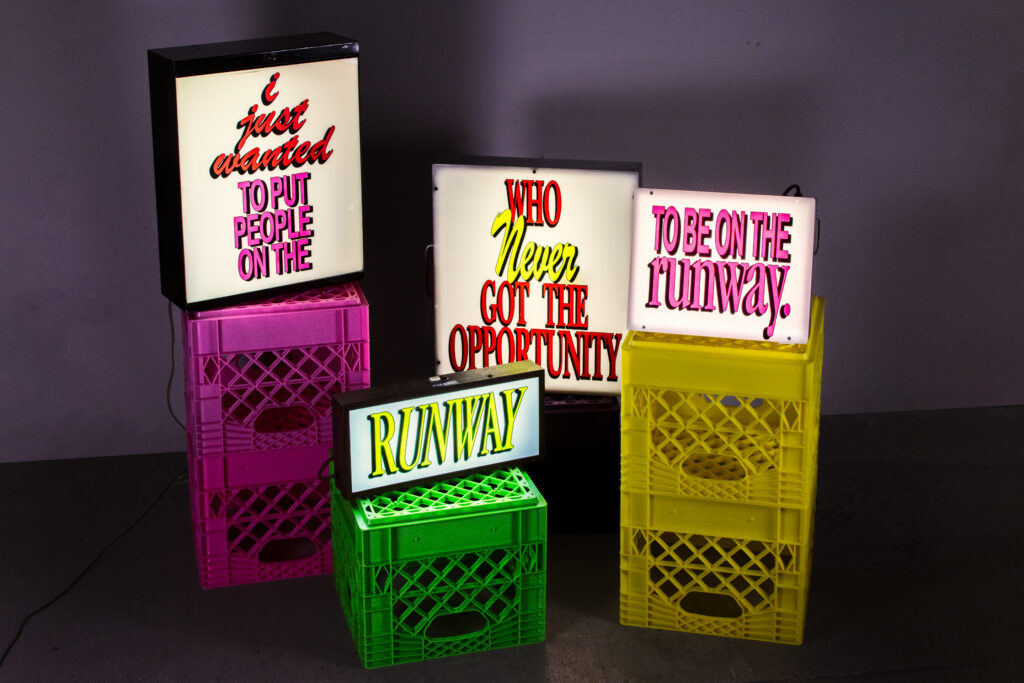
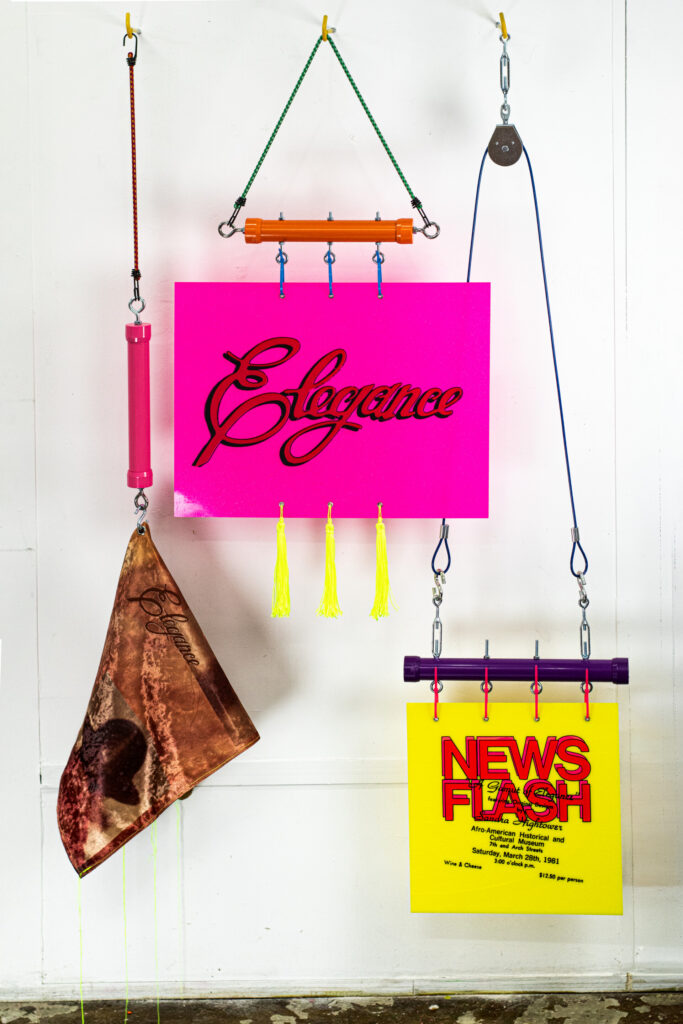
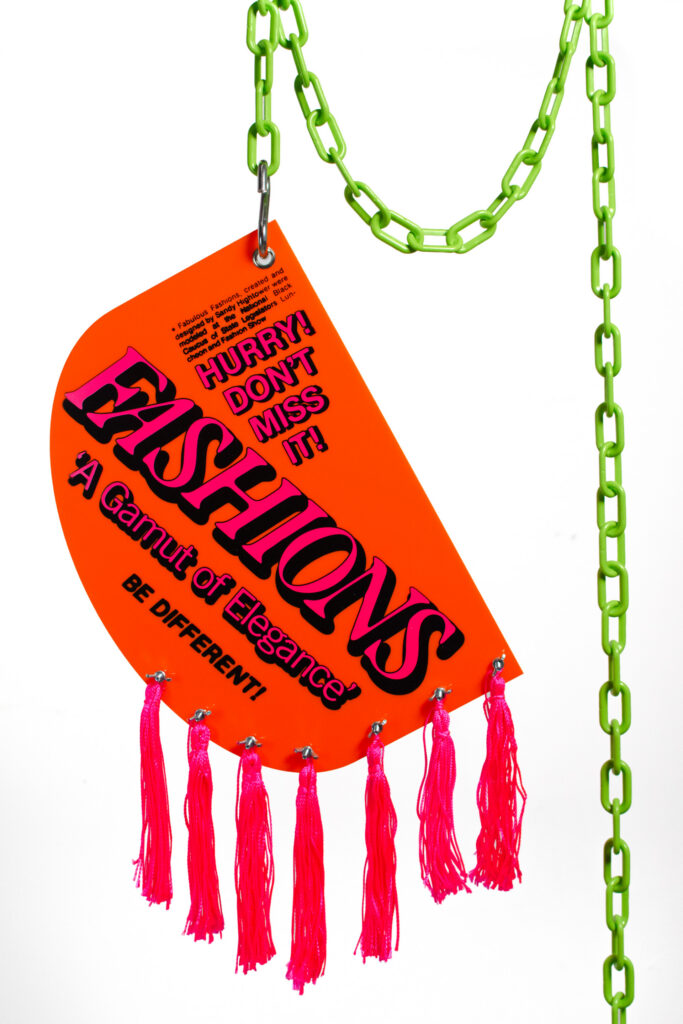
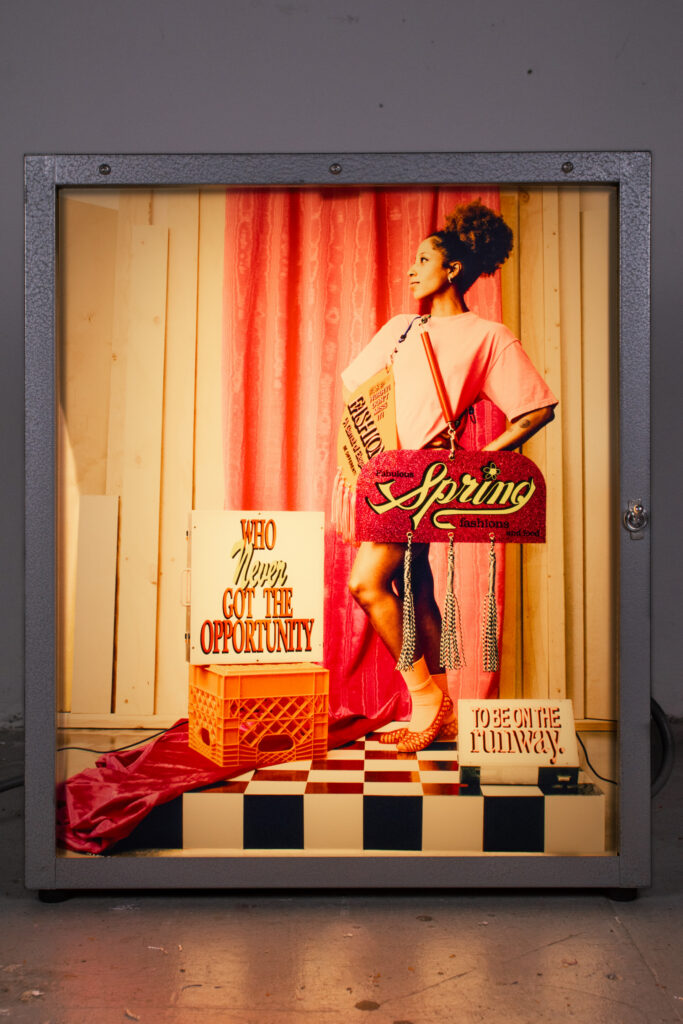
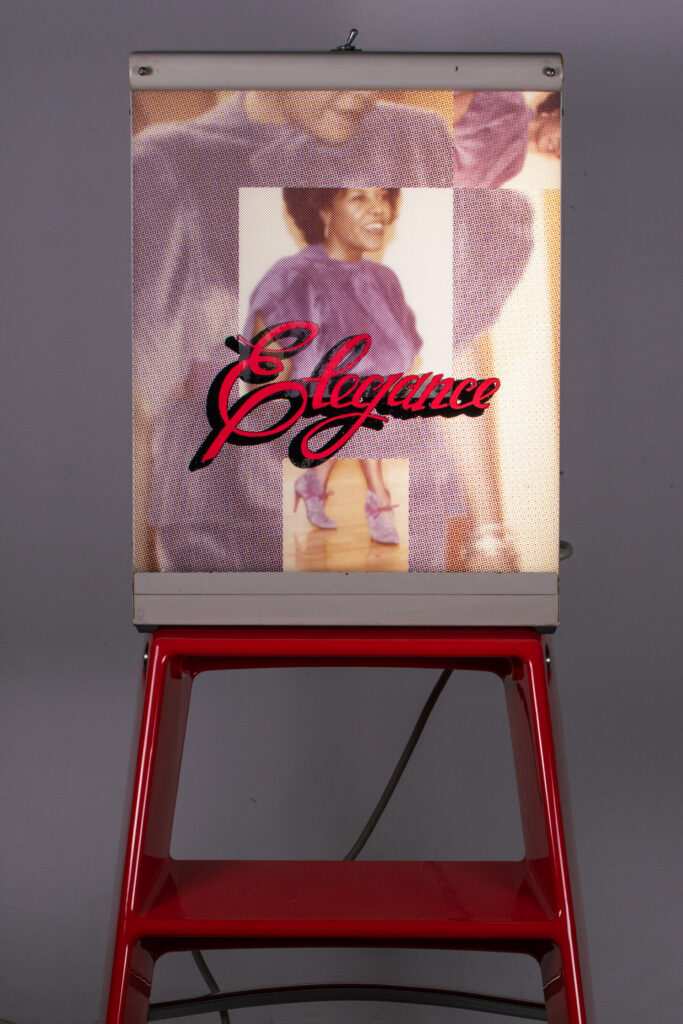
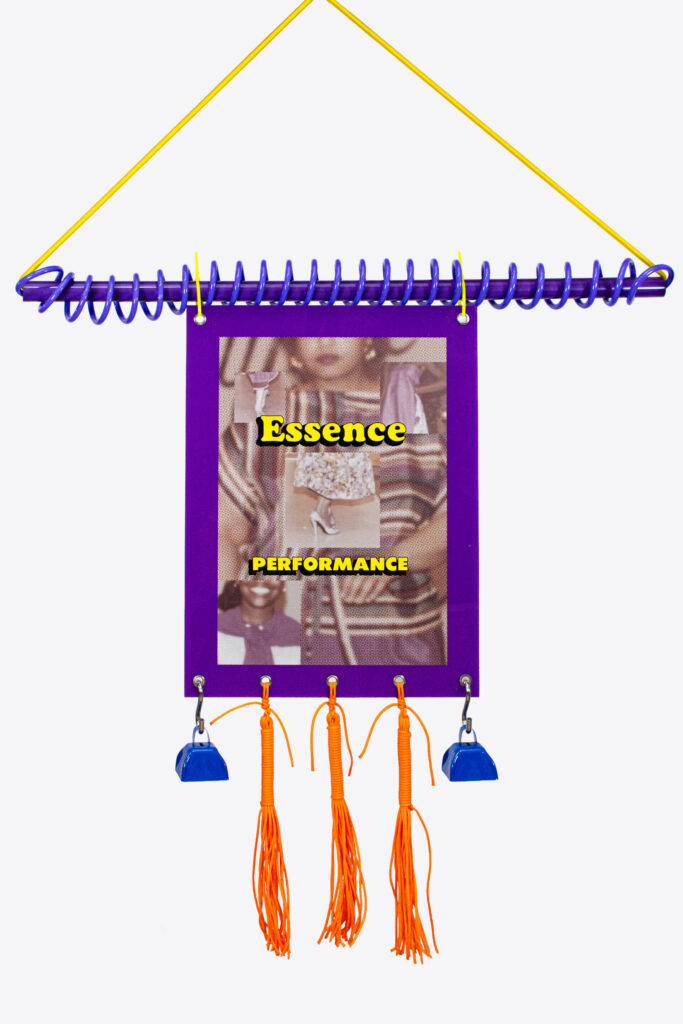
Each show Superposition puts forth–and has put forth in locations around the world–becomes a full visual, immersive experience driven by the artist’s work as well as Ascher’s own visual background as an artist. This is not your standard white cube situation. At the upcoming Armory Show, Ascher will present the work of Zoë Pulley, which is driven by fashion, personal history, graphic design, and typography. Images of this work appear below, inspired by Pulley’s grandmother, a fashion designer. “For Zoë, it’s repurposing the actual material itself and giving it a new function. She’s thinking of these garments, these ideas of how her grandmother would design a piece of fabric or a shape, and she’s extracting those shapes into these plastic riso-acrylic objects that are going to be hanging from the ceiling,” Ascher says. There will be a checkerboard platform in the booth, designed to make the booth feel like a fashion show.
Then, later this year at the Untitled Art fair in Miami Beach, Ascher will present ceramics by Audrey Lyall, also inspired by fashion. The presentations are each artist’s first solo show in New York and Miami, respectively. Indeed, Superposition has a background in working with emerging diasporic artists, particularly those who “aren’t first thinking about the objects we’re making. We’re thinking about what in society is fucked up, right?” Ascher says. “It may not be the same way I’m thinking, but they’re thinking about something that they want to solve.”
Ascher has spent not just her time at Superposition, but in her career overall, thinking about what can be fixed in the art world. In 2023, for example, she also founded the Hamptons Black Arts Council, dedicated to preserving the legacy of Black artists and institutions on the East End, and ensuring their ability to make work there in the future. In all of her work, Ascher is considering ways to uplift artists, to decolonize the art world, and to make sure all the choices for how artwork is presented are made mindfully, not relying on a past script for no reason other than “well, that’s how it’s always been done.” Because as any innovator knows “well, that’s how it’s always been done” is actually a reason to start fresh and make genuine choices that actually suit not just your needs, but the needs of the people and the work you serve.
Here, Storm Ascher talks with V about putting her own stamp on the art world, working against gentrification narratives, and what moves her to keep going.
V: I read each new Superposition show has a whole visual experience so it’s not just a white cube. Why did you want to do that?
SA: Part of it is my own resources and ability to capture an audience, when I can. That is our main time to actually interact in person. The visual aesthetic of where I am when that’s happening is important to lend itself to my mission statement. By saying I’m an anti-gentrification model, it’s like, oh, where are we right now? We’re at the Javits Center, so I’m not in someone’s neighborhood. This all goes away in three days. It’s a poignant conversation that’s apt to that very specific moment. Frieze LA, for example, is a tent in Santa Monica Airport. I remember a client coming up in the last hours of a Sunday being like, “So what do you mean your gallery’s nomadic? You just pitch a tent? And I was like, “Well, yeah, aren’t we in a tent right now?” It’s funny the types of words we’ll reach for and the ideas we think are so out of this world when we’re literally experiencing it and living it.
I would say I’m a very collaborative artist, seeing these shows as a collaboration–these are obviously all the artists’ work, but I think the way their presentations come out when working with me is vastly different from if they were to work with a different gallery. We want your most interactive, fun ideas. We don’t want just what sells the best or the most often. We can do that online on the side together. Being from LA with this idea of set building, growing up around acting, theater, and dancing, there’s a lot of transitional moments I’m thinking about when it comes to art and how the set can change. Artists, working in the parameters of Superposition, are more inspired to bring out concepts they would feel less invited to speak on in a different space or environment. A fair also lends itself to riskier ideas because it is up for a shorter amount of time. I think that’s why we get some of the more interesting work.
V: What was the moment when you decided, I can’t be a part of the art world in this standardized, gentrifying way, but I still want to push this work forward productively?
SA: It’s this timely thing. I’m actually in talks with a lot of my community members about the Olympics coming up in LA in 2028. I wrote my thesis in art about the 1992 Olympics in Barcelona, how they used a lot of artists from outside the country and put [buildings] in the center of all these shantytowns. It destroyed the fabric of the city and the way the neighborhood was flowing, and gentrified thousands of people, old vecinos, which was awful and sad. In 2015 when I was studying this, to now, this is coming to a city I know and love. How are we going to make sure this doesn’t happen in LA? But in LA, in comparison to Barcelona in the ’90s, so much has already happened on a global stage. When we’re thinking about preventing this or that, it’s a lot muddier. When I was interning at different galleries, the reason Superposition could start was because I was home in LA. There is this ever-changing, multi-layered affinity to LA that’s hard to replicate anywhere else. I don’t think my launch would have been as successful if I tried to start it right here in the middle of Manhattan. There’s so much layered gentrification where you don’t even know what the original neighborhood was. I mean, we’re on Lenape land, right? So what are we talking about? In the beginning I was romanticizing Chelsea studios back in the day, the New York School. Even that was a gentrified version of what was actually supposed to be there. In general, these cycles keep happening. I can’t prove to anyone or change their minds about what they think is the start or end of gentrification. However, you can communicate with whoever is around you to prevent and encourage something in that moment, whether that’s specifically about art or not. As an artist or cultural worker, a lot of us aren’t first thinking about the objects we’re making. We’re thinking about what in society is fucked up. At Superposition, we’re looking for artists thinking this way, too. It may not be the same way I’m thinking, but they’re thinking about something they want to solve. More times than not, it goes back to how society was slighted in some way, or how some group was misaligned.
I’m always thinking back to this class I was in in Barcelona–this man was so nice, constantly trying to tell us about the Museum of Contemporary Art in Barcelona, and how it was this huge, Mack Daddy building in the middle of everything. Barcelona’s city streets were made in these beautiful curved and crisscrossed street lines– it’s a drawing, it’s not a grid system like New York. He was talking about how the architecture of the West was ruining Barcelona’s actual city plans because they were inspired by museum plans in New York. When you follow a model you think will produce the same results, but it’s not actually for the people living there, it just doesn’t work. In that way too, I was like, I can’t participate in just copy-pasting something, and that’s what galleries do. It’s like, okay, we now have a space, we now have a roster. Let’s announce our roster. Let’s say we’re going to consign this many works with this artist for this amount of time, and let’s do two shows a year. Let’s have this calendar, and let’s go. Then you’re stuck in this cycle, but you have no mission statement behind it. Of late there are a lot of more mission-based programs happening. I hope I’ve pushed a little bit into that world to help make that less just about sales, but there’s still a lot to be done.
SA: How do you choose sites for shows with anti-gentrification in mind?
One specific town I would love to highlight is the SANS District in Sag Harbor. Two shows we have up now are at historically Black museums, one of which was built in 1840 by a Native American and Black man named Reverend Paul Cuffee. This is a site that manages the first Black, Jewish, and Indigenous gravesite in the Hamptons. In the 1700s, that was pretty insane. This was before America was even founded. Freed slaves built a community of multiple different races with the natives in Sag Harbor. I thought that was interesting, given my own identity and history, being Jewish and Black, and also having lived in Sag Harbor myself, not knowing that I was sitting right on top of that history. It was culturally shocking for me when I realized I was living across the street from the Eastville Community Historical Society because there was no signage. There’s a gas station across the street. There’s no sidewalk or crosswalk that denotes that this is something historical, that you should maybe be careful driving around those corners. Come to find out my lovely mentor, Dr. Georgette Grier-Key, the executive director and curator there, has been fighting the town for years, trying to get these things passed. She gave me my first space in the Hamptons to hold a gallery show to talk about all these problems. We hosted a panel during George Floyd for Black artists to speak about what it means to have a second home in the Hamptons, what that even meant for Black people during the Harlem Renaissance, and how we have different waves of this understanding. Gentrification happened because people didn’t want affluent Black people to continue being affluent. That’s a very different story than what is shopped around to most people when they’re researching gentrification.
It’s not that anybody of any race can’t gentrify, but the reasons it happens sometimes can be way more insidious than others, and sometimes you have no idea. A lot of times it has nothing to do with you but you’re complicit in something. Then there’s times where you’re actively and aggressively doing something. That was the case in Sag Harbor. We’re now raising funds, and we launched a $6 million campaign this year to buy back property in the historic Azurest district in SANS, and we hope to turn it into an artist residency in the future. That’s also the next phase of things through my foundation, the Hamptons Black Arts Council. The past few years have been these ongoing conversations at the Watermill Center, where I first had my internship, which has been nice and full circle. They host eight artists on the property every summer on Juneteenth, and we break bread. We have a chef come and cook a meal inspired by where the artist is from. This year, we worked with a Senegalese chef, Rosa Troy, and showed art by an artist, Anthony Akinbola, who’s from Nigeria. He was able to take over the whole gallery museum space at The Watermill Center. A Nigerian artist who shows with Superposition gallery in these nomadic spaces is now taking over one of the most historically famous museums in the Hamptons that is often reserved for people like Robert Wilson, who just passed, and his contemporaries that are globally respected. We’re trying to not dismantle that history because it’s very important, but be additive to it. We want to be part of this conversation, and we are a part of this conversation and this history. It’s not separate. It’s not segregated. These institutions and organizations are helping us actually get to that next step. Let’s talk about it together so we can make it work and get to our goal faster. I’m never trying to isolate us further, but to get other people to understand why we even got here in the first place, and that we can all come back in now.
V: It seems to me a lot of your work is not just against the gentrification of space, but against the gentrification of ideas as well.
SA: It goes back to the Barcelona conversation. What happened to New York happened in such a crazy way. Then something similar happened in Barcelona, but even worse because they tried to follow for a society that wasn’t like theirs. That’s the gentrification of ideas aspect. When you try to subscribe to something you feel only connects to you, you’re pushing out all these other ways you could be inspired to change your life, or that could help get you out of the hole you’re digging yourself, or a hole someone dug for you.
Why can’t I put nomadic as my city name on the fair sign? You have to put a city. So I’m gonna put Marrakech, London, New York, LA, and everywhere I’ve ever shown. That actually happened in one of the fairs. Somebody thought I had literally Mack Daddy locations in each of these cities, and that’s the antithesis of what I want them to think. Words matter, visuals matter. I do not have a space. I am not opening a space. It’s a funny thing for people to be like, “but why?”
V: You’ve talked in the past about feeling that the art system is not built for you as a gallery. How has that changed since starting Superposition?
SA: It’s definitely more accepted. Artsy put out an article saying why nomadic galleries are popping up everywhere with a list of all of these peers I now have. I am now on the host committee for EXPO CHICAGO, which is a Frieze organization now. They’re thinking about bringing in more galleries with alternative models. It has given them some hope when a lot of galleries are closing down because of the old model and a lot of articles talking about how the overglobalization of art galleries-blue-chip spaces, hindered the market, was blown out of proportion and unrealistic, not necessary. The globalization of art isn’t the issue. It was the real estate part of it. That’s why fairs are so addicting. You’re able to participate in this nomadic experience. That’s why it was so funny to me that the fairs at first weren’t accepting us. I’m like, we’re literally trying to follow you around the world and participate in this nomadic model.
Frieze called and asked why my address was a residential address. It was my mom’s apartment in LA, and I was like, “Well, that’s where all my mail goes. Yeah, that’s the address,” and they’re like, “This isn’t a gallery.” I was like, “I mean, I have a lot of art in here. If somebody buys something, that’s where they’re gonna pick it up,” point blank period. It’s funny now because [Frieze Director of Americas] Christine Messineo is so gung-ho, texting me “Can’t wait to see your next application.” Our Frieze booth from LA was the poster child of the next application round for 2027: ‘Apply to Frieze 2027’ with my booth right there. So they get it, and then also the artists get it. A lot of artists who at first would give me a few works for an auction or a group show now are down to do solos, and I totally understand that. I started my gallery because I was so skeptical of every gallery that I didn’t want to put my work into them. I’m creating models I hope an artist would feel comfortable putting their work into. Is the model actually changing? Yes, and I hope that people can also help with sustainability. A lot of people didn’t believe in it at first, and a lot of people have to believe in an idea for it to gain traction. It’s great that a lot of artists believe in it. Those are the easiest people to convince because they’re researching the same things you are. But it’s about having collectors understand, “I have to keep helping sustain this idea by buying from this gallery instead of this one.” If they’re showing the same artist or fairs giving more opportunities to models like mine and putting me on a selection committee, that’s a nod to the model. I think that’s amazing. I’m looking forward to being given more decision-making power that affects other galleries and other up-and-coming curators and gallerists that want to do something like this. That’s what makes it a system, something symbiotic. I don’t want to be just the anti-gallerist pushing against everything. No, I wish everyone was doing this so we could all share the space and ebb and flow off of each other. Seeing the articles about closures is funny–many people weren’t even saying they were closing. They were saying “we’re moving towards a more internal model,” or “I’ll be advising on the side.” They used all the words except nomadic gallery. We’re trying to figure out a new way to keep doing this because we need this and we need the artists to keep making work because we have to keep changing minds. We just can’t sustain this McDonald’s version of it.
V: While working on Superposition, were there specific moments where you thought to yourself, “this is why I’m doing it”?
A lot of it is when I’m walking around with a group of people, and they all have Superposition bags. When we’re in the Hamptons, I’m walking around behind everyone, all the artists whose lives have changed since we’ve met each other, walking towards the beach I’ve introduced them to. Then we’re sitting down, and another friend of mine walks up, and she also has her Superposition bag, and her husband is coming with their baby. We’re building these lives. It’s not actually the moments in the gallery or fairs necessarily. It’s the in-between moments where you feel, because of what I do, we now have a community that does these things together. We have an understanding that this created a family or a movement. When you think about movements and how you would read about artists responding to each other in the past in art theory, we’re doing that in real time. Even if we’re not writing these things down. This gallery model sets up parameters for artists to live in the moment and slow down and be with each other, and I get to experience it with them too.
The Philadelphia Museum of Art also purchased a work from my booth. That was huge. That is going to be historically known forever, that an object I helped present because I believed in the story and the history of this artist, Helina Metaferia. The way it was purchased was also why I do what I do. Three Black women pulled the funds together to donate it to the museum because otherwise it wouldn’t have happened. The museum couldn’t afford it because museums are defunded right now. The time it took to build all three of those relationships, where they felt comfortable enough to each donate a certain amount of money, not necessarily knowing they’d get credit for that, just knowing this needed to happen. The more people are involved with a sale or an experience is why I do what I do. Those gathering moments. The Philadelphia Museum curator, the three women who pitched in to donate, were all in the booth at the same time, hugging and the artist is there, crying. I’m crying. They’re taking pictures of us, cheersing us. That’s the why.
Discover More