“Dancer in the Dark”: Schiaparelli Spring/Summer 2026
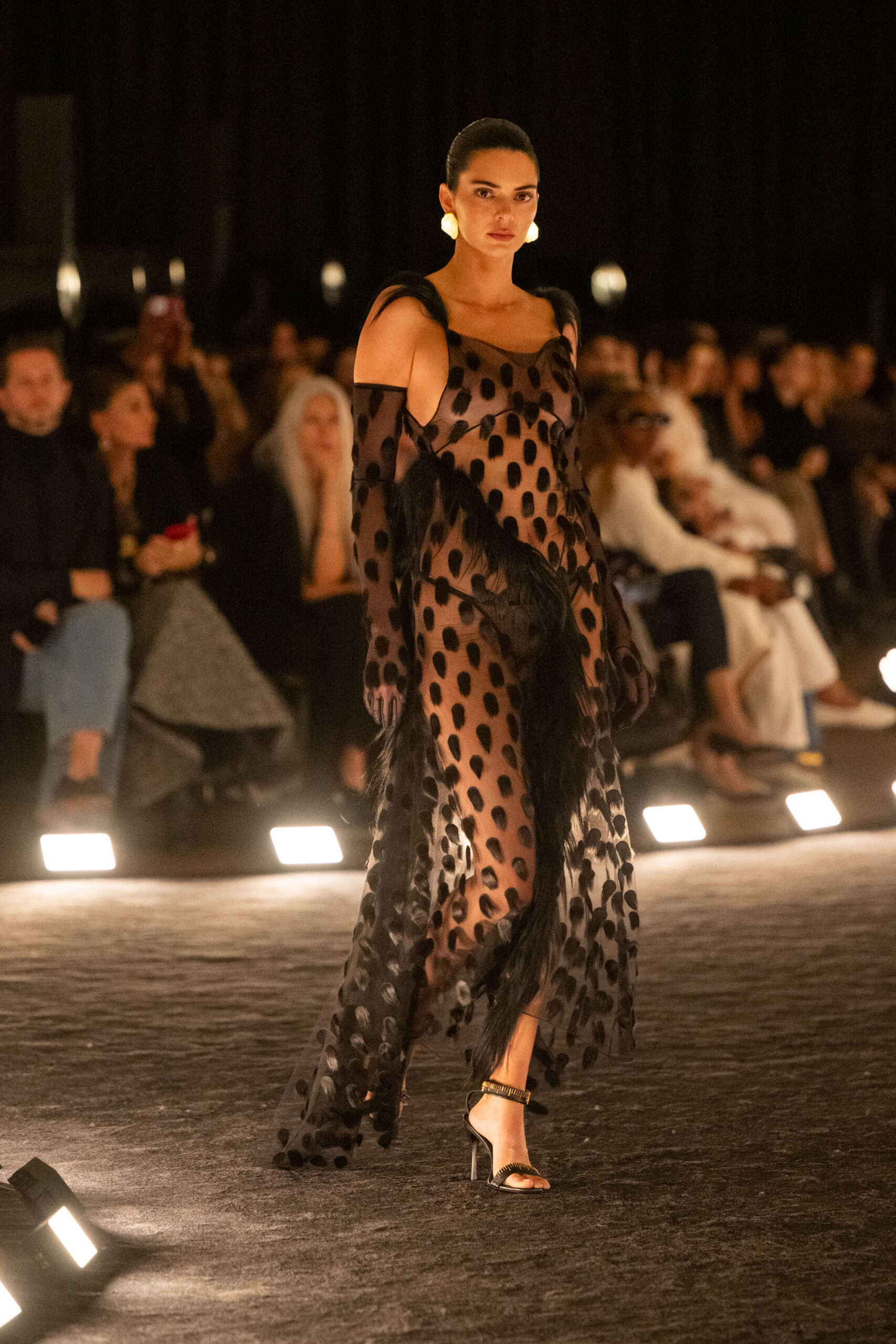
Six years into his tenure, Roseberry uses this collection to argue that ready-to-wear can carry as much weight and fantasy as couture
At the Centre Pompidou in Paris, Daniel Roseberry presented Schiaparelli’s Spring-Summer 2026 ready-to-wear collection, Dancer in the Dark, in the same gallery that had housed the museum’s Brancusi retrospective. The venue reflected the house’s longstanding relationship with art, which began with Elsa Schiaparelli’s trompe-l’œil bow sweater in 1927. By knitting the image of a bow directly into the fabric, Elsa established visual illusion as an early house code, which she later developed through her collaborations with Surrealist artists, particularly Salvador Dalí.
Roseberry refers to this history first through construction, beginning with precisely cut jackets that establish a defined shoulder line before moving into draped gowns that fall more loosely over the body while maintaining a long, narrow column silhouette. Across both, black and bone white dominate the palette, with crimson appearing as an accent. The focus then moves from shape to fabric, as trompe-l’œil jacquards based on Roseberry’s drawings recall Elsa’s early knitwear. That use of illusion continues in the accessories, where necklaces of stacked salt stones emit their light and the Secret Padlock bag takes on a slumped form inspired by Dalí’s melting clocks. The Dalí connection then returns to the clothing through new interpretations of the 1938 Tears Dress in bias-cut satin and gold metallic mesh, with trompe-l’œil panels creating the appearance of shredded material.
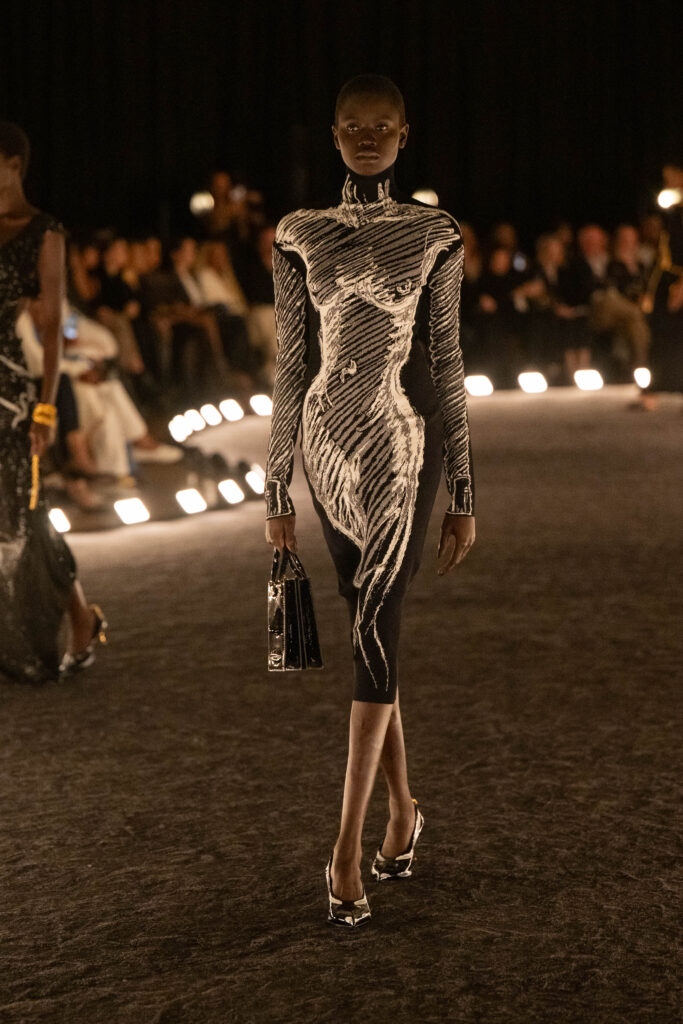
Schiaparelli’s love of trompe-l’œil appears in the form of a black jacquard knit dress sketched with the contours of a woman’s body. Both humorous and sensual, it plays with perception: where does the body end, and where does art begin? Styled with a black leather Face Bag adorned with enameled white anatomical jewels.
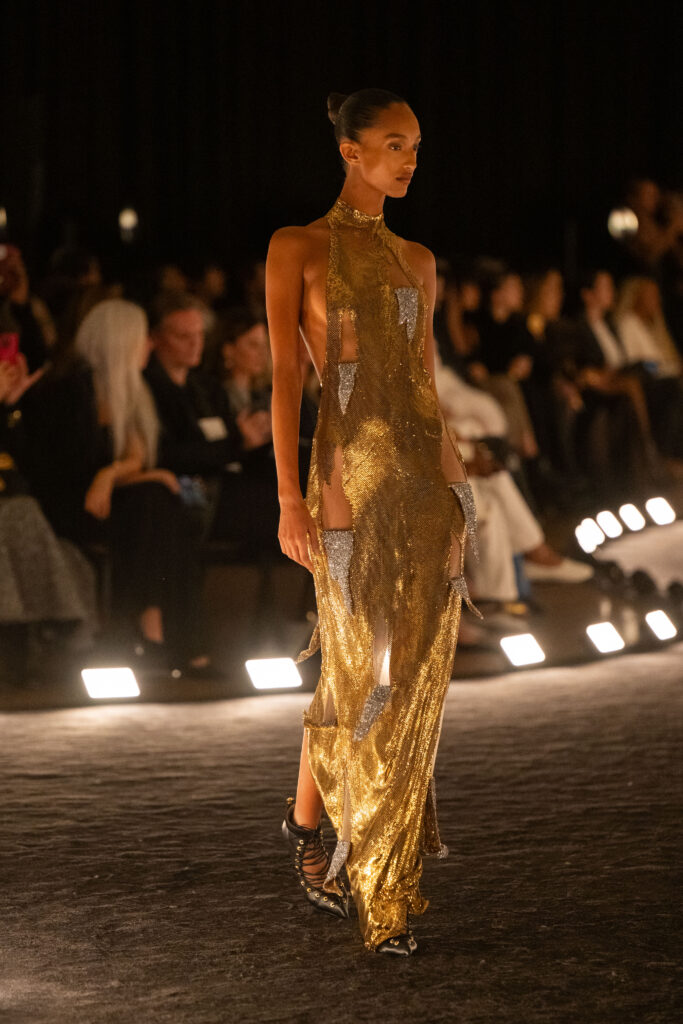
In homage to Elsa Schiaparelli’s collaboration with Salvador Dalí, Roseberry reimagines the Tear Dress as a gold halter gown in metallic mesh. Trompe-l’œil fabric shreds embroidered with crystals shimmer across the body, while open-toe boots with gilded eyelets complete the vision of surrealism fused with extravagance.
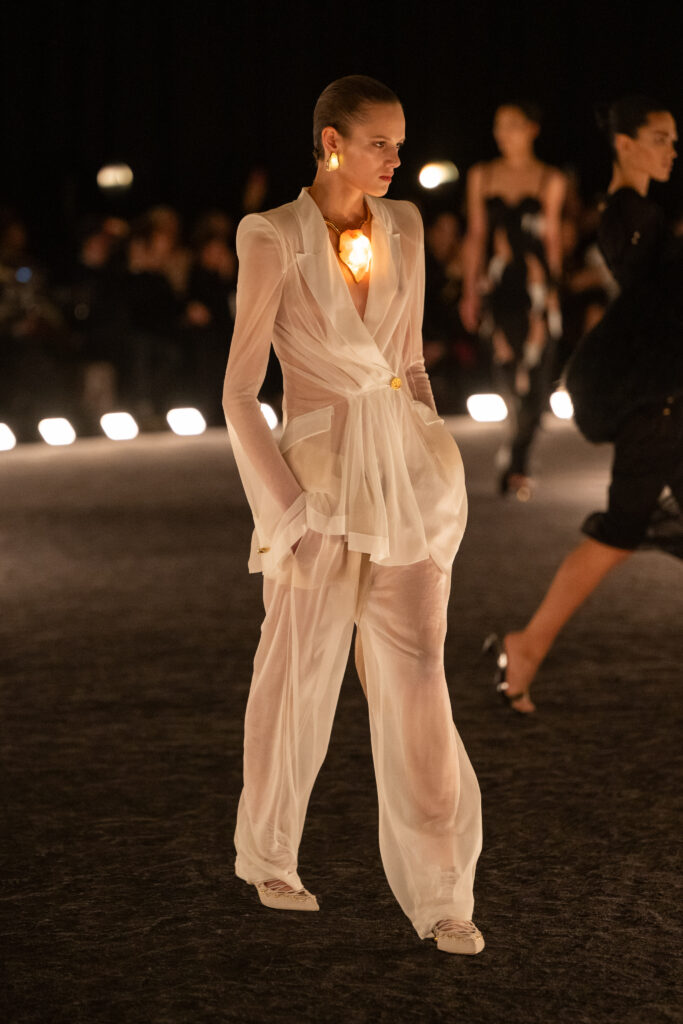
Volume and transparency is explored through a white jersey ensemble with a draped double-breasted jacket gathered by a gold bijou button, layered over pegged pants of the same fabric. The weightless tailoring contrasts with a glowing salt stone necklace, turning minimalism into a statement.
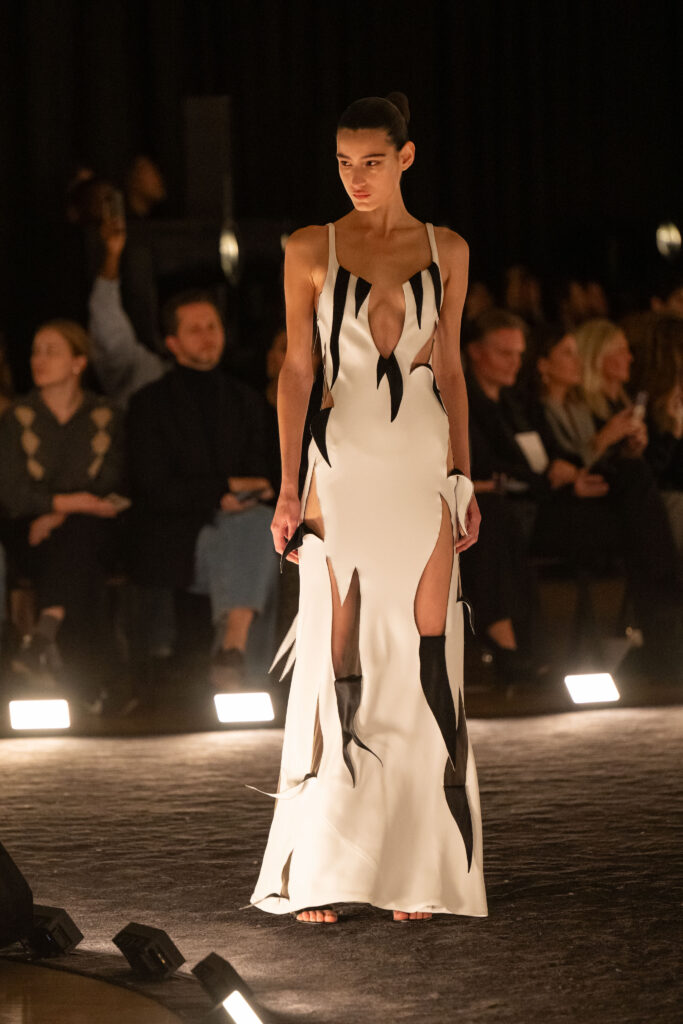
In a second reinterpretation of Dalí’s Tear Dress, a plunging white satin gown, shredded with trompe-l’œil cut-outs, reveals stark contrasts. The neckline elongates the figure, while the bias-cut drape recalls fabric caught mid-rip. The look is completed with Measuring Tape heels in gilded leather.
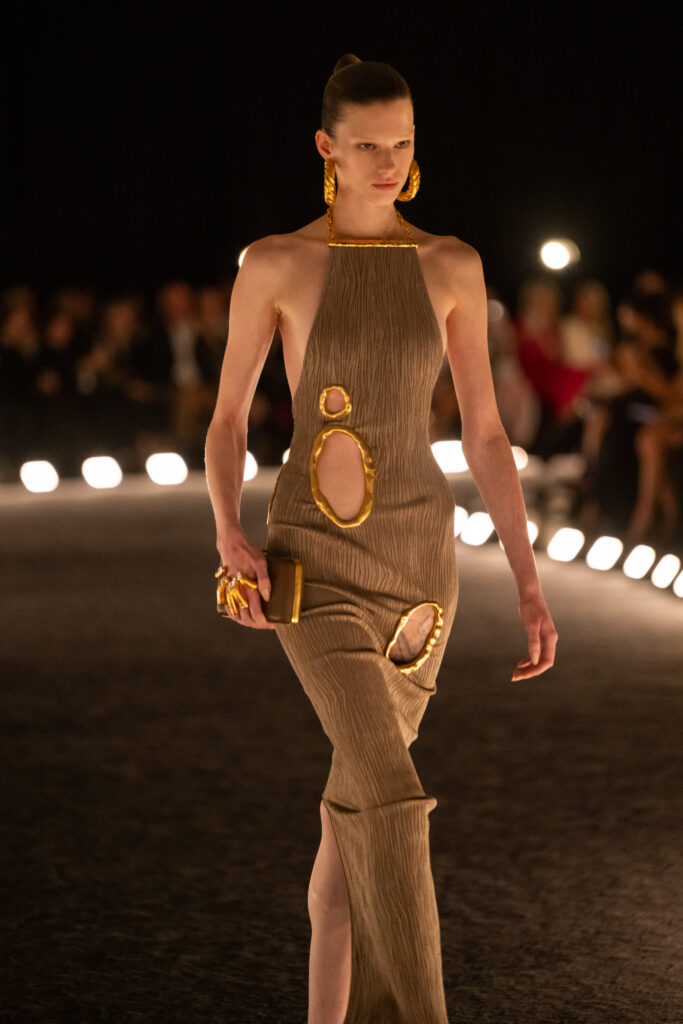
A halter-neck gown in khaki viscose knit, textured with a tree-bark effect. Cut with irregular openings framed in golden metal, and finished with a golden jewel chain trailing the back, the dress refashions a classic into a showpiece. The stylistic choices amplify its presence through the use of twisted brass hoop earrings and a brown leather Hand-in-Hand clutch gripped by golden fingers.
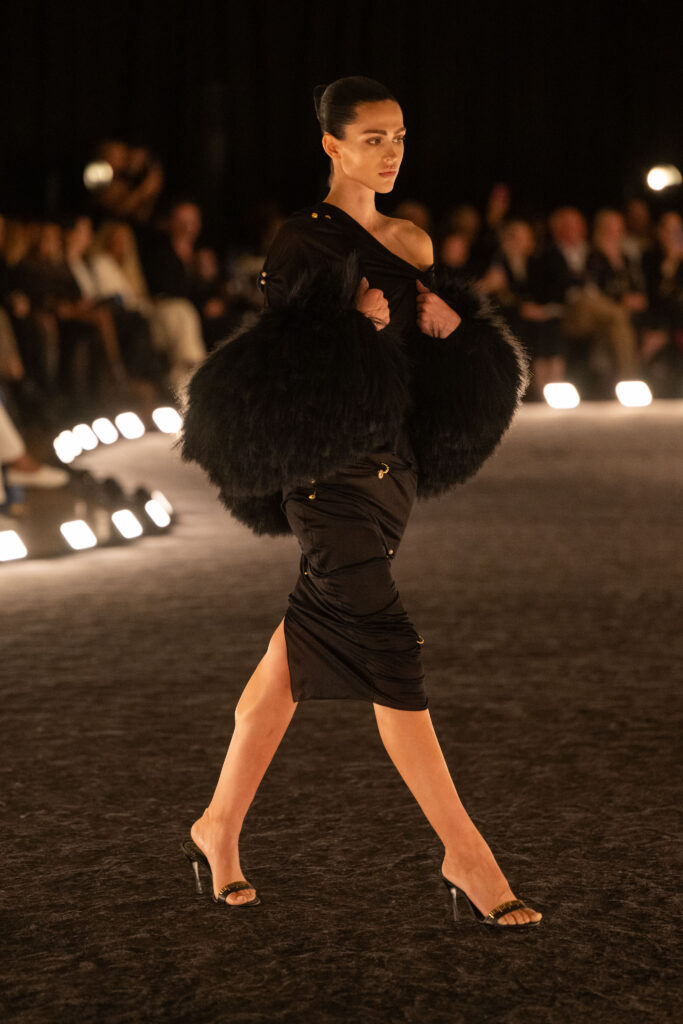
An asymmetrical black jersey dress, its volume gathered by piercing-like jewels, creates a deliberate disarray. Draped rather than tailored, the black jacket embroidered with monkey fur tops the ensemble.
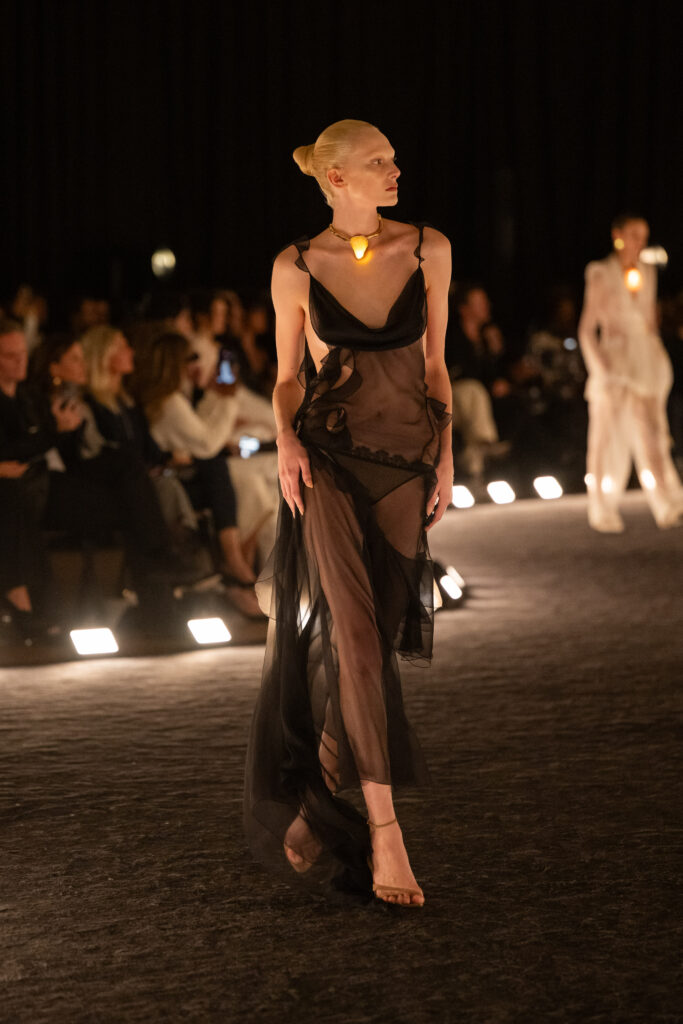
A black chiffon asymmetrical dress, traced with ruffles and delicate straps. Its transparency is framed by a glowing necklace of stacked salt stones that illuminate the neckline. This moment, on the runway, conveyed Roseberry’s conviction that ready-to-wear can carry couture’s electricity.
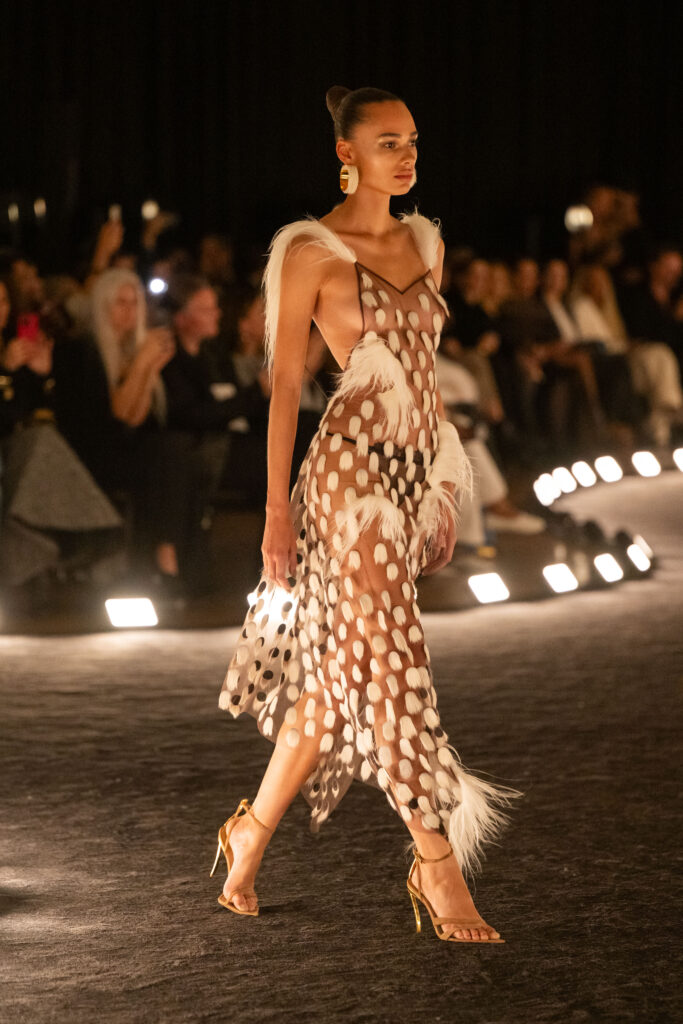
A brown tulle gown embroidered with white goat-hair circles, layered with tufts of fur at shoulders, waist, and hem. Hoop earrings wrapped in goat fur add to the uncanny spectacle.
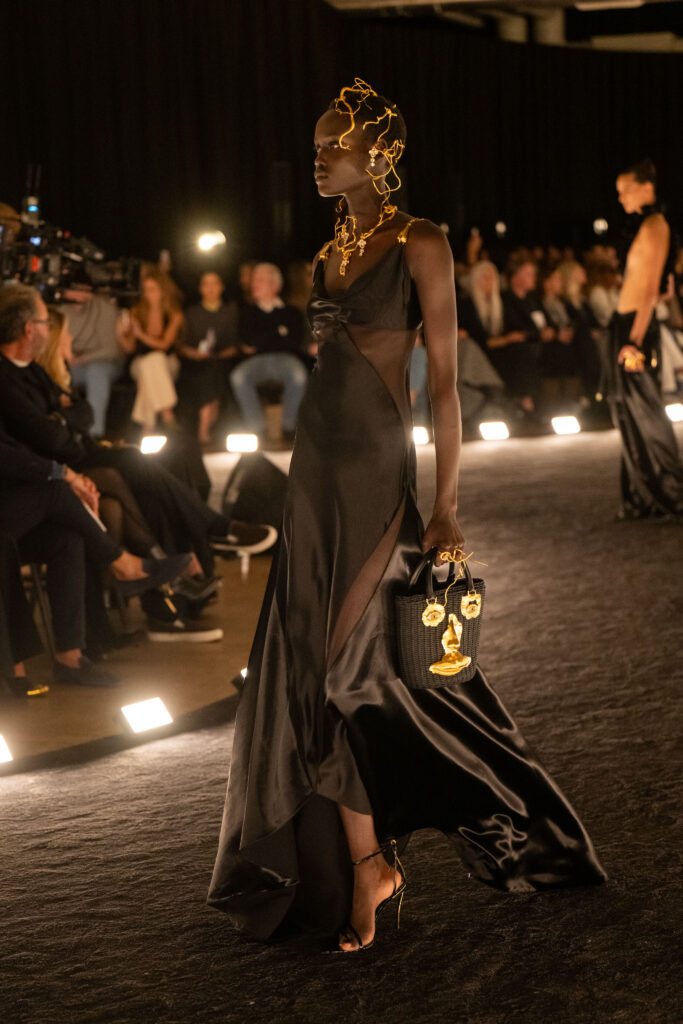
This black satin maxi dress embraces the bias cut with precision, its fluid drape enhanced by cut-outs and sheer tulle at the sides. Gold straps and buttons trail down the back. The star accessory is a black rattan-effect leather bucket bag adorned with a “melted” gilded face, recalling Dalí’s distorted clocks.
“Dancer in the Dark”: Schiaparelli Spring/Summer 2026, all images courtesy of Schiaparelli
Daniel Roseberry has said that a Schiaparelli show should feel like visiting a museum rather than watching a conventional runway, and the presentation encouraged the audience to examine both the silhouettes and their details. Aaliyah’s music gave the show a slower pace, allowing the construction of each look to remain visible. Although Dancer in the Dark is classified as ready-to-wear, its development reflects the same level of consideration associated with Roseberry’s couture.
Discover More