Heroes: Marina Abramović Is Turning Presence Into Power

With her new exhibition, ‘Transforming Energy’, the art provocateur invites us all to feel what lingers beyond the visible
Energy has always been a central element in Marina Abramović’s work and public presence. Her status in the art world has had less to do with mystique and more with energy and charge of the now. You feel her before you explain or interpret her. This has given her a massive and strikingly diverse following that extends far beyond the usual circles of contemporary art. Younger audiences in particular are drawn to her with a kind of fervor, perhaps because she asks of them something that the present moment so rarely does. She requires them to be here, in the present, and to remain with silence, stillness, and the discomfort of undiluted feeling. In a culture of endless distraction, Abramović has made unfettered attention feel radical, even glamorous, and decidedly transformative.
This may be the secret of her singular popularity. Through the force of her own energy, she has positioned herself beyond the categories that so often narrow public life and artistic reception. Beyond gender, she remains one of the most powerful women artists in history. Defying age, she now approaches eighty with her aura intact and her artistic output in full swing. Her work carries an intensity that many experience in devotional terms, while avoiding overt religious themes. Her life and career have crossed war, ideology, and social upheaval but resist the simple interpretation of regional or identity politics. Abramović certainly belongs to a long art historical lineage of the body, but also to a wider human longing for transformation.

It makes perfect sense that energy would remain central to her practice. Abramović has always been drawn to sources of force, whether in breath, ritual, stillness, vulnerability, or the raw limits of the body. Over time that sensitivity led her further into the earth, toward crystals, minerals, copper, iron, and the resonant energies held within physical matter. What emerged from that movement was an expansion of the logic of her earlier work. The body remained central, though now less as a site of endurance and more as a receiver, a vessel, a charged instrument in relation to larger metaphysical currents.
The decisive passage in that evolution came with The Great Wall Walk in 1988, now one of the most famous works in the history of performance art. For three months, Abramović walked across the Great Wall of China through sublime and changing landscapes. Sleeping in villages along the Wall, she encountered elders and local sages who shared with her ideas about traditional Chinese medicine, the energetic properties of crystals, and the invisible forces that move through the natural world. Beneath her walking feet, on the Great Wall, was stone, immense distance, and geological time.
From that experience grew the Transitory Objects, which stand at the center of her new exhibition, Transforming Energy. Made from materials such as quartz, amethyst, copper, iron, and other mineral elements, these works ask viewers to do something at once simple and profound. To stand, sit, recline, pause, and most importantly, to receive. They extend Abramović’s lifelong commitment to presence into a subdued and more enduring register. Their power comes from contact, concentration, and the charged relation between the human body and materials that long predate it. They draw the viewer toward another timescale entirely, one measured less by the urgency of the moment than by the slow and enduring life of the earth.
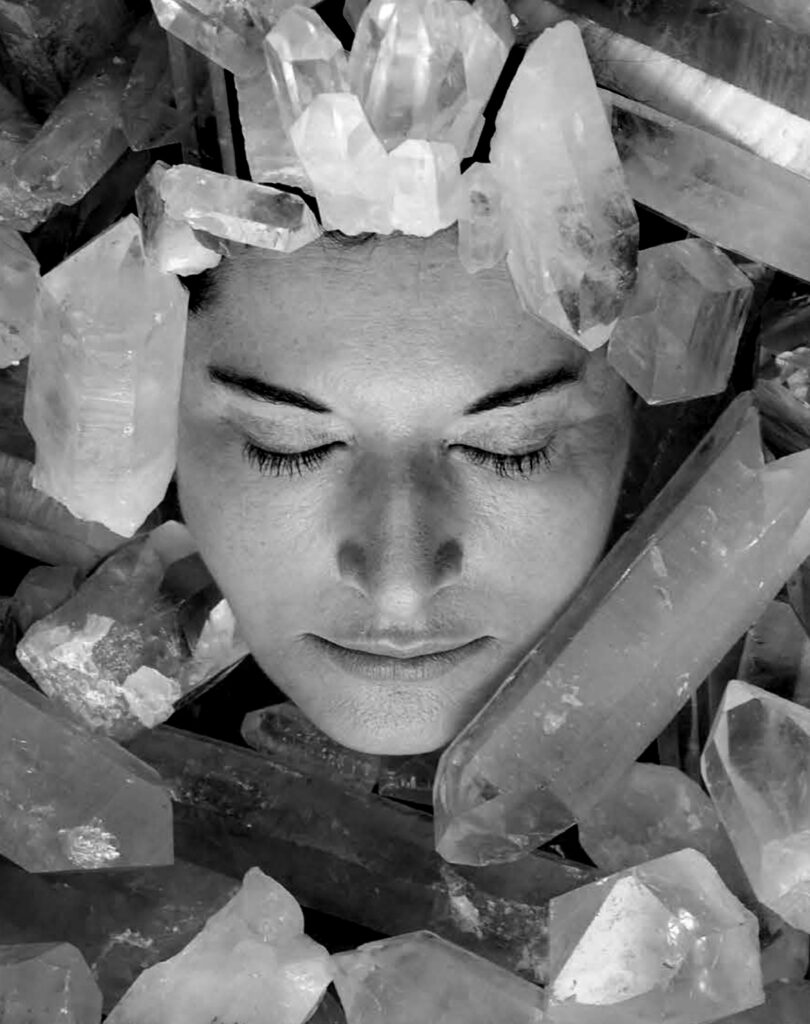
This May, Transforming Energy opens at the Gallerie dell’Accademia in Venice, placing Abramović in dialogue with the long inheritance of Venetian artmaking. For an artist so often encountered through the defining institutions of modern and contemporary art, the setting clarifies something fundamental. Venice reveals Abramović as she has long been understood by her public as a figure of remarkable force, charisma, and reach; an artist whose energy has traveled so far beyond the expected limits of performance that she now occupies a realm closer to cultural myth.
In Venice, these concerns take on a special resonance. Abramović first came to the city as a girl with her mother, who worked in Yugoslavia’s Cultural Ministry, and she has spoken of being overwhelmed by its beauty, even crying when she saw it at fourteen. At the Accademia, her work moves into proximity with Titian’s Pietà, and the encounter carries affective and historical weight. It places Abramović within a lineage of artists for whom the body is a site of grief, exaltation, transformation, and the possibility of transcendence.
This exhibition arrives at a moment when Abramović’s legacy is already indisputable, yet her energy remains wholly active, generative, and present. More than a body of work, her practice has produced an energetic afterlife of aura that continues to circulate far beyond the original moment of performance. Crystals, minerals, memory, and presence all play a role in that transmission, but the true subject is Abramović herself and the extraordinary force that allowed her to change performance art forever. What endures into the future is not only the work, but the charge she placed within it that continues to move outward, to gather followers, and to keep her presence vividly alive.
This story appears in the pages of V160: now available for purchase!
Discover More