In Allie Rowbottom’s New Novel ‘Lovers XXX,’ Glitter and Grit Collide
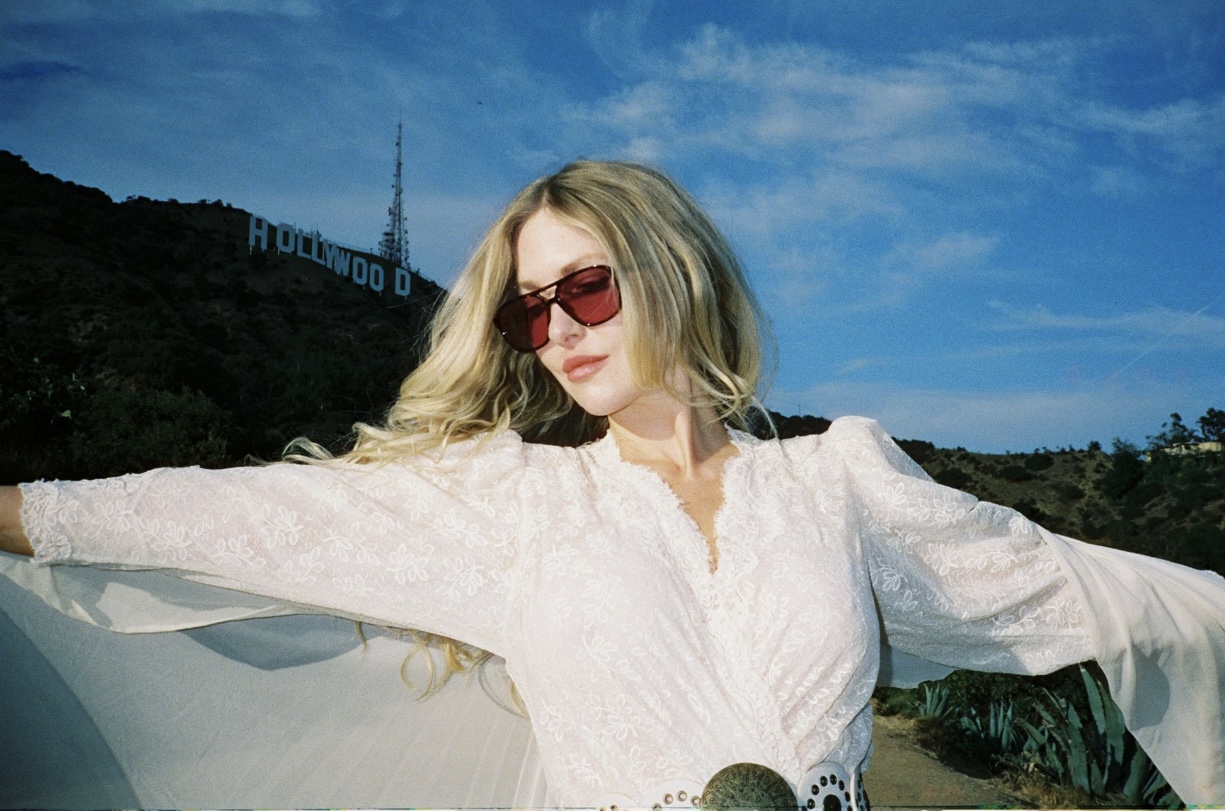
What does it look like when a taboo topic gets the literary treatment? Allie Rowbottom wants to show us
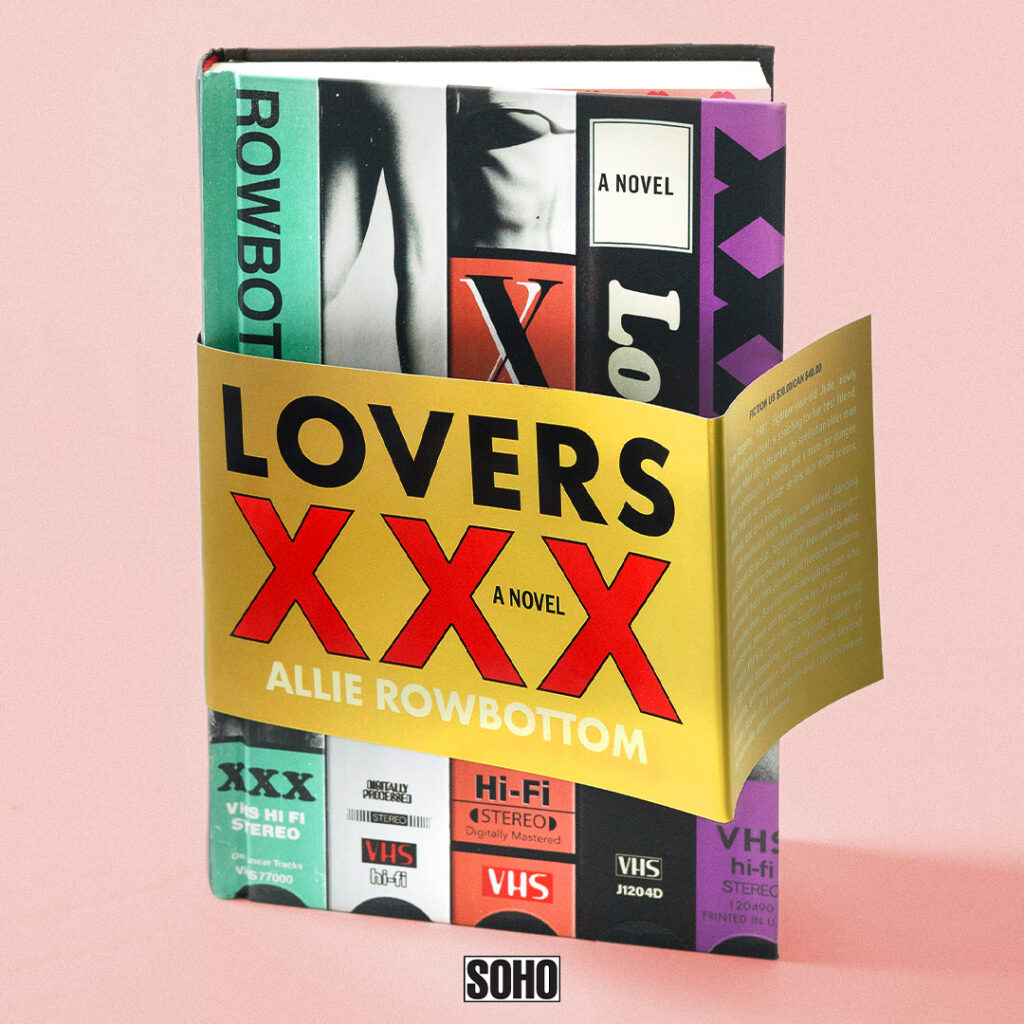
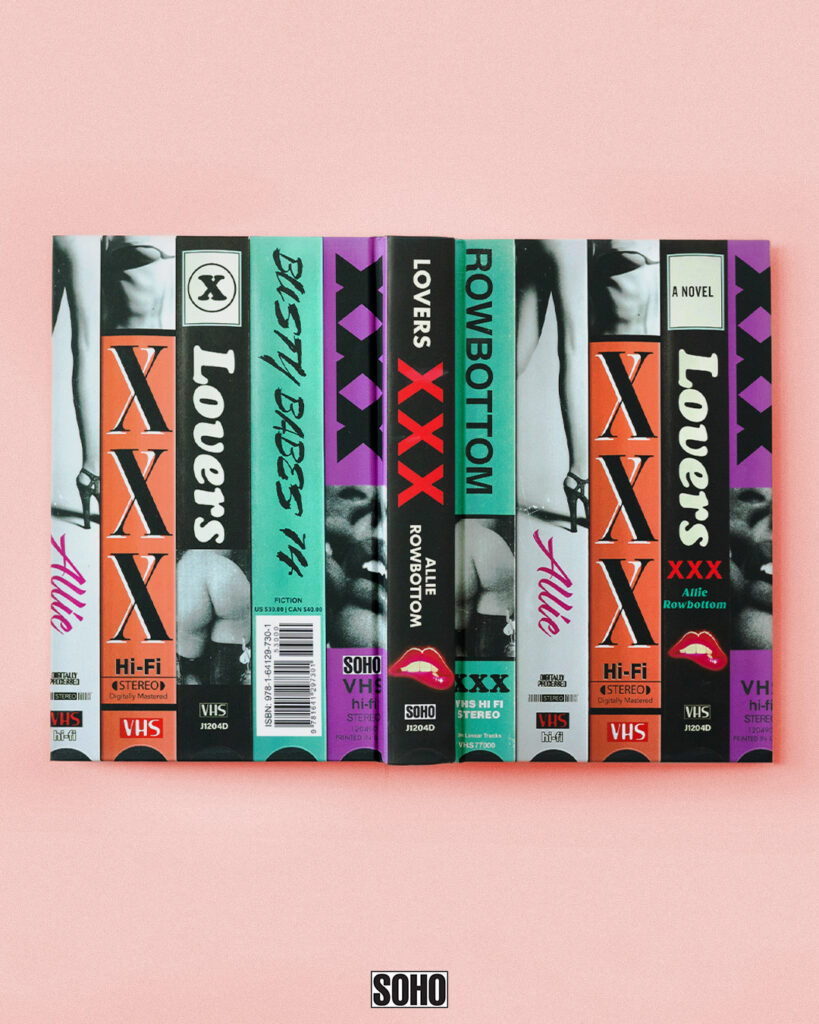
In Allie Rowbottom’s new novel Lovers XXX, two young women traverse the pleasure and pain of the pornography world in 1980s Los Angeles. In one scene, our heroines arrive at a porn awards show oozing of glitter and grunge–somehow this scene has come to life at New York nightclub The Box on a Thursday night as Rowbottom launches the book into the stratosphere.
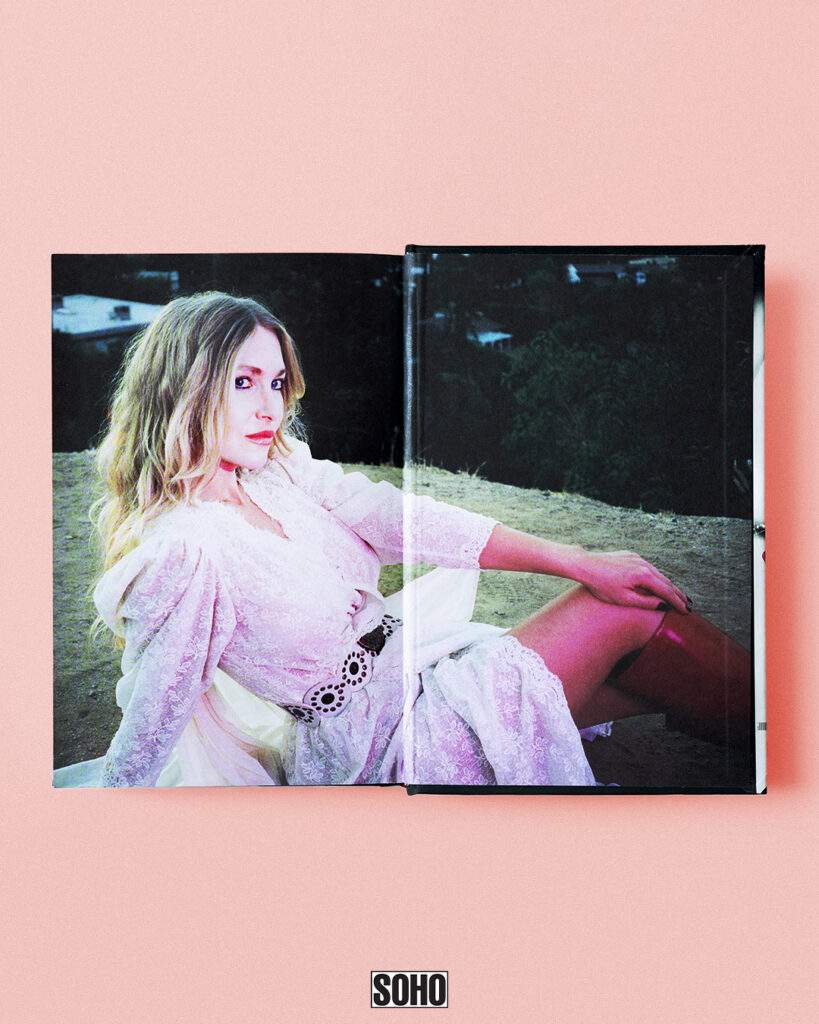
Outside, there’s a red velvet rope opposite a peeling black door, and inside bodies crowd together under the venue’s red lights. A disco ball spins, hip-hop plays, go-go dancers swivel and preen. Rowbottom’s long, wavy blonde hair flows around her shoulders as she reads from a custom dress made of her own book, ripping off the pages as she finishes, performing a striptease. If there’s any time to be a hot, literary baddie, it’s at your own book launch party (it officially arrived in bookstores on June 2).
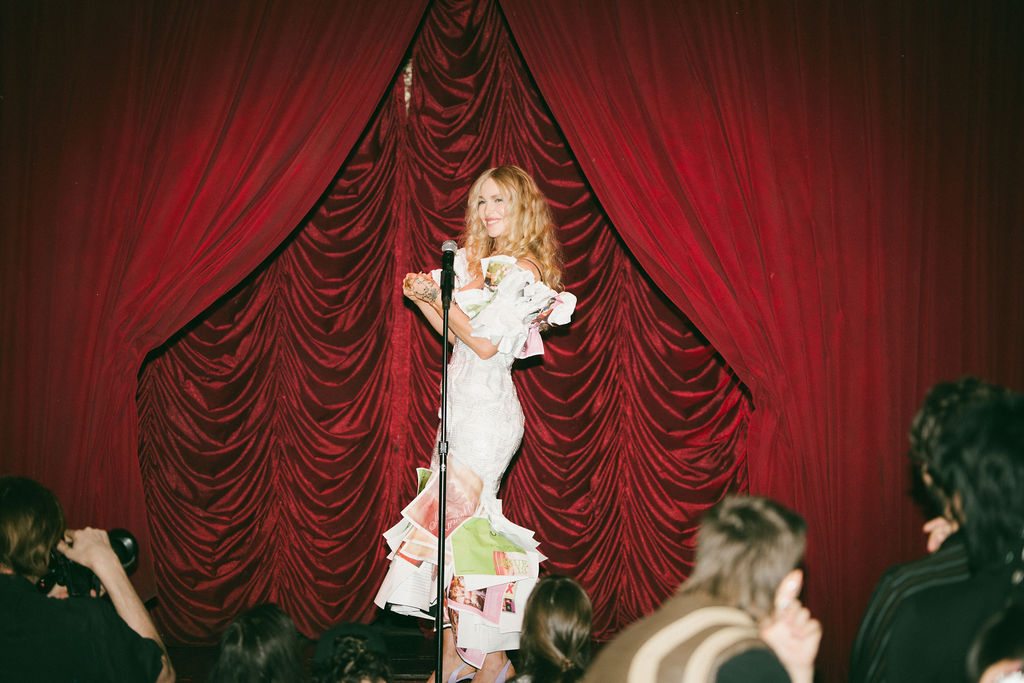
Rowbottom has spent much of her life, she says, fighting against the forces that try to dismiss her and her work as frivolous, superficial. This is despite the fact that she’s now on her third book, after her acclaimed novel Aesthetica and memoir Jell-O Girls; that she has a PhD in literature and creative writing; that she’s written for publications like The New York Times and Vanity Fair. She explores this fight often in her work, and her characters go through the same challenges. But neither she nor they should be discounted, respectively flying in the face of what we’re told an author should be, what we’re told a woman should be, and thankfully so.
Because if you’re writing a book about 1980s pornography, there should be a dancer wearing a television headdress dancing onstage in a highlighter yellow zebra swimsuit next to another dancer in a black patent leather bikini with neon lips flashing on her head. There should be ‘80s porn playing in the background over red velvet curtains, a round of tequila shots delivered to each table, girls in sinuous lamé dresses slinking toward the stage with martini glasses half-full, and tiny (working) vibrator keychains as party favors. If you wrote a book, you should throw whatever party you want. And if you didn’t, you should shut up. Use the metaphor however you will.
Rowbottom talked to us about living in the world of 1980s porn, taboo topics made literary, and the prospects of self-invention.
V: What interested you in exploring the porn world of 1980s Los Angeles?
ALLIE ROWBOTTOM: I am blessed to have Lili Anolik, who did the podcast Once Upon a Time in the Valley, as a friend. I remember listening to it after moving to Malibu. I was driving into the Valley, where I do a lot of errands. I was thinking I would write this novel as a singer-songwriter in the 1960s epic. I thought of two best friends loosely based on Joni Mitchell and the singer Judee Sill, who was weirder and less well-known–she had gone to reform school and done liquor store stick-ups. I thought it was a cool dichotomy, but I was struggling to access the world of the ‘60s. I was not as compelled as I was driving, listening to Lili talk about the ‘80s porn world with all these amazing adult stars. She was the impetus for shifting the book from the ‘60s to the ‘80s. I found other great resources from there, like testimonies by film stars of that era. There’s a great podcast called The Rialto Report by Ashley West that has tons of hours of adult stars talking about their past. I was super into it, and as a novelist, I have to write about what is obsessing me, what has that heat, and where I want to spend a lot of time, because writing a novel is so time-consuming.
V: What other kinds of research did you do to make it so visceral?
AR: Obviously I had to start watching pornography from this time period. I grew up in the ‘90s in rural New Hampshire and we had super slow internet. I didn’t really encounter pornography until I moved to New York for college in 2004-2005, which was a DVD I got from Toys in Babeland [later Babeland]. I watched giggling with my friends and never watched again. I saw some porn as an adult, but wasn’t a real pornography aficionado. That’s enabled me to come to porn from this serious, outsider perspective. A lack of porn literacy has helped me see it from a remove. I started watching a lot of porn from that era, the most famous titles. I was reading, and have reread many times, The Other Hollywood: The Uncensored Oral History of the Porn Film Industry by Legs McNeil and Jennifer Osborne with Peter Pavia, and which is a bible to me. I watched Fallen Angels, a documentary from 1985 that follows a couple different adult performers starting their careers, which was helpful. I think out the plot out to a logical endpoint, and I might be making an element up, but then, later I’ll find stories that mirror whatever fictionalization I’ve come up with: how would this go realistically in the world that I’ve created?
V: What was the experience of watching porn from that era?
AR: I started watching that vintage porn after having heard the testimonies from various adult stars of that era discussing how they felt about their careers, their experiences at the time. A lot of them–and granted these were successful adult stars, like Christy Canyon or Ginger Lynn or Amber Lynn–were people who, regardless of their background, got into the industry and had what they say are positive experiences. That surprised me, but it also excited me and made me curious. When I started watching, I felt I was watching it from this perspective of, these women quite possibly were having a really good time, and look back positively on their careers. I have a journalistic curiosity about whatever I write about. I do not and did not come to the world of adult film with judgments or a sense of propriety. It has surprised me how difficult some people find the subject matter, but that’s me. I quite like vintage porn, and I find it funny at times. There’s sometimes a sincerity I find refreshing.
V: You’ve talked about your interest in women’s agency and their relationship to power–what made you want to address that in the world of porn?
AR: Porn is such a deep-rooted cultural mechanism that doesn’t feel talked about enough to me. I’m drawn as a writer to cultural areas that feel huge and weirdly taboo. Even if we don’t use porn, we all have a relationship to it. It’s rarely given a serious literary treatment. That feels wrong, and I feel like I have to correct it. I want people to question why this is a subject matter we don’t seem to want to talk about, especially when it affects so many people’s lives, so many women’s lives, and feeds a cultural tendency to reduce and other women. I feel there’s such an unfairness to passing them off as bimbos. There’s this cultural ease with which we dismiss people who don’t perform womanhood exactly the way we want them to, or perform it too well to patriarchal standards, and I want to challenge that. I wanted to show that these people are human. There can be a tendency among women to look at other women and say, she’s the problem. But we’re all trying to survive in this larger system that’s somewhat predicated on our disempowerment, and that is not necessarily coming from other women.
V: Your work often features the interplay between appearance and objectification. What interests you in that?
AR: I think it’s growing up as a woman and coming into my own sense of who I am, where my value lies, how I want to present myself, and if that’s really what I want or if that’s a cultural mandate. Those questions have been very hot for me throughout my life. I don’t know why exactly. I recently read Sophie Gilbert’s Girl on Girl:How Pop Culture Turned a Generation of Women Against Themselves, and that felt like an answer. There’s tension in my life between wanting to be seen, to be special, and also feel like myself to myself; wanting to be intellectual, wanting to be a writer, and going through academia, a PhD program; and this strange discordance between wanting to be seen, to be beautiful, to be loved, and the perverted cultural enmeshment of love and beauty. It’s also wanting to be taken seriously as a writer. It’s created this perfect storm of interest in why it can feel so hard to be multiple things at once, where our agency starts and ends in a culture that is so determined to make an authentic agency hard for us.
V: You’ve discussed wanting to write about women who are dismissed as stupid, unserious, or not worthy of literary treatment, and being written off as unserious yourself. How did you want to explore that here?
AR: During the early phases of the writing of this book, there was a minor article about literary it-girls. I found the discourse around that annoying, but it did feed this book a little bit. I won’t speak for anyone else, but I put so much effort into making good work and into my education. Wanting to play with performing the content of my work as a public-facing writer and making that choice, having that automatically reduced to a stupid vanity project or PR stunt, and used as an excuse to not engage seriously with my work, and the frustration therein–I would probably put that into any book. It’s a whole lifetime of struggling with that academically. I have memories of my teachers in middle school telling me I was a silly girl. That was a different time; I hope that wouldn’t happen now, but it makes an impact and sets a tone in one’s life, or how one thinks about themselves. I’m always pushing against that, if only to convince myself that I can be more than one thing. So I write to push on that a little: you thought this was a one-dimensional archetype of whatever patriarchal oppression. Let me completely change your mind, or at least invite you to change your mind. See these people as people with round characteristics and backstories who do some good and some bad, but give them the privilege of being more than that archetype, or getting passed off as unserious. Getting older, I’m finding that the accomplishments make it so much easier to feel confident and secure, because it has nothing to do with aesthetics. As a younger person, I thought what would make me feel the best about myself was superficial, was external, it was lip filler, but it turns out it’s writing three books.
V: What interests you about the way women engage with self-invention and self-preservation, and how did you want to consider that in Lovers XXX?
AR: To me, any fictional or non-fictional exploration of that inherently has to take place under the umbrella of patriarchy and capitalism. So how do you carve a life for yourself, find confidence, or struggle to find confidence, given that? There’s such an inherent conflict and tension there. From a fiction writer’s perspective, that tension is where plot and interesting characters come from. Sometimes I’ll encounter books that want to demonize attention, or be like, this is bad, men are bad, but to me it’s so boring. I’d rather get into the gray areas. The men in this book, yes, they do terrible things, but there’s also some redeeming moments. It can’t be one thing or the other, it has to be multiple things at once. A reader has to contend with those various truths happening simultaneously. That, to me, is where literary fiction comes in and shines– it’s not going to give you an easy answer, you have to come to it yourself.
Discover More