In “Beneath the Moonlight,” Mickalene Thomas Contemplates the Spectrum of Black Masculinity
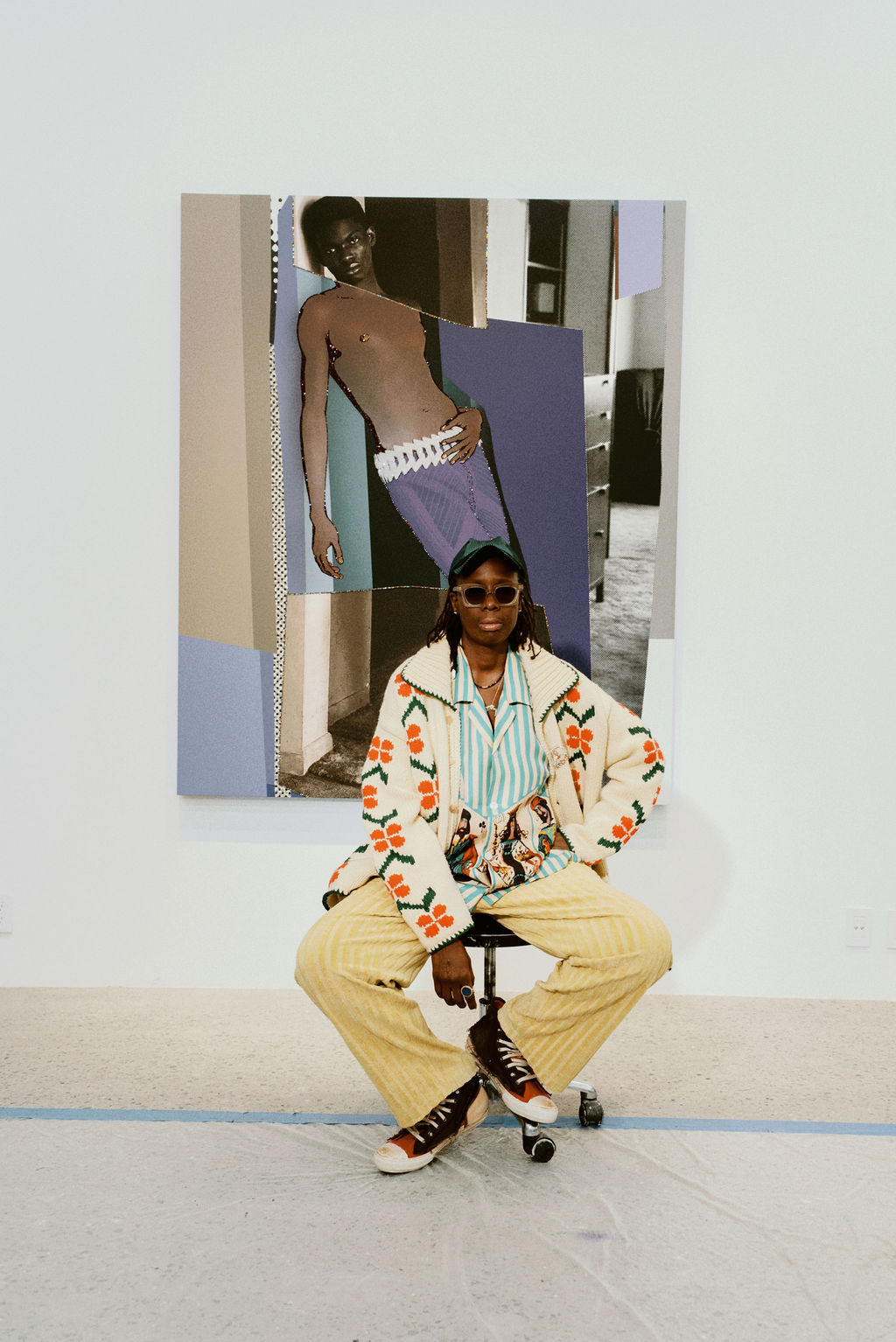
What started as an editorial commission expanded into a new series of artworks
“Do you really want to see where I keep the rhinestones?” Mickalene Thomas asks me.
And when Mickalene Thomas asks that question, you say yes.
The lauded artist, whose work has embodied visions of Black beauty and power throughout her career, is known for her use of rhinestones and glitter to celebrate subjects she both photographs and collages. When I visited her open studio last month, she was preparing for her exhibition “Beneath the Moonlight,” which opened last week at The Shepherd, a former church and current art space in Detroit, Michigan, run by the city’s influential Library Street Collective art gallery.
Until now, Thomas’s work has primarily focused on Black female beauty, power, and sexuality, all through a queer lens. With “Beneath the Moonlight,” however, she journeys into the spectrum of Black male sexuality and gender identity. Her work in this series is in part influenced by the artists Quil Lemons and John Edmonds, whose work Thomas admires for its storytelling and contemplation of Black male queerness.
Though “Beneath the Moonlight” initially began as an editorial commission, Thomas was inspired to expand the series, finding that it resonated with her ongoing interests in aesthetics and power.
Thomas spoke to V about her growth as an artist with this series, her continued interrogation of gender and sexuality, and what a successful artwork looks like to her now.
V: How did this series begin?
Mickalene Thomas: AnotherMan reached out to me to do an editorial project with non-binary subjectivity, sensuality, vulnerability, and masculinity through a queering lens, exploring the particular softness and deepening the same concern of beauty, agency, and representation in my work. I love when other platforms or other creatives may see something in my work that they want to pull out of me and challenge new ideas.. That always excites me. When I worked with Dior, Maria Grazia Chiuri, she invited me to do the scenography for her Spring/Summer show in 2023. That was also a challenge, to work on that scale with embroidery, for people to see my work beyond painting and my concepts in other mediums.
At the time, I was doing a lot of editorial work. I’ve photographed a lot of different subjects, male and female, but this was a very specific body of work they wanted me to explore. I’m a photographer, but I’m a painter first, so I’m very selective about the work I take on. I say no to many projects because I like to leave that space open for photographers who solely use their craft as their financial means and accessibility. So I will only take on projects that are very creative and lend themselves to my painting concepts. I worked with the Black male body before–I photographed my friend Kalup Linzy; earlier in my career, we were roommates. I just never produced those pieces. I thought about them recently. I was also thinking about my brothers–we’re close and we’ve gotten closer as we’re older, so it seemed to make sense this time in my career to explore the male body, what it looks like and means for me.
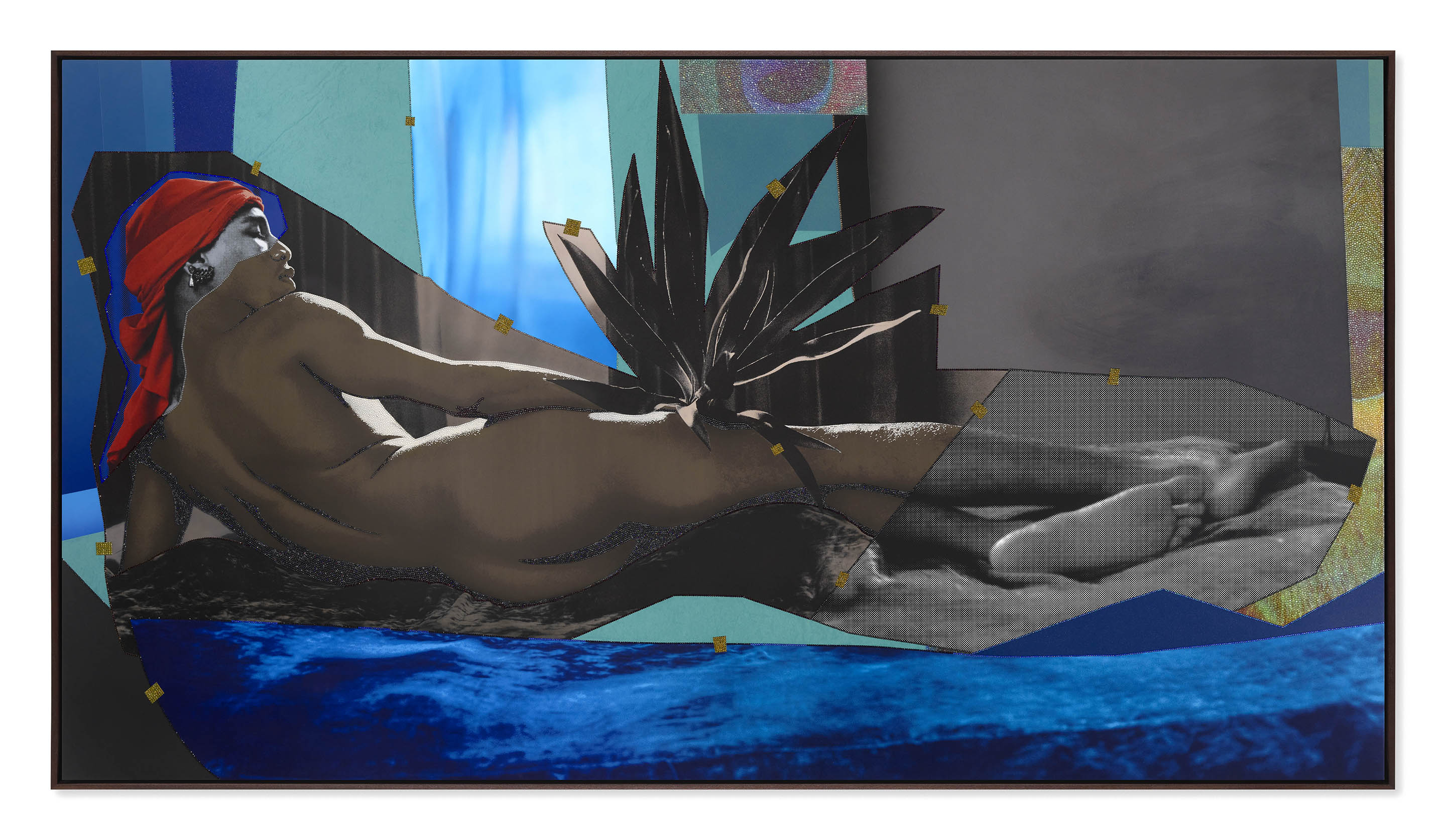
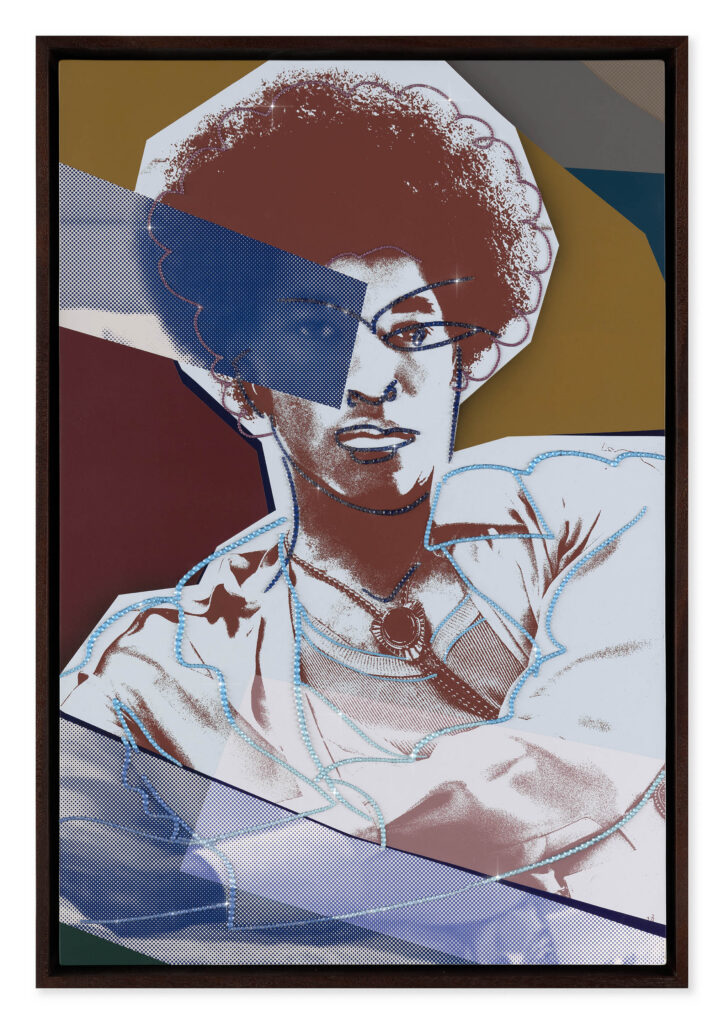
Mickalene Thomas, In Blue: The Odalisque, 2026. Rhinestones, glitter, and acrylic paint on canvas mounted on wood panel with mahogany frame.
V: Do you see this work as a continuation of your past projects?
MT: Yeah, I think all my work is always a continuation. That’s the hope. For me, it’s hard to do the work if it’s not directly related organically. I have to find some connection to my own practice and how it’s evolving. It has to be expansive. For me, art making is like an accordion, it’s this movement of motion—expansion and contraction, and you have the air in between. You find space for and room to move in different directions, and you come back to the center. You go out and explore, and then you come back to the core. You take that information, then you go back,and say, okay, I have this–now, what can I do with it?
V: What were there specific ways you saw yourself growing as an artist while working on this series?
MT: For me, thinking about the Black male body, it’s often represented as this transgression under this particular white authoritative imagining, especially in America. It’s distorted throughout the diaspora and other countries so, for me, that’s aligned with the Black female body.. With my brothers and my male friends, there’s this similarity with familiarity, but it’s with different gazes upon us. There’s still the disparity that they are subjected to. I was slowly reifying some of the images of the Black body itself. The work is about the Black body now, not necessarily about whether it’s a male or female. I think I’ve evolved enough with my work with the Black female body to find other ways of working with the Black body and having that be the expansion and exploration. Now, I have this freedom to explore other ideas and have them intersect and be nuanced. That is how that’s going to evolve. It’s a beginning, another window in. I’m excited about what comes after this. Even as I talk to you, I’m sitting here looking at the work and I have all these ideas for the next body of work: how things are altered by history, how this Black body continues to pose challenges to our own imagining in the world today, and how I can use that as a way of thinking about new narratives for my work.
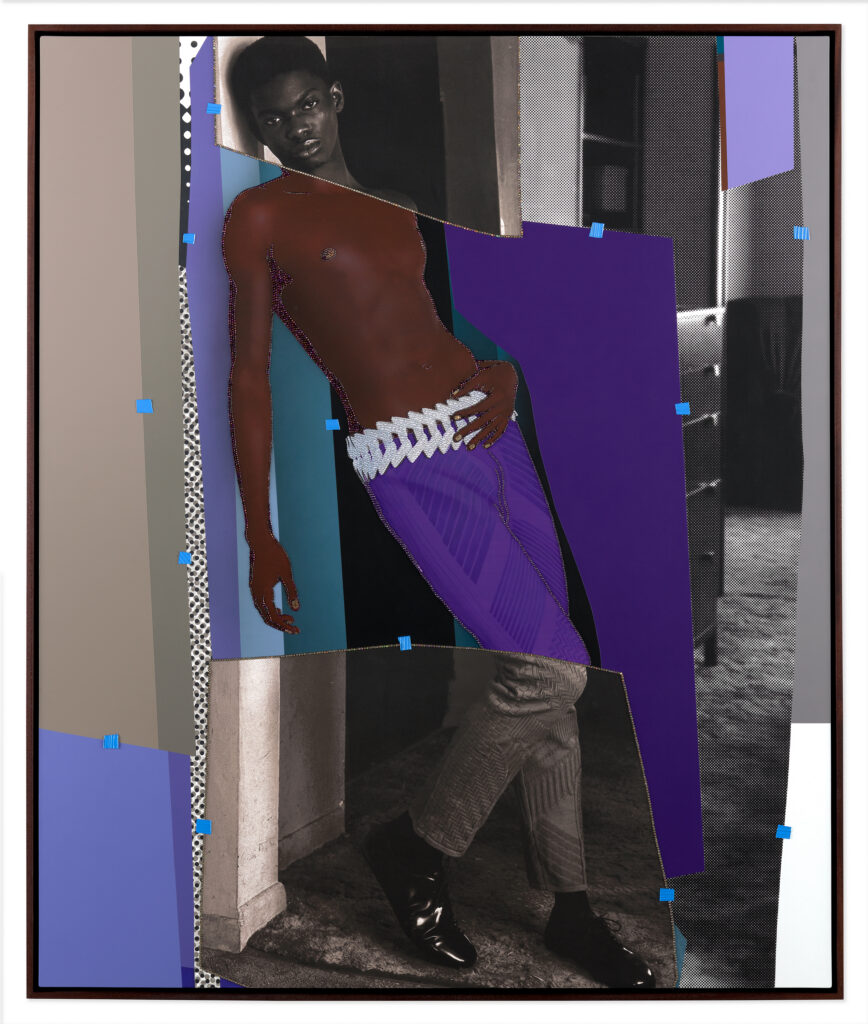
Mickalene Thomas, Perfectly Purple Standing, 2026. Rhinestones, acrylic and oil paint on canvas mounted on wood panel with mahogany frame.
V: I remember you discussed adding certain attributes to these works that had a stereotypical relationship to femininity–what are they, and why did you choose to use them?
MT: The softness of the pastels–the pinks, the violets, the lavenders, the sky blues, and how those juxtaposed against the Black male body lends to a particular engagement of softness of familiarity that you might find comforting. You might view the Black body as different if paired with a neon pink or electric blue that creates a high contrast, right? That will provide some more sleek, futuristic look that may draw attention. You may come to the work with notions of how to perceive the Black body. But imagine falling back and landing softly, and you land on your feet, with grace, with, support, that sense of leisure of seeing oneself in the state of luxuriating, in the state of that joy. I’m here in this church, and we see some of these narratives in the stained glass, these Christ-like figures with no Black bodies in them–it’s as if we didn’t even afford that space, that spirituality wasn’t a part of us, though it comes fully from us in so many ways, ritual and medicinal care and self-care, but we’re once again written out of the narrative of spirituality, as if to say that this vessel does not carry that.
V: You mentioned it’s a softness not typically afforded.
MT: This is in my own way of thinking, and it has nothing to do with anyone else, but the notion of the male body itself–regardless of it being Black, white, or whatever–there’s the sense of the male figure being a protector of their family, the provider. So imagining these Black bodies ripped from their culture, power, lineage, legacy, and then shackled, stripped, and not being able to protect their loved ones. Imagine seeing that, being that, and then continuing to have that society say you’re ‘the other.’ Providing this new context of how I see them in the same way as I see Black women in my life, it’s really important to extend that love, care, validation, and understanding is invaluable for me. To have a platform to allow a different engagement in how we view our Black bodies is a way of celebrating us. As an artist, you have the right to do that, even if you’re working it out in the world. That’s what’s so much fun about creativity, is that as an artist, you might not have all the answers, but you can work it out in real time, and it can either land or stick or not. Maybe there’s someone in the world that sees it, is fueled by it, feels it, who is impacted by it enough to to become the best version of themselves. That’s always the hope of my work, is that people, one person sees themselves within it, that they’re inspired and lifted by it in some way.
Discover More