On knitting’s New Album ‘Souvenir,’ The Band Asks What it Means to Grow Up
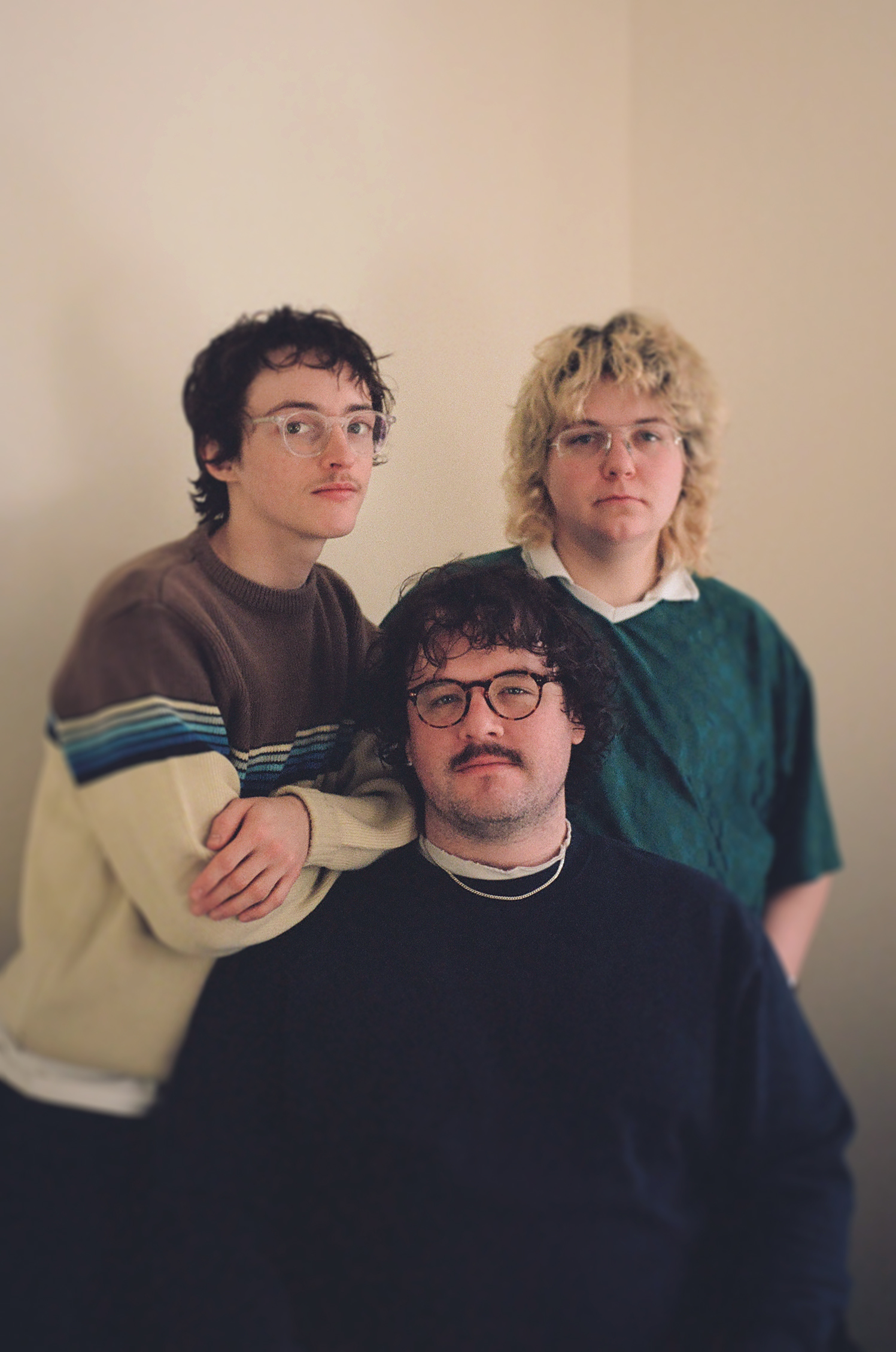
With their sophomore album, the Montreal-based band gets exisistential.
I was in the airport the first time I heard knitting, which released me from the crabbing of screeching children and gate change announcements into the intimate, grunge-inflected, introspective sonic landscape the band created. The songs were “Here Comes” and “I Want to Remember Everything,” singles from their then-forthcoming album Souvenir, which arrived in full on June 26. I became instantly grateful for both the psychic unburdening of airport nonsense and the opportunity to visit with knitting’s blend of indie rock, shoegaze, and alt-pop, its introspective, cathartic yearning.
Souvenir is the Montreal-based band’s second album, an album made as the band looks at what it means to get older. There’s a Saturn return-influenced existential dread, yes, but it’s not an album rooted in fear; rather, it’s rooted in trying to find a way to surpass it, to live alongside your own uncertainties, whether they’re related to settling down, gender identity, longing, or something else.
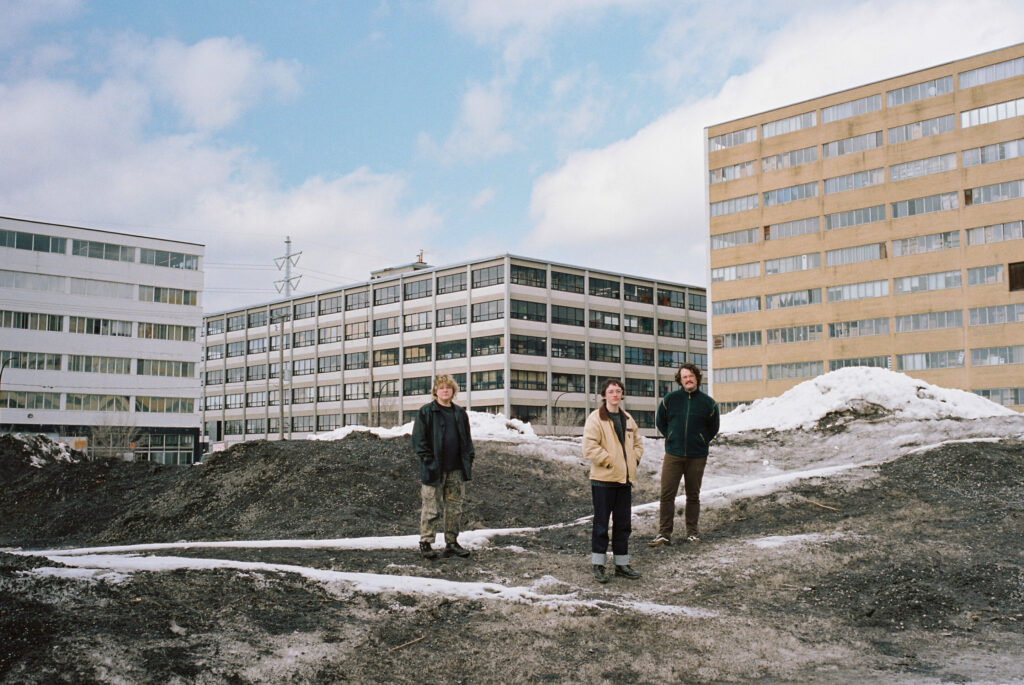
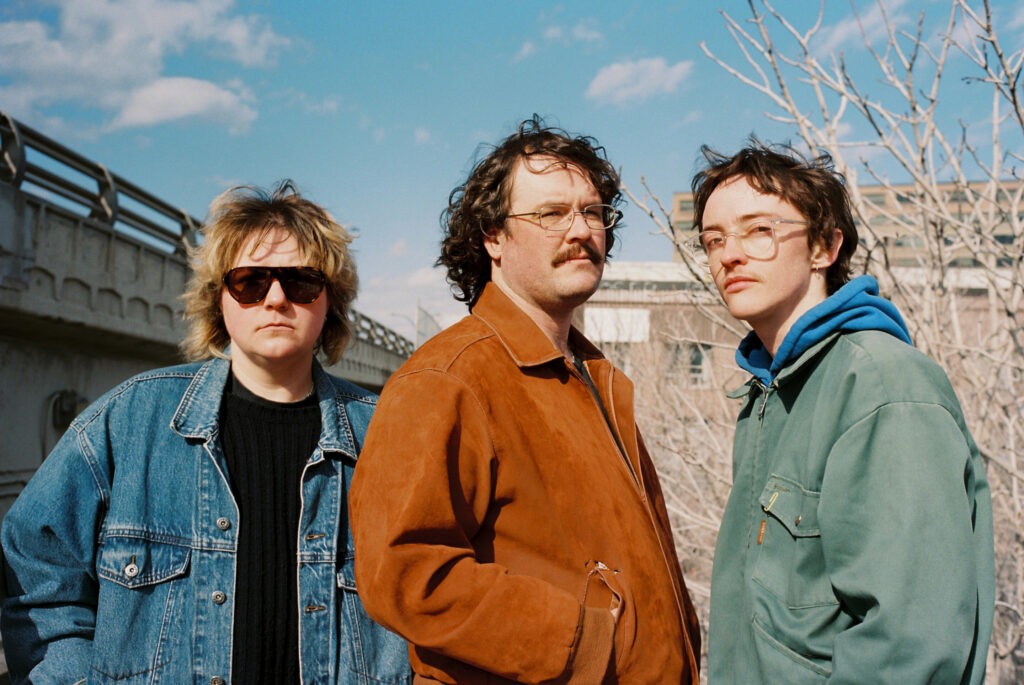
Knitting’s Mischa Dempsey (guitar/vocals), Andy Mulcair (drums), and Sarah Harris (guitar/engineering) constructed the album between their home bases in Montreal and Newfoundland and Labrador, working and recording at their own pace. With this album, they’ve continued to develop their voice and process as a band, one informed by their roots in Montreal’s DIY scene.
V spoke to Dempsey, Mulcair, and Harris about constructing Souvenir, changing the shape of your life, the queering of universal experiences, and more.

V: What is the album a souvenir of, if anything?
Mischa Dempsey: I came up with the album title as almost a placeholder while we were applying for funding for the record. I only had demos for two songs at that time, which were “I Want to Remember Everything,” and the last song on the record, “Exit Desire.”“I Want to Remember Everything,” obviously, is about memory and “Exit Desire” is about being really depressed, and addressing whether or not you want to be here. It’s a sad topic, but Souvenir resonated on some level because these were songs that made me think about life in a bigger picture. When I was thinking about the bigger picture, it was also more about what was actually important and meaningful.
Andy Mulcair: We can also point to the fact that, this being our sophomore record, we found a new way to work together. At least for me, I would say it feels like a flash in time, which you would associate with a souvenir. It’s where we’re all at right now, how we’ve learned to work and create together.
What were you thinking about as you worked on this album, and how is it different from the last?
MD: I feel like we were trying to find our sound with the last album. That was the first full album. we all worked on together–we’d done singles and stuff. It was a learning process, of finding our footing. This one, I feel we had something more to build on. Songwriting-wise, thematically, I tried to keep things more related, but not necessarily trying to make it a concept album. With our last record, a lot of the songs I was writing were related in the sense that they were about my experience; I wrote them so they had some correlation lyrically. But we were a lot more intentional about what this album would be. We definitely had songs we decided not to pursue because we thought it wouldn’t fit in with the rest of the album. We were more discerning with sounds rather than being like, okay we’re a band, here’s our record–which was fun and good for the last record, and I think we totally got something great out of it, and it was also totally a picture of where we were at.
Sarah Harris: Is it also fair to say the songs for [debut album] Some Kind of Heaven came about over a longer period of time?
MD: Yes.
SH: We did full band demos of all 10 songs before we went into the studio. It’s possible that you had little snippets of songs written for years before we put them together. For Souvenir, I think we were like, we need to make another record, and then I was like, okay, Misha, you have until May to write 10 songs. They came together in a much more condensed period of time, and thus were more cohesive in their theme and motifs.
AM: I would also say Souvenir solidifies the band’s identity as creators, as writers, for the exact same reasons. We’ve established a pattern in how we work together, and it’s a souvenir of this point in time.
V: When you were writing the songs, how did you decide what you wanted to tackle on the album?
MD: I feel depressed a lot of the time, so I feel that was a pretty big well to mine from. Especially because as Sarah said, my deadline was May, so a lot of my writing time was early spring, late winter. New York is probably not that different seasonally, but in Montreal, winter is pretty bleak. It’s peak seasonal depression time. In the sense of trying to keep things correlated, it was easy to keep going back and trying to look at something from a different angle, or see what I hadn’t really pulled from yet.
There’s a contemplation of different parts of the timeline of one’s own life, too–what made you want to investigate that?
MD: Yep. I think probably existential dread a lot of the time, and fear of the end.
SH: Andy’s a bit older than us, me and Misha, but both of us have arrived in our late 20s, so there’s a reflection on what that means, everything leading up to this point, and now what we’re going to become.
MD: Totally, it feels like a tipping point, late 20s, pushing 30.
SH: That was in reference to the song “Here Comes,” which is released as a single, and it’s about going out every weekend and singing karaoke.
MD: Yeah, big time. It’s about feeling like the shape of your life is slowly changing. A lot of my early 20s were during the pandemic. When we came out of that era, there was a little burst of having to seize the day. In my late 20s, and I feel there’s a collective vibe shift where people are buying homes or partnering up or talking about having kids.
SH: On a bigger scale, everything’s so expensive now, and we’ve all been playing in bands for the past 10 plus years–the same size bar venues, brown bottles, you know what I’m saying. There’s also a sense that we want to get more serious and build the project beyond what we’ve been doing for the past 10 years. We put a lot of trust in ourselves on this album to use our skills to the biggest potential.
What did you want to consider on the album beyond the tipping point of getting older?
MD: I definitely am always trying to look at it from a lens of my experience with gender. I definitely don’t want to be very heavy-handed with it, not that there’s anything wrong with that, but a lot of the time trans , non-binary, or genderqueer experiences get treated as if they’re a very unique experience that’s not relatable to the general human population. Songs that get written by men end up being considered universal experiences. Writing songs from my position, not necessarily trying to conceal that they’re about my experiences with gender, but also trying to consider how my experiences are also about a more human experience.
How does being part of a DIY scene affect what you want the experience of being in a band to be?
SH: It’s very social at its core, going to shows and seeing other bands. You become friends with those people and if you’re traveling, you might see them at festivals you’re both playing. There’s a community that builds around being in a band playing shows locally. The spirit is that anyone can do it. One band that came up, Poolgirl, they’re a bit younger than us, and we did a bit of mentorship for a minute with them. I recorded their album and Misha met with them to talk about touring. In the beginning, we tried to support them in getting started.
AM: I would connect back to, speaking of younger artists, being excited to see new projects happening, and then being very happy to link with those people, play a show together, and get your music heard.
What has the experience been of moving through the positive release and reception of your first album as a band?
MD: It definitely meant we were spending a lot of time together, traveling, jamming, writing, and we got a lot closer. I think that also influenced the path forward into this new record. The last record was a lot of us getting to know each other, and this one we know each other a lot better. I don’t want to say we knew our roles in the band necessarily, because that is a little bit limiting, but I think we knew how we related to each other in terms of what parts work well together.
SH: There’s more trust in each other, in the process. Between Misha and I, because we’re the guitar players, we each fill a different frequency spectrum, I would almost never come up with a part they would play. We knew that was going to work because of our previous experience, figuring out our different niches within the musical part of the band. Other parts we work on together. I think at one point I got sick of playing, and I gave you the guitar, and I was like, play something. Remember that?
MD: That was awesome.
SH: We looped it until something came of it, and then, realizing the stakes are pretty low, creativity and results come from playing around sometimes. Playing around, you have to be more comfortable with each other. I think it was a more fruitful experience, and there were less nerves, less red light panic, because we were doing everything ourselves. There was no third person we were paying for time. We could play around and do what we wanted. There was one day me and Mischa spent eight hours reworking a song that we ended up ditching, but cost us nothing but time.
MD: With the last album, I had a lot of issues with my singing range when we went to go record the vocals, so me and Sarah spent a lot of time together trying to get those takes down. Even this time around recording, Sarah’s seen me try and hit the same note, in probably 80 takes or something like that. It was punishing. It’s not embarrassing, but it was a vulnerable spot to be in. I started T around the same time we started jamming, then we didn’t really jam for a lot of the summer because we were working on the record. Then my voice drops, and I couldn’t sing a lot of the songs anymore. I started sounding like a goose; I was honking on every take, so that is a vulnerable moment–obviously, your friends are not going to give you a hard time for that, but going through that made us stronger.
SH: I think it was 40 hours.
MD: Of doing vocals.
SH: A full work week.
MD: Sometimes word by word, I was like, okay, I’ve got the note, punch it, we’re good. Going through and doing vocals this time was less harrowing, even though a lot of those songs had to get written or finished in the studio. There’s a level of trust that things could, that things did, get done.
Discover More