Read The Room: Luke Goebel’s ‘Kill Dick’
In our new series, we speak with the authors behind today’s most fashionable and engrossing books
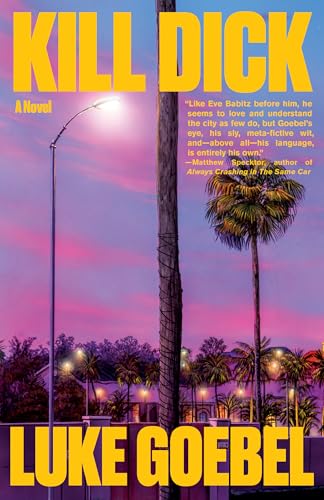
Luke Goebel’s Kill Dick is a novel, confrontation, and movement, all in one. The award-winning author and screenwriter, known in part for his debut novel, Fourteen Stories, None of Them Are Yours, hasn’t invented a world shaped by violence, addiction, and a blasé, let-them-eat-poisonous-cake indifference. Rather, he’s reflecting the one we’re already stuck in. What he offers in his latest work, now available wherever you buy books, is a sharpened, highly unsettling lens; a cast of characters who move through this landscape like the walking dead, or simply the dead dead, numbed by spectacle and habit yet hyper-aware of the systems enclosing them.
Told through a fluid, shape-shifting point of view, Kill Dick resists easy categorization. It’s at once darkly humorous and deeply disorienting, toggling between intimacy and distance as it interrogates evil, money, and the limits of resistance in a socio-economic and political landscape that seems to have evolved past morality. In conversation with V, Goebel speaks about the line between his truth and the book’s fiction, plus finding laughter in the bleak.
Mathias Rosenzweig: What was the initial hook that brought you into this book? Or the first idea that then grew into something larger?
Luke Goebel: Two things happened simultaneously. I met the muse. The story came to me in terms of the character. And then I was also looking for a way to process the devastation or heartbreak of losing my only brother to Oxy. So in a sense, it’s just Sophoclean revenge. Like, what do you do when they won’t let you bury your brother? You know who’s behind it, and what responsibility do you have? We live in a world where we don’t take action, even though we know a lot of who’s causing us a great deal of suffering. I think that’s why people are drawn to a Luigi Mangione type, because it’s somebody who’s doing something directly, or at least attempting to do something directly to the people that are at the top—the people that we see pulling the string that affect our lives in a very serious way.
So my brother died. I was aware of Curtis Wright, an FDA agent who gave the Sackler family exactly what they wanted in order to claim that their pills were much less addictive than they are. And then he got a job immediately after at Purdue Pharmaceuticals, making way more money. You can look at all the different ways that the drug was targeted, misrepresented, and deceitfully pushed. And then even when they received felony convictions for misleading practices, they just doubled down and said you need to take a larger dose. They victim-blamed.
And at one point, at some level, it’s like, well, that’s just boring to be focused on nonfiction, to be focused on the one thing that you’re wringing your hands about. It really wasn’t just that. It was also seeing the turn of the nation around 2016, with Bernie and Clinton tearing apart what was left of a Democratic Party that had largely failed to represent the interests of the majority and had served K Street and Wall Street, to the trickery of QAnon and Pizzagate, which misplaced the actual actions of Trump and others, Democrat and Republican, at the top, in terms of child rape, and located it on Hollywood with blood libel, which is a dirty old trick.
That was the impulse. I want to say something significant about the state of our world and the systems that create, like Steinbeck did with The Grapes of Wrath. These are systems that are intentional, that benefit the top, and that are meant to keep us from having access to the life that creates happiness and health.
MR: Outside of your brother’s passing, what specific events in your life helped catalyze this book’s formation?
LG: I had destroyed an Acura in Manhattan Beach in a crash. I was kicking in my bumper, my chrome bumper, barefoot, or in house slippers. When the cops come, I had illegal objects in the car, and my friend’s like, “Yo, come to Brentwood Circle, we’re across from Reese Witherspoon’s house. And I got this girl who’s an artist that you should meet.” And I was like, all right, I gotta get out of here. So I went to Brentwood Circle. I somehow got through the guard shack. I parked across from Reese’s house. I met this artist who kind of had everything except success, and it was ruining her day, that she had access to the success and status of Los Angeles, but she couldn’t find a way to make it as a creative person. And it just kind of hit me. It was such an interesting thing when you can have it all except the one thing you want, which is such a common story among people who come from money and think they want to be artists, and something about her just clicked. I stayed there for three or four days until Reese or someone else threw me out.
I had no idea that her best friend would be the Sackler daughter. I had no idea that there would be a killer, and these addicts and unhoused people mutilated and found dead all across bad motels in LA. You start to engage in the world, and you have access to all of these realms. I wouldn’t say I was homeless, but I lived above the strip clubs on Broadway in San Francisco in the early 2000s for $75 a week. I stayed in cars. I stayed with whoever was willing to have me.
I’ve been an addict. I’ve been in mental institutions. I’ve been sober now, and I’ve lost a lot of people to drugs. So I’m familiar with the street kind of realities to some extent.
MR: Tell me a bit about your personal experience with Los Angeles and how you chose to write about the city for this specific book.
LG: Through being married to Ottessa (Moshfegh), I found myself at dinner parties that Matthew Marks and Jack Bankowsky, who were hosting for Barbara Kruger, Charles Ray, and Jordan Wolfson. I’m like, holy shit, there’s a whole other side of the world. And then I got interested in the art world, and learning about the intersection of the Sackler family and the art world, and how these investments and notoriety scratch each other’s backs. When you donate, you buy two pieces, and you make yourself a tax break. So I just started to look at that. Then I find myself with producers and actors and people in this kind of upper echelon of LA, and so I was able to play catch-up and learn the town in a way that most people wouldn’t, and I’m not a native Los Angeleno. So it was a project to be like, can I make this book? Can I actually pull off LA? Because it’s not a place that you can fake really easily.
And then the other thing was, I was comfortable enough from my past that I went and walked Skid Row and got a tour and met all the street bosses and handed out candy bars, and talked to people. I am also on the board of directors of the Alano Club in Portland, which is the nation’s oldest nonprofit for recovery services. Part of what I do is go out and walk on the streets and talk to people and deal with the people who are largely on fentanyl.
It just made sense to me to build a city that was stratified and that was struggling, that we could focus on the one issue of the opioid epidemic and how it was planned, and then to take that and use it as a lens to look at the way that one system of corruption is a mirror and a holograph of these systems of corruption everywhere. We get 3 million Epstein files dropped on our lap with mostly photos of doors, rather than just saying, here’s the thing you’re asking for. It’s like, just deny, distract, and deceive. I mean, I then make it fun and sexy and play with it, because we’re all here.
MR: When you’re writing a book, you have to consciously decide to live in that world for a couple of hours every day. Was this a difficult world for you to revisit, seeing as how you had proximity to it in your real life?
LG: I wish I would have only done it for a couple of hours a day. This thing took me like 10 years, and I wrote so much. I wrote this book four times, and I wish I were a more efficient writer.
I mean, I’m a drug addict like my brother. My brother and I were both addicts. He died. I got sober, and I was always the one that everyone thought was gonna die. I broke my femur when I was 12. I got hooked on morphine, snapped in half, so I was in traction. I was on morphine for a week. And then my whole family, both sides, are riddled with addiction, and it just flipped the switch for me. And I was always an uncomfortable kid. I broke my head twice before I was five, with massive head injuries. So I was just always weird. I was always a weird, top 1% ADHD kind of kid. I’ve had more diagnoses than you can imagine and been in mental institutions. I’ve been in five jails. I’ve been in rehab four times. I’ve been around the block.
When the dope hit my system at 12, I was like, “Yes.” Ironically, later, when I did heroin, I was like, “I don’t like this.” It’s like cartoons. I want to get drunk and enact my psychodrama. Now, I’m just really glad to be sober. But that said, it wasn’t like I had to be like, “Well, what would it be like to be strange?”
MR: I had a teacher once tell me: “When a little kid wants to hear the same bedtime story over and over again, it’s because they’re still trying to figure something out.” I think it’s the same when we’re writing novels. What were you trying to figure out with this novel?
LG: It’s a great way to put it, because you write a movie because you want to represent something on screen. You write an essay because you kind of have an idea that you want to play with a little bit, but you’re not really going to figure it out. Most likely, in the essay, you’re going to kind of throw a few anecdotes in there to teach people something so that they believe in you and trust your voice. And you’re gonna do a few turns in your new outfit and leave. But you write a novel because you’re trying to figure something out that is really a reflexive relationship between you, the work, and the world, and you’re trying to discover who you are in the world. And I think with this book, I was watching the tearing apart of the social unity around identities and privileges and traumas and things. I was like, how are we ever going to get together? But I was also personally kind of feeling the challenge as a quote-unquote straight white male author. I was like, what do I have to say? And I think that a lot of men then take that and just complain. And I think that that’s the most disgusting thing in the world. But I did feel the challenge of, okay, I’ve got this thing that really hurt me. When we did this movie on the Animal Liberation Front with Joaquin Phoenix and Rooney Mara with Apple, which didn’t end up getting made, but it was something I really want to see happen.
I was talking to a lot of people who were in the ALF, or people who knew people who’d been in the Animal Liberation Front, who would break into vivisectionists’ offices and other places where animals are tortured and treated inhumanely. There was this common theme where it’s like, these people felt like they had been tortured or trapped, right? And they were trying to liberate themselves through liberating other sentient beings.
I was born in 1980. I was writing an essay recently, and I was talking about Didion’s White Album, and Apocalypse Now, and eight years later was Welcome to the Jungle, just going jungle to jungle, right? The jungle of Kurtz’s jungle to the jungle of Guns N’ Roses.
The kind of radical sentiments and radical politics were still very much in the air, right? I was originally born in a small town in Ohio, moved to Portland when I was 11, broke my femur, and got into grunge, growing my hair and being a little punk little shit. It was a time of direct action. There was Earth First and the Animal Liberation Front. There was a kind of consciousness of the WTO. It was just like, fuck it, we’re not gonna let them trap us.
And you know, the first thing that the nation and the FBI say after 9/11 is that the largest terrorist threat to the United States will come from eco domestic terrorism groups. And that’s immediate, and then they make laws that you can’t take pictures of animals suffering, and you can’t interfere with this industry and that industry. We just saw the nation going quickly into what it is now, and the rise of this, which gave birth to this sort of Trump wrestling theatrics and spectacle of corruption and deception. We saw it coming. And so there was this part of me that was like, I still want to speak to that without being a remainder to some kind of irrelevance and boredom.
I was like, how do you fuck with this and make it fun, but reinvigorate the social imagination that there is a resistance that is necessary and that it doesn’t just happen on your telephone when you’re using electricity and giving money to Zuckerberg? So it was just sort of like, what do you do when you feel the walls closing in? And also, how do I speak in some way to capture my experiences and my voice in a way that can give something back to the world? So I guess that’s what I was trying to do.
MR: You mention wanting the book to feel fun despite its darker themes. How did you think about balancing that tone while writing?
LG: It was always about making it fun. If I’m not having a good time, and you’re not having a good time at every sentence, then I’m just not gonna do it. The world is dark enough, so why put yourself through that?
But then Luigi Mangione happened, and I was like, what? After the book was written, that’s happening, and it’s already out to market.
And then the other thing that happened is I got to know Bret Easton Ellis a little bit, and I read The Shards, and that’s really when I figured out, like, oh shit, I could do something totally different with point of view. I could have this be a novelization told by Susie, where she’s going in and out of third. I don’t know why his book told me that—just the autofiction element of it and the play that he was doing, and the open queerness, open gayness of the book. Something about it all just clicked. It already had kind of these queer leanings.
And then I don’t know, there was just something about it where I was like, oh, I feel a kinship with this. And I can use this point of view, this new kind of metafictive element that I have not seen before. And that’s when it really lit up.
Discover More