Read the Room: ‘Orange’ by Curtis Garner
In our new series, V discuss books everyone’s talking about—or should be—with their authors
Fashion and literature have had a longstanding flirtation that’s only growing more heated. Examples are endless, but some favorites include Dior’s 2025 version of the Book Tote, which featured covers from Bram Stoker’s Dracula and Truman Capote’s In Cold Blood. More recently, Coach released miniature book-shaped charms to elevate their Kisslock bags.
Carrying a book might be performative, but so long as you’re actually reading it…what’s the difference between that and any other accessory? And so our new series, Read the Room, is here to tell you which novels are not only deeply “in fashion,” but also brilliant reads.
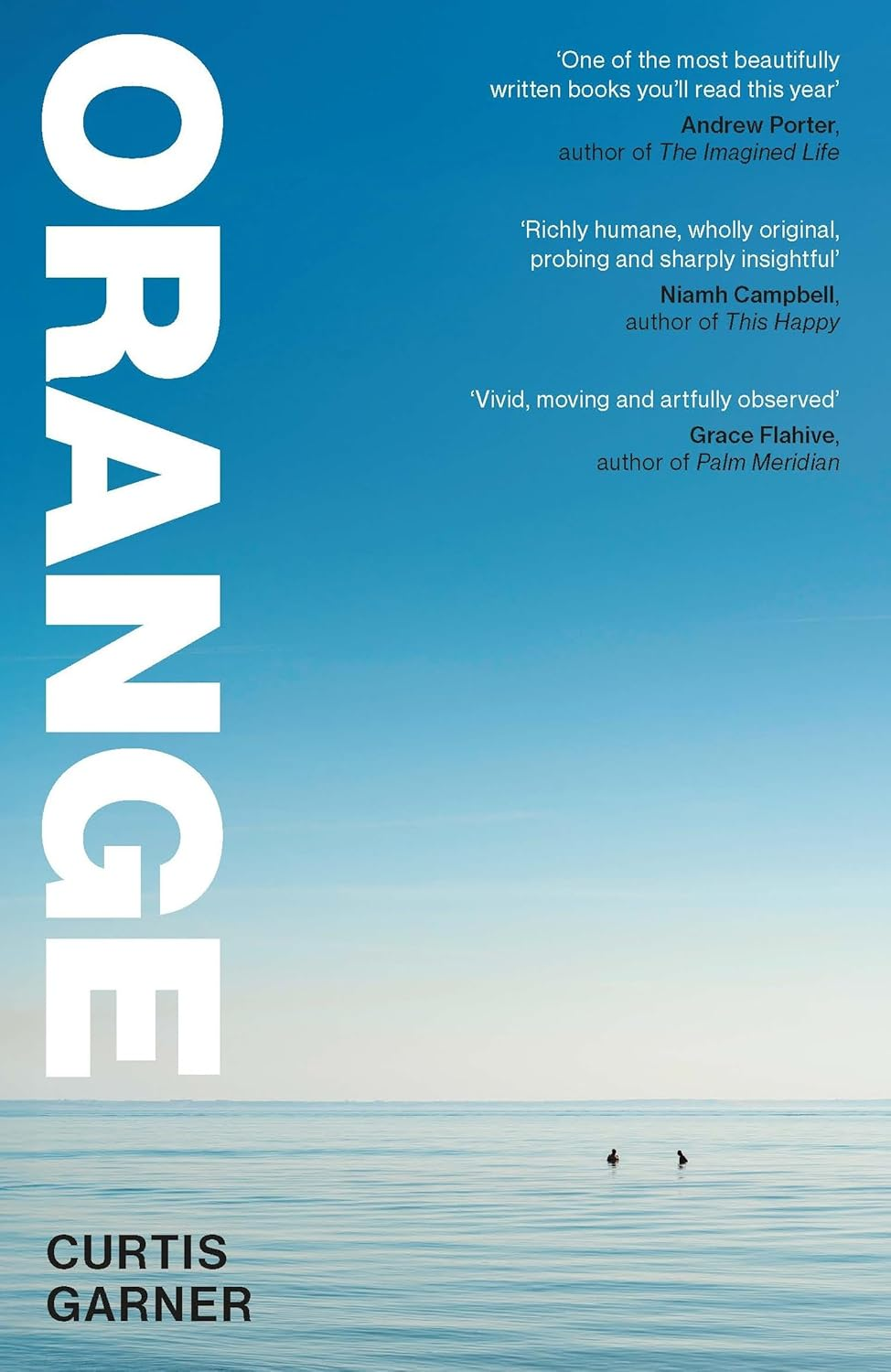
First up, V spoke with English author Curtis Garner about his latest novel, Orange, his sophomore follow-up to Isaac, widely considered an instant queer classic. An examination of varying degrees of youth and love, vices and virtues, and identity’s connection to geography, Orange intertwines romantic idealism with real-life grit while remaining nonetheless hopeful about human beings and the relationships they foster.
Mathias Rosenzweig: Let’s start with something very basic. When did you know that you wanted to be a writer, not just as a hobby, but as a career?
Curtis Garner: I’ve always known. I was, and always have been, a voracious reader and writer ever since I’ve been able to do both, and I’ve just never wanted to do anything else. I never allowed anything else to really be an option for me, because the thought of any other kind of life always felt trivial and a bit nonsensical to me. And I know that makes me sound really pretentious, but I always knew that I had to write novels. Who knows why a person feels compelled to be published, but I really don’t know what else I would have done.
MR: Did you ever think about trying to be a poet or a screenplay writer, or was it always novels?
CG: No, I was always dead set on novels because I couldn’t do anything else, and I studied creative writing for my undergrad and for my Master’s, and in both, you had to do screenwriting and script writing and poetry and reading drama and all these other things. And I just realized that I was no good at anything else. I suppose novels have more room for error, and you can play a lot more with a novel—you can sort of make it your own a lot more. And because, I suppose, it was always novels that I read. I mean, poetry never interested me. I’ve read some scripts. I always remember reading Jerusalem by Jez Butterworth when I was a teenager. I absolutely loved it. And I loved Tennessee Williams, but I was never an avid script reader.
And I think a lot of that is, at various stages in any person’s life, you sort of realize your limitations, don’t you? Because I studied writing, I learned pretty quickly what I wanted to do and what my own limitations were as a writer. Not to say that everyone should study writing, because I really don’t believe that, but it certainly helped me in realizing the kind of writer that I wanted to be. I suppose I’m just quite black and white as a person, really.
MR: When you are conceiving of a plot or a character or setting, how much of it appears to you visually before the words actually come? For example, do you know what your characters’ faces look like?
CG: My boyfriend asked me this question the other day. You know, I have no idea. I have absolutely no idea. It’s really strange because you spend so much time with them, and the more time you spend with them, the more visually nebulous they become—the more hazy they become. Lots of people ask me, ‘What do they look like?’ I think, especially with my first novel—my protagonist, Isaac—I remember he had blonde, curly hair, and so do I. But really, in my own head, that was where the similarity ended. I couldn’t tell you what he looked like, or what any of my characters looked like, aside from the objective physical traits I’ve given them. In terms of setting, I think very visually; I come at it from that perspective, starting out wide and then zooming in. But I don’t do that with everything. I’m not always thinking intricately about how to phrase what I see in a scene. I know what everything looks like, but I’m not necessarily always thinking about how to articulate it.
And I think the majority of people do that, because they always tell me one of two things: that when they read my novels, they could only see me, because they could only hear my voice, or that they could see someone they knew, that they related that person to. And I do think that’s interesting, how it seems no one is able to extract themselves and their own lives from anyone’s books.
MR: It’s made me wonder if a human can really invent a human face in their head. Can we actually do that? When I try to now, because of AI, I think of an AI face.
CG: Yeah, well, do you remember that old myth about dreams? I can’t remember if it’s actually true—I’ll have to look it up—but apparently, in dreams, you can only see people whose faces you’ve seen in real life. Your subconscious mind can’t invent a human face.
MR: Google says that neuroscientists believe the brain cannot invent entirely new faces and dreams. So you’re right. Someone get this man another degree.
CG: I was right. I’m basically a neuroscientist.
MR: How does Orange explore the tension between youthful, all-consuming love and the more pragmatic understanding of relationships that comes with age?
CG: Well, I think the funny irony—I know it to be an irony now that I’m old enough for my retrospective vision to be 20/20—is that adolescence is completely about incoherence, but that’s also the time in your life when you’re so certain of everything. And I remember at that age—that’s probably where I see most of myself in both of my novels, actually. It’s probably where my authorial intrusion takes the most shape—because I remember falling in love, or love as I understood it then, and thinking that I was completely set for life, and that everything was going to be so easy and sugary and black and white. It’s because I had so much confidence when I was that age.
It’s really weird, but it’s true. I know people always think that teenagers are gawky and awkward, full of hormones and going through the wringer, but I remember having so much more confidence than I do now. I didn’t think that the feelings I had were idyllic or romantic at all—I thought I knew everything when I was a teenager. And with every passing year of my life, I realize that I know less. Honestly, it’s really strange. I’m less and less certain about my position in the world the older I get.
I think I address a lot of those feelings in this novel—that actually, as a 21-year-old, Daniel is much more unsure of what he wants than his 16-year-old self, who was pretty sure of what he wanted and how he would get it. And so maybe, while his life is steeped in a bit more realism, I wouldn’t say that people get less romantic or less idealizing or daydreaming as they get older. I just think they become more uncertain, perhaps more cynical, as we all struggle under the constraints and responsibilities of adult life. It’s harder to be romantic when you’ve got bills to pay, you’re tired, and you’re constantly consuming content about genocide.
MR: How do you think about the tension between romantic relationships and chosen family in the book—particularly in Daniel’s dynamic with Ralph and Jago—and where, if at all, one should be prioritized over the other?
CG: Of course. I mean, you can tell that I grew up watching Will and Grace.
MR: Same, of course, because it’s the best.
CG: I think—if Daniel had to choose—he’d choose Ralph, because she’s his saviour in the novel, really. And in my idyllic view of the world, I like to think that your friends will always be there, whereas boys won’t be. But I’ve always believed that a relationship should only ever be a bonus to an already nice or successful life. And I think the issue—with this, well, with any character I’ve ever written, actually—is that men become a crutch, and it’s easier to have sex and to date awful people than it is to address your own inner turmoil. And I think there’s something interesting in that—the codependency. It’s a strange term, because it suggests that it’s unhealthy, but I don’t think that it is, because, you know—
MR: We’re a codependent species!
CG: Exactly—and you wouldn’t say that about your family or your siblings, so why can’t you be codependent with your friends? I think it is different with a relationship, where there’s a good chance they’ll leave you, it’s not going to work, and then you’ve fucked your whole life up for no reason. But I think the book does ultimately come back to the fact that Daniel has a really good friend in his life who will always be there, looking after him. And regardless of how they mirror each other in this kind of hilarious way, and how maybe they aren’t always a good influence on each other, he knows that she’s always going to be there. There’s something really comforting about that, because he didn’t have that with his family, and he doesn’t have that with Jago. So she’s the one stable character in his life. And throughout the novel, really, she’s always just kind of there, being quippy in the background.
MR: Do you enjoy the writing process?
CG: Yes and no. When you write your second and third novels, you have these things called deadlines and existing readers, both of which make novel writing a totally different experience than your debut. A lot of the beauty and joy of writing Isaac, was the real expectation that nobody would ever read it. But with Orange, I knew I had an audience (a great privilege but also daunting/a distraction). And with both novels I found real catharsis – I don’t think I could’ve written certain parts of either without being spurred by anger. It’s strange, interrogating the things that confuse me in real life and not professing to have any of the answers. It’s the beauty of writing a novel, I guess – you don’t have to be unequivocal and there’s something very satisfying about that. You present versions of life that readers can make their own decisions about.
MR: What advice would you give to new writers?
CG: Don’t put pressure on yourself to get a six-figure advance straight away. There are lots of courses and programmes out there which are great for putting together your submission pack and maybe securing an agent or a book deal, but they cost thousands of pounds and they cannot make you decide what kind of a writer you want to be. You need to understand that first. And to do that, you have to read. Without constantly reading, I wouldn’t be a writer. I’ve also never heard of a successful writer who isn’t also a successful reader. Read omnivorously, too; don’t limit yourself. It’s good to have different writers’ voices spinning around your brain at all times. I’ve gone a week or two without reading before and realised suddenly that I’m a terrible writer because of it.
I’m two novels in and only now am I realizing the sort of writer that I am and want to be. It takes time. If that means spending an extra couple of years reading, writing, going to galleries, taking long walks, and figuring it all out, that’s fine. Don’t force yourself to be an overnight sensation when you’re not ready.
MR: What are your thoughts on AI?
CG: I think the joy and the importance and the gravity of writing, and the reason it’s endured over thousands of years, is that it’s a distinctly human effort. Much like photography and art, it’s about doing, point of view and thinking about why someone has made the choices they have made. With AI, there is no point of view, and so in pretty much any creative endeavour, I find it not only harmful and upsetting and dystopian but also utterly futile and pointless. I don’t want to sound like too much of a Luddite, so I will say that I have been known to use ChatGPT to minute the occasional very boring meeting at work, but I really hope it dies a death soon and leaves authors alone.
MR: What’s one book that changed your life?
CG: Hundreds of novels have changed my life. This is a very mean question. I do distinctly remember reading White Teeth by Zadie Smith when I was a teenager, and not only thinking I wanted to be as brilliant a writer as her, but that I wanted to live in London and to write London novels. And so in many ways that novel was a catalyst; I developed this obsession with London despite the fact I’d never really been, and now I’ve lived here for eleven years and am still as in love with the city as I was when I was eighteen. So, whilst it’s not my favourite novel of all time, it did change my life.
MR: How did your own upbringing in a small town compare with Daniel’s?
CG: Well, yes, I think it was important to caveat in my acknowledgements that my own mother and grandmother are nothing like Daniel’s. I grew up in a loving family, but I was the small-town boy cliché. Cornwall bored me as a teenager – it was so insular and claustrophobic, and I knew that regardless of what I ended up doing with my life, I wouldn’t be able to achieve it there. I moved to London when I was eighteen, and I’m still very happy here. But I have a very different relationship with Cornwall now—it’s very sacred and dear to me, and I love going back when London gets too much.
Discover More