The Mulier Archetype: Alaïa Summer Fall 2025 Campaign

Drawn from collective memory, the Summer Fall 2025 campaign evokes the whisper of a breeze against bare skin
What if summer wasn’t a season but a memory embedded in us before we were even born? That’s the question posed in Archetypes. Embodied by Anok Yai and Binx Walton and photographed by Tyrone Lebon in the South of France, the visual story conjures a figure drawn from the collective memory. In Jungian psychology, this is known as an archetype: a form recognized instinctively, as though it has always existed within us. The Alaïa Summer Fall 2025 campaign casts her as the Liberated Woman, a figure whose freedom is expressed through the way she inhabits her body.

Photography by Tyrone Lebone
That figure takes shape through Pieter Mulier’s design language as much as through the imagery. Before joining Alaïa, Mulier trained as an architect at Brussels’ Institut Saint-Luc, and it shows. Spiral-cut skirts wind around the body like structural coils, while molded swimsuits trace its contours the way a building follows its load lines. Bustiers act as a form of scaffolding, shaping and supporting the body without concealing it. It continues the philosophy on which Azzedine Alaïa built the house: clothing treated not simply as a covering but as a second skin, cut to move with the body rather than sit on top of it.
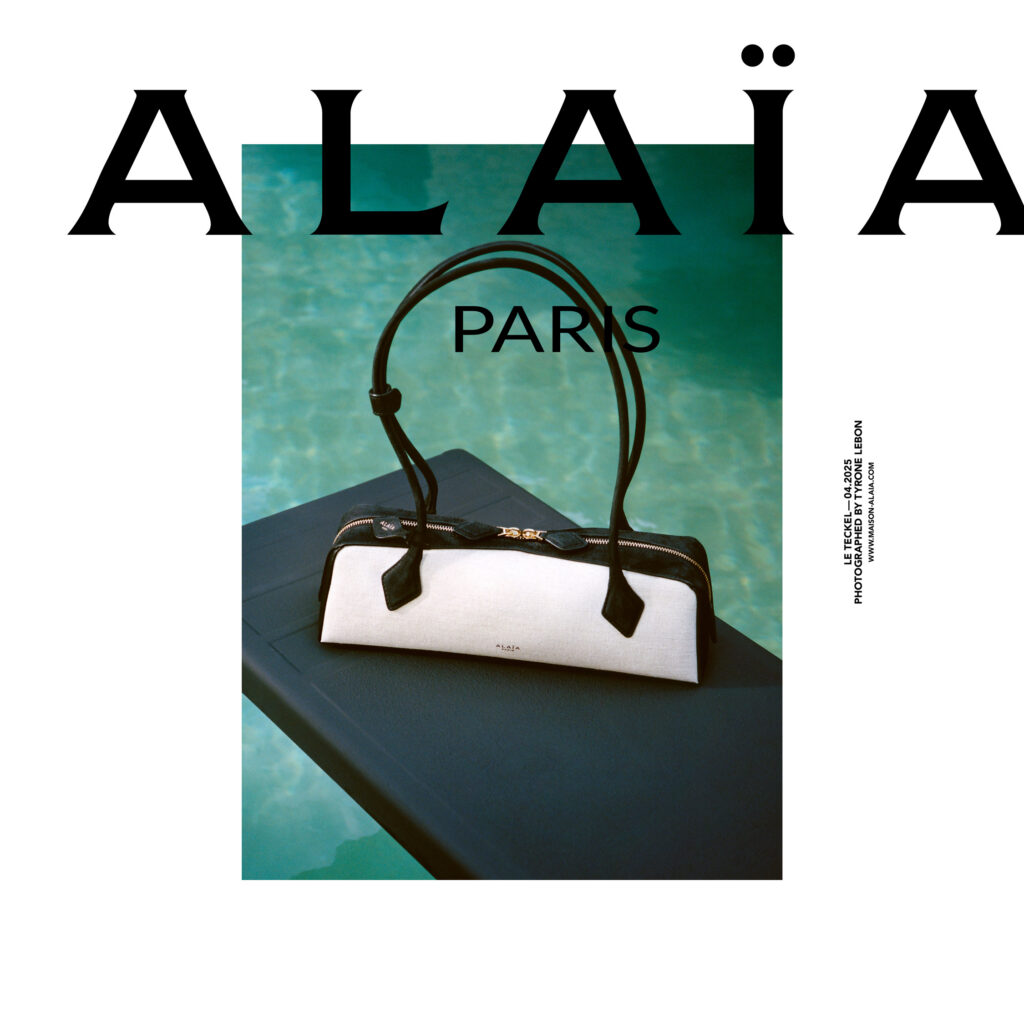
That attention to the body’s lines continues in the accessories. Le Teckel and Le Cœur translate the collection’s curves into objects held close, while the Hip bag sits flush against the body. Spiral hoop earrings and bracelets repeat the circular gesture. Oversized mask sunglasses reframe the face, while ballerinas and sculpted heels subtly alter the wearer’s stance.
Photography by Tyrone Lebone
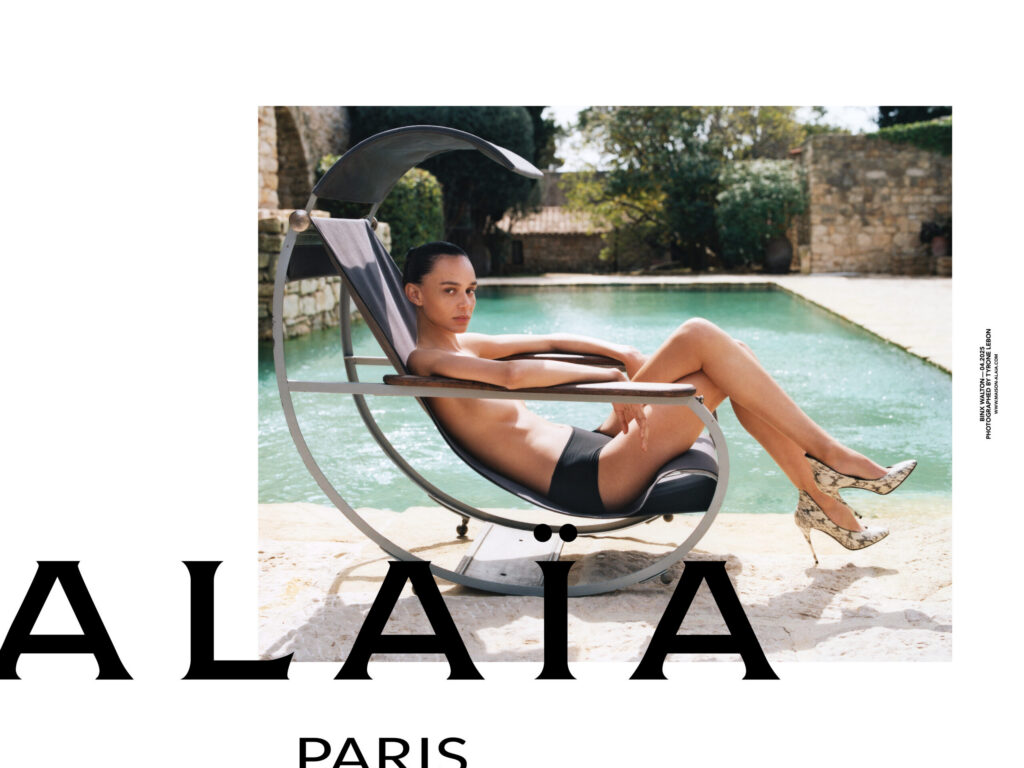
The setting reinforces the idea, with curved loungers and floating forms echoing the spiral running through the collection, while stone arches frame the same circular logic. The geometry of the backdrop gradually blurs into the geometry of the clothes. As the circle moves between setting and silhouette, it begins to suggest something beyond decoration: continuity and the possibility of return, with each repetition changed by the body inhabiting it.
Photography by Tyrone Lebone
This tension between a recurring form and the person who inhabits it becomes visible in Lebon’s close framing. He shoots in natural light, leaving little distance between the viewer and the woman in the frame. At that range, the feminine form is no longer presented as a distant ideal. Yai and Walton remain fully individual, even as the imagery connects them to something that precedes the photograph itself. The archetype is not a fixed image imposed on a woman but an idea reshaped by the individuality of whoever embodies it.

Photography by Tyrone Lebone
Discover More