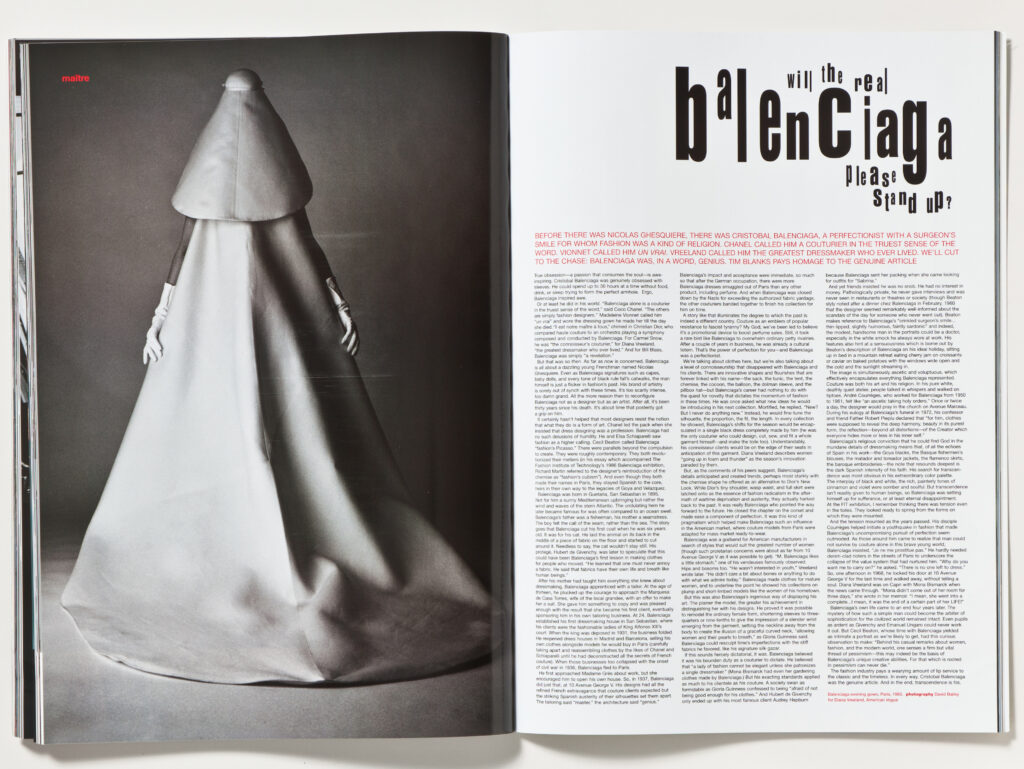
V Archives: Paying Homage To Legendary Designer and Fashion Genius Cristóbal Balenciaga
He sculpted fabric like marble, prayed over patterns, and pursued perfection until it hurt. Cristóbal Balenciaga wasn’t just a designer—he was fashion’s purest believer. Tim Blanks pays tribute to the couturier who turned creation into faith
Before there was Nicolas Ghesquiere, there was Cristobal Balenciaga, a perfectionist with. a surgeon’s smile for whom fashion was a kind of religion. Chanel called him a couturier in the truest sense of the word. Vionnet called him Un Vrai. Vreeland called him the greatest dressmaker who ever lived. We’ll cut to the chase: Balenciaga was, in a word, genius. Tim Blanks pays homage to the genuine article.

True obsession—a passion that consumes the soul-is awe-inspiring. Cristobal Balenciaga was genuinely obsessed with sleeves. He could spend up to 36 hours at a time without food, drink, or sleep trying to form the perfect armhole. Ergo, Balenciaga inspired awe.
Or at least he did in his world. “Balenciaga alone is a couturier in the truest sense of the word,” said Coco Chanel. “The others are simply fashion designers.” Madeleine Vionnet called him “un vrai” and wore the dressing gown he made her till the day she died. “Il est notre maître à tous,” chimed in Christian Dior, who compared haute couture to an orchestra playing a symphony composed and conducted by Balenciaga. For Carmel Snow, he was “the connoisseur’s couturier,” for Diana Vreeland, “the greatest dressmaker who ever lived.” And for Bill Blass, Balenciaga was simply “a revelation.”
But that was so then. As far as now is concerned, Balenciaga is all about a dazzling young Frenchman named Nicolas Ghesquiere. Even as Balenciaga signatures such as capes, baby dolls, and every tone of black rule fall’s catwalks, the man himself is just a flicker in fashion’s past. His brand of artistry is sorely out of synch with these times. It’s too scarily intense, too damn grand. All the more reason then to reconfigure Balenciaga not as a designer but as an artist. After all, it’s been thirty years since his death. It’s about time that posterity got a grip on him.
It certainly hasn’t helped that most designers resist the notion that what they do is a form of art. Chanel led the pack when she insisted that dress designing was a profession. Balenciaga had no such delusions of humility. He and Elsa Schiaparelli saw fashion as a higher calling. Cecil Beaton called Balenciaga “fashion’s Picasso.” There were parallels beyond the compulsion to create. They were roughly contemporary. They both revolutionized their metiers (in his essay which accompanied The Fashion Institute of Technology’s 1986 Balenciaga exhibition, Richard Martin referred to the designer’s reintroduction of the chemise as “fashion’s cubism”). And even though they both made their names in Paris, they stayed Spanish to the core, heirs in their own way to the legacies of Goya and Velazquez.
Balenciaga was born in Guetaria, San Sebastian in 1895. Not for him a sunny Mediterranean upbringing but rather the wind and waves of the stern Atlantic. The undulating hem he later became famous for was often compared to an ocean swell. Balenciaga’s father was a fisherman, his mother a seamstress. The boy felt the call of the seam, rather than the sea. The story goes that Balenciaga cut his first coat when he was six years old. It was for his cat. He laid the animal on its back in the middle of a piece of fabric on the floor and started to cut around it. Needless to say, the cat wouldn’t stay still. His protegé, Hubert de Givenchy, was later to speculate that this could have been Balenciaga’s first lesson in making clothes for people who moved. “He learned that one must never annoy a fabric. He said that fabrics have their own life and breath like human beings.”
After his mother had taught him everything she knew about dressmaking, Balenciaga apprenticed with a tailor. At the age of thirteen, he plucked up the courage to approach the Marquesa de Casa Torres, wife of the local grandee, with an offer to make her a suit. She gave him something to copy and was pleased enough with the result that she became his first client, eventually sponsoring him in his own tailoring business. At 24, Balenciaga established his first dressmaking house in San Sebastian, where his clients were the fashionable ladies of King Alfonso XIII’s court. When the king was deposed in 1931, the business folded.
He reopened dress houses in Madrid and Barcelona, selling his own clothes alongside models he would buy in Paris (carefully taking apart and reassembling clothes by the likes of Chanel and Schiaparelli until he had deconstructed all the secrets of French couture). When those businesses too collapsed with the onset of civil war in 1936, Balenciaga fled to Paris.
He first approached Madame Grès about work, but she encouraged him to open his own house. So, in 1937, Balenciaga did just that, at 10 Avenue George V. His designs had all the refined French extravagance that couture clients expected but the striking Spanish austerity of their silhouettes set them apart. The tailoring said “master,” the architecture said “genius.”
Balenciaga’s impact and acceptance were immediate, so much so that after the German occupation, there were more Balenciaga dresses smuggled out of Paris than any other product, including perfume. And when Balenciaga was closed down by the Nazis for exceeding the authorized fabric yardage, the other couturiers banded together to finish his collection for him on time.
A story like that illuminates the degree to which the past is indeed a different country. Couture as an emblem of popular resistance to fascist tyranny? My God, we’ve been led to believe it’s a promotional device to boost perfume sales. Still, it took a rare bird like Balenciaga to overwhelm ordinary petty rivalries. After a couple of years in business, he was already a cultural totem. That’s the power of perfection for you-and Balenciaga was a perfectionist.
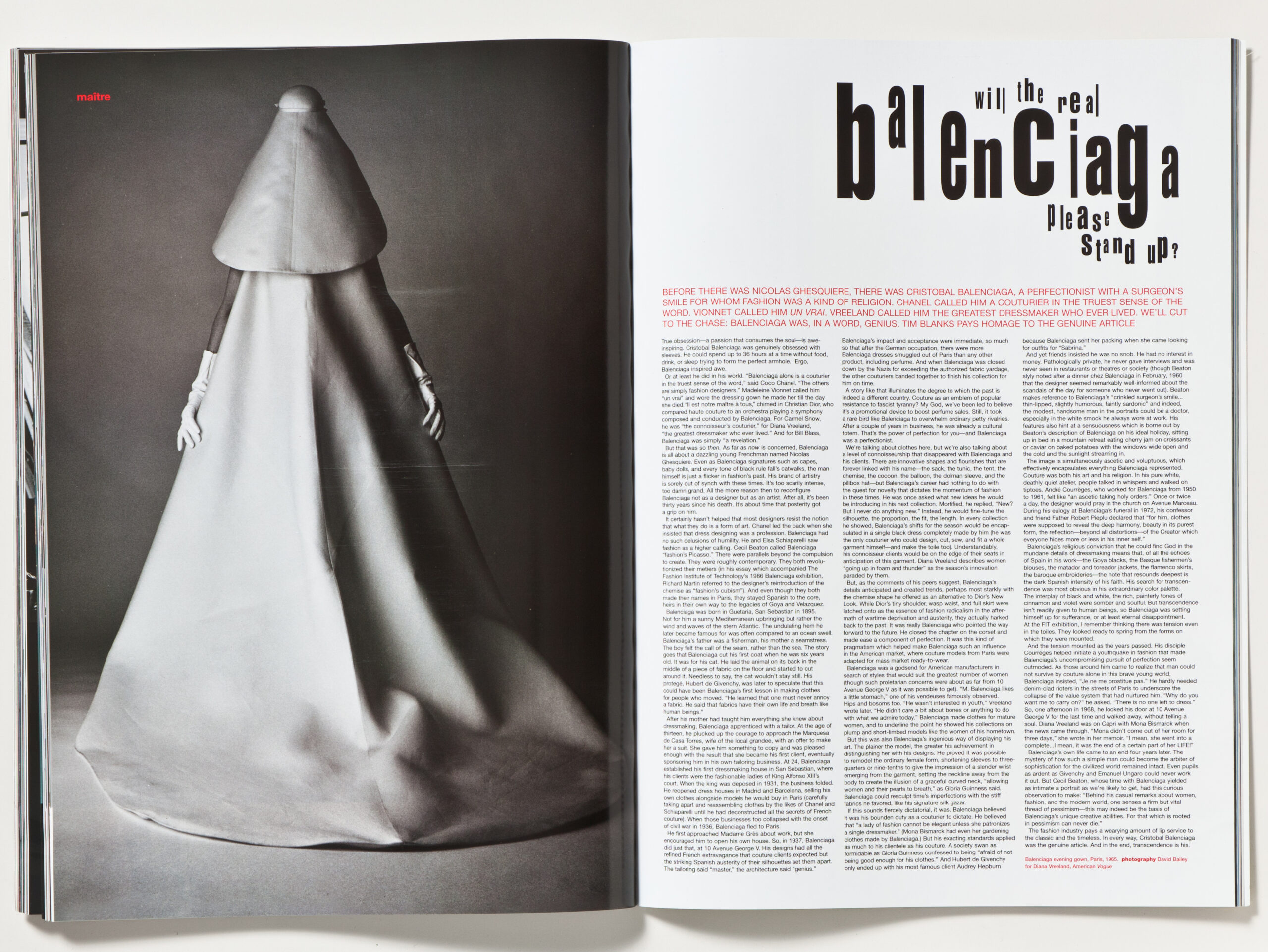
We’re talking about clothes here, but we’re also talking about a level of connoisseurship that disappeared with Balenciaga and his clients. There are innovative shapes and flourishes that are forever linked with his name-the sack, the tunic, the tent, the chemise, the cocoon, the balloon, the dolman sleeve, and the pillbox hat—but Balenciaga’s career had nothing to do with the quest for novelty that dictates the momentum of fashion in these times. He was once asked what new ideas he would be introducing in his next collection. Mortified, he replied, “New? But I never do anything new.” Instead, he would fine-tune the silhouette, the proportion, the fit, the length. In every collection he showed, Balenciaga’s shifts for the season would be encapsulated in a single black dress completely made by him (he was the only couturier who could design, cut, sew, and fit a whole garment himself-and make the toile too). Understandably, his connoisseur clients would be on the edge of their seats in anticipation of this garment. Diana Vreeland describes women “going up in foam and thunder” as the season’s innovation paraded by them.
But, as the comments of his peers suggest, Balenciaga’s details anticipated and created trends, perhaps most starkly with the chemise shape he offered as an alternative to Dior’s New Look. While Dior’s tiny shoulder, wasp waist, and full skirt were latched onto as the essence of fashion radicalism in the aftermath of wartime deprivation and austerity, they actually harked back to the past. It was really Balenciaga who pointed the way forward to the future. He closed the chapter on the corset and made ease a component of perfection. It was this kind of pragmatism which helped make Balenciaga such an influence in the American market, where couture models from Paris were adapted for mass market ready-to-wear.
Balenciaga was a godsend for American manufacturers in search of styles that would suit the greatest number of women (though such proletarian concerns were about as far from 10 Avenue George V as it was possible to get). “M. Balenciaga likes a little stomach,” one of his vendeuses famously observed.
Hips and bosoms too. “He wasn’t interested in youth,” Vreeland wrote later. “He didn’t care a bit about bones or anything to do with what we admire today.” Balenciaga made clothes for mature women, and to underline the point he showed his collections on plump and short-limbed models like the women of his hometown.
But this was also Balenciaga’s ingenious way of displaying his art. The plainer the model, the greater his achievement in distinguishing her with his designs. He proved it was possible to remodel the ordinary female form, shortening sleeves to three-quarters or nine-tenths to give the impression of a slender wrist emerging from the garment, setting the neckline away from the body to create the illusion of a graceful curved neck, “allowing women and their pearls to breath,” as Gloria Guinness said. Balenciaga could resculpt time’s imperfections with the stiff fabrics he favored, like his signature silk gazar.
If this sounds fiercely dictatorial, it was. Balenciaga believed it was his bounden duty as a couturier to dictate. He believed that “a lady of fashion cannot be elegant unless she patronizes a single dressmaker.” (Mona Bismarck had even her gardening clothes made by Balenciaga. But his exacting standards applied as much to his clientele as his couture. A society swan as formidable as Gloria Guinness confessed to being “afraid of not being good enough for his clothes.” And Hubert de Givenchy only ended up with his most famous client Audrey Hepburn because Balenciaga sent her packing when she came looking for outfits for “Sabrina.”
And yet friends insisted he was no snob. He had no interest in money. Pathologically private, he never gave interviews and was never seen in restaurants or theatres or society (though Beaton slyly noted after a dinner chez Balenciaga in February, 1960 that the designer seemed remarkably well-informed about the scandals of the day for someone who never went out). Beaton makes reference to Balenciaga’s “crinkled surgeon’s smile… thin-lipped, slightly humorous, faintly sardonic” and indeed, the modest, handsome man in the portraits could be a doctor, especially in the white smock he always wore at work. His features also hint at a sensuousness which is borne out by Beaton’s description of Balenciaga on his ideal holiday, sitting up in bed in a mountain retreat eating cherry jam on croissants or caviar on baked potatoes with the windows wide open and the cold and the sunlight streaming in.
The image is simultaneously ascetic and voluptuous, which effectively encapsulates everything Balenciaga represented. Couture was both his art and his religion. In his pure white, deathly quiet atelier, people talked in whispers and walked on tiptoes. André Courrèges, who worked for Balenciaga from 1950 to 1961, felt like “an ascetic taking holy orders.” Once or twice a day, the designer would pray in the church on Avenue Marceau.
During his eulogy at Balenciaga’s funeral in 1972, his confessor and friend Father Robert Pieplu declared that “for him, clothes were supposed to reveal the deep harmony, beauty in its purest form, the reflection beyond all distortions—of the Creator which everyone hides more or less in his inner self.”
Balenciaga’s religious conviction that he could find God in the mundane details of dressmaking means that, of all the echoes of Spain in his work-the Goya blacks, the Basque fishermen’s blouses, the matador and toreador jackets, the flamenco skirts, the baroque embroideries-the note that resounds deepest is the dark Spanish intensity of his faith. His search for transcendence was most obvious in his extraordinary color palette. The interplay of black and white, the rich, painterly tones of cinnamon and violet were somber and soulful. But transcendence isn’t readily given to human beings, so Balenciaga was setting himself up for sufferance, or at least eternal disappointment. At the FIT exhibition, I remember thinking there was tension even in the toiles. They looked ready to spring from the forms on which they were mounted.
And the tension mounted as the years passed. His disciple Courrèges helped initiate a youthquake in fashion that made Balenciaga’s uncompromising pursuit of perfection seem outmoded. As those around him came to realize that man could not survive by couture alone in this brave young world, Balenciaga insisted, “Je ne me prostitue pas.” He hardly needed denim-clad rioters in the streets of Paris to underscore the collapse of the value system that had nurtured him. “Why do you want me to carry on?” he asked. “There is no one left to dress.” So, one afternoon in 1968, he locked his door at 10 Avenue George V for the last time and walked away, without telling a soul. Diana Vreeland was on Capri with Mona Bismarck when the news came through. “Mona didn’t come out of her room for three days,” she wrote in her memoir. “I mean, she went into a complete…I mean, it was the end of a certain part of her LIFE!” Balenciaga’s own life came to an end four years later. The mystery of how such a simple man could become the arbiter of sophistication for the civilized world remained intact. Even pupils as ardent as Givenchy and Emanuel Ungaro could never work it out. But Cecil Beaton, whose time with Balenciaga yielded as intimate a portrait as we’re likely to get, had this curious observation to make: “Behind his casual remarks about women, fashion, and the modern world, one senses a firm but vital thread of pessimism-this may indeed be the basis of Balenciaga’s unique creative abilities. For that which is rooted in pessimism can never die.”
The fashion industry pays a wearying amount of lip service to the classic and the timeless. In every way, Cristobal Balenciaga was the genuine article. And in the end, transcendence is his.
Discover More