This story originally appeared on our V3 Spring/Summer 2000 Issue.
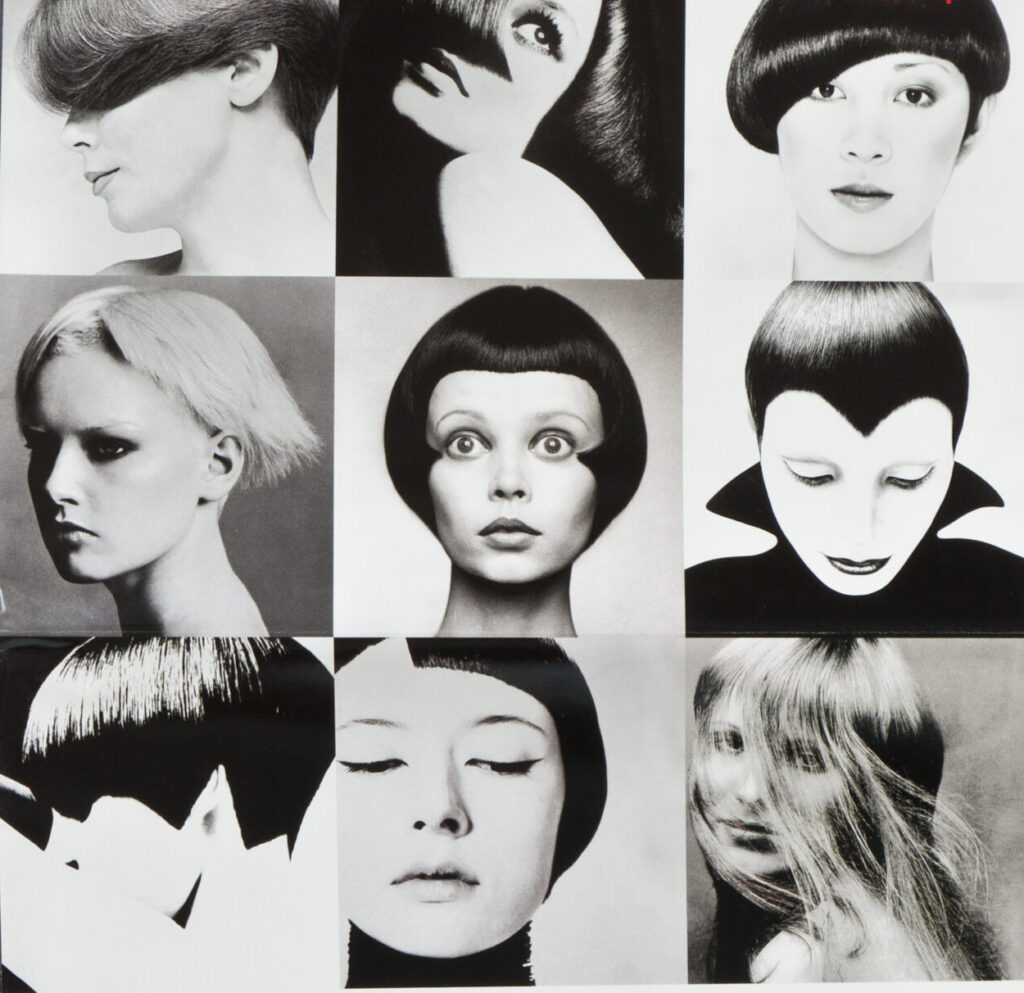
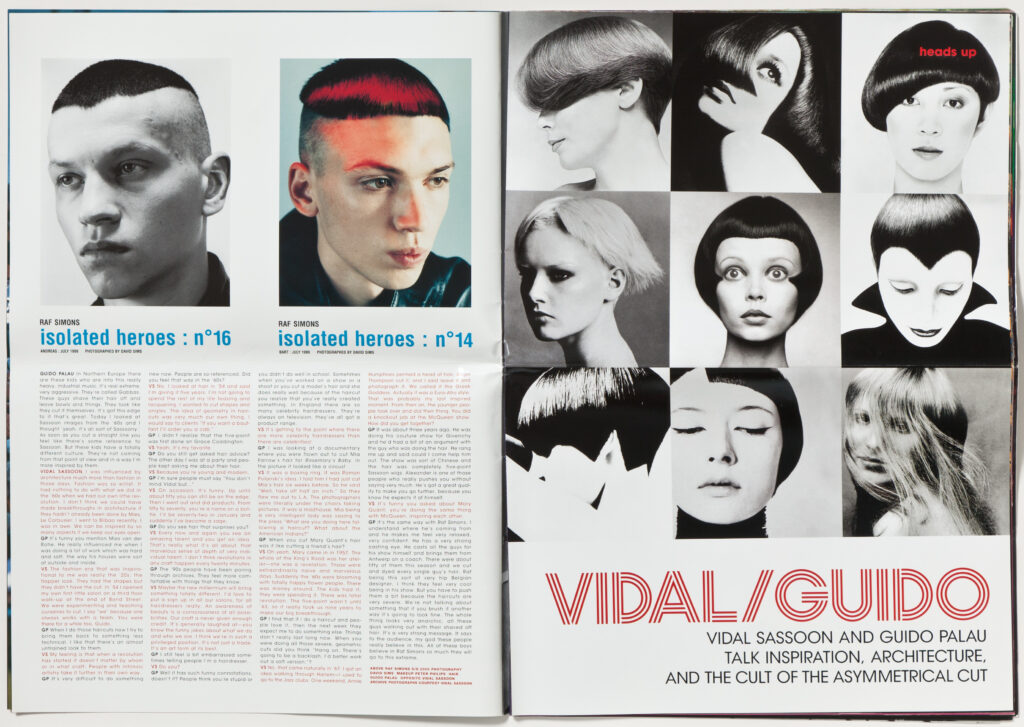
GUIDO PALAU: In Northern Europe there are these kids who are into this really heavy, industrial music. It’s real extreme, very aggressive. They’re called Gabbas. These guys shave their hair off and leave bowls and things. They look like they cut it themselves. It’s got this edge to it that’s great. Today I looked at Sassoon images from the ’60s and I thought yeah, it’s all sort of Sassoon-y. As soon as you cut a straight line you feel like there’s some reference to Sassoon. But these kids have a totally different culture. They’re not coming from that point of view and in a way I’m more inspired by them.
VIDAL SASSOON: I was influenced by architecture much more than fashion in those days. Fashion was so elitist. It had nothing to do with what we did in the ’60s when we had our own little revolution. I don’t think we could have made breakthroughs in architecture if they hadn’t already been done by Mies, Le Corbusier. I went to Bilbao recently. I was in awe. We can be inspired by so many aspects if we keep our eyes open.
GP: It’s funny you mention Mies van der Rohe. He really influenced me when I was doing a lot of work which was hard and soft, the way his houses were sort of outside and inside.
VS: The fashion era that was inspirational to me was really the ’20s, the flapper look. They had the shapes but they didn’t have the cut. In ’54 I opened my own first little salon on a third floor walk-up at the end of Bond Street. We were experimenting and teaching ourselves to cut. I say ‘we’ because one always works with a team. You were there for a while too, Guido.
GP: When I do those haircuts now I try to bring them back to something less technical. I like that there’s an almost untrained look to them.
VS: My feeling is that when a revolution has started it doesn’t matter by whom or in what craft. People with intrinsic artistry take it further in their own way.
GP: It’s very difficult to do something new now. People are so referenced. Did you feel that way in the ’60s?
VS: No. I looked at hair in ’54 and said I’m giving it five years. I’m not going to spend the rest of my life teasing and lacquering. I wanted to cut shapes and angles. The idea of geometry in haircuts was very much our own thing. I would say to clients ‘If you want a bouffant I’ll order you a cab.’
GP: I didn’t realize that the five-point was first done on Grace Coddington.
VS: Yeah, it’s my favorite.
GP: Do you still get asked hair advice? The other day I was at a party and people kept asking me about their hair.
VS: Because you’re young and modern.
GP: I’m sure people must say ‘You don’t mind Vidal but…’
VS: On occasion. It’s funny. Up until about fifty you can still be on the edge. Then I went out and did products. From fifty to seventy, you’re a name on a bottle. I’ll be seventy-two in January and suddenly I’ve become a sage.
GP: Do you see hair that surprises you?
VS: Every now and again you see an amazing talent and you get an idea. That’s really what it’s all about, that marvelous sense of depth of very individual talent. I don’t think revolutions in any craft happen every twenty minutes.
GP: The ’90s people have been poring through archives. They feel more comfortable with things that they know.
VS: Maybe the new millennium will bring something totally different. I’d love to put a sign up in all our salons, for all hairdressers really: An awareness of beauty is a consciousness of all possibilities. Our craft is never given enough credit. It’s generally laughed at—you know the funny jokes about what we do and who we are. I think we’re in such a privileged position. It’s not just a trade. It’s an art form at its best.
GP: I still feel a bit embarrassed sometimes telling people I’m a hairdresser.
VS: Do you?
GP: Well it has such funny connotations, doesn’t it? People think you’re stupid or you didn’t do well in school. Sometimes when you’ve worked on a show or a shoot or you cut a model’s hair and she does really well because of the haircut you realize that you’ve really created something. In England there are so many celebrity hairdressers. They’re always on television. They’ve all got a product range.
VS: It’s getting to the point where there are more celebrity hairdressers than there are celebrities!
GP: I was looking at a documentary where you were flown out to cut Mia Farrow’s hair for Rosemary’s Baby. In the picture it looked like a circus!
VS: It was a boxing ring. It was Roman Polanski’s idea. I told him I had just cut Mia’s hair six weeks before. So he said ‘Well, take off half an inch.’ So they flew me out to L.A. The photographers were literally under the chairs taking pictures. It was a madhouse. Mia being a very intelligent lady was saying to the press ‘What are you doing here following a haircut? What about the American Indians?’
GP: When you cut Mary Quant’s hair was it like cutting a friend’s hair?
VS: Oh yeah. Mary came in 1957. The whole of the King’s Road was her atelier—she was a revelation. Those were extraordinarily naive and marvelous days. Suddenly the ’60s were blooming with totally happy flower people. There was money around. The kids had it; they were spending it. There was total revolution. The five-point wasn’t until ’63, so it really took us nine years to make our big breakthrough.
GP: I find that if I do a haircut and people love it, then the next week they expect me to do something else. Things don’t really last long now. When you were doing all those severe, geometric cuts did you think ‘Hang on, there’s going to be a backlash. I’d better work out a soft version.’?
VS: No, that came naturally in ’67. I got an idea walking through Harlem—I used to go to the Jazz clubs. One weekend, Annie Humphries permed a head of hair, Roger Thompson cut it, and I said leave it and photograph it. We called it the Greek Goddess. Actually it was a Euro-Afro style. That was probably my last inspired moment. From then on, the younger people took over and did their thing. You did a knockout job at the McQueen show. How did you get together?
GP: It was about three years ago. He was doing his couture show for Givenchy and he’d had a bit of an argument with the guy who was doing the hair. He rang me up and said could I come help him out. The show was sort of Chinese and the hair was completely five-point Sassoon wigs. Alexander is one of those people who really pushes you without saying very much. He’s got a great quality to make you go further, because you know he expects it of himself.
VS: It’s funny you asked about Mary Quant; you’re doing the same thing with McQueen, inspiring each other.
GP: It’s the same way with Raf Simons. I understand where he’s coming from and he makes me feel very relaxed, very confident. He has a very strong casting eye. He casts all the guys for his show himself and brings them from Antwerp on a coach. There were about fifty of them this season and we cut and dyed every single guy’s hair. Raf being this sort of very hip Belgian designer, I think they feel very cool being in his show. But you have to push them a bit because the haircuts are very severe. We’re not talking about something that if you brush it another way it’s going to look fine. The whole thing looks very anarchic, all these guys walking out with their shaved off hair. It’s a very strong message. It says to the audience, my god these people really believe in this. All of these boys believe in Raf Simons so much they will go to this extreme.
Discover More